Algeria
 Egypt
 Libya
 Morocco
 Sudan
 Tunisia
 Benin
 Burkina Faso
 Cabo Verde
 Côte d'Ivoire
 Ghana
 Guinea
 Guinea-Bissau
 Liberia
 Mali
 Mauritania
 Niger
 Nigeria
 Senegal
 Sierra Leone
 The Gambia
 Togo
 Cameroon
 Chad
 DR Congo
 Equatorial Guinea
 Gabon
 Republic of the Congo
 São Tomé and Príncipe
 Burundi
 Comoros
 Djibouti
 Eritrea
 Ethiopia
 Kenya
 Madagascar
 Malawi
 Mauritius
 Mozambique
 Rwanda
 Seychelles
 Somalia
 South Sudan
 Tanzania
 Uganda
 Angola
 Botswana
 Eswatini
 Lesotho
 Namibia
 South Africa
 Zambia
 Zimbabwe

A rise in fuel prices can be seen at the pump, but also in daily journeys, the cost of goods and the incomes of small businesses. In the Central African Republic (CAR), protests over these costs have now opened a legal showdown between civil society leaders and the judicial authorities.
A social protest amid a sensitive political moment
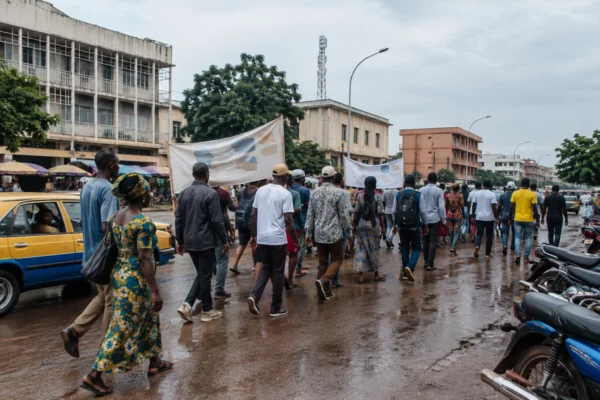
The “dead city” day on 12 October 2026 was intended as a protest against the high cost of living and rising fuel prices. It was partially observed, according to the information available. In Bangui, as in other towns and rural areas, a halt to activity does not affect everyone in the same way: it hits sellers, transport operators and daily-wage workers, whose incomes often depend on day-to-day business.
The mobilisation comes after the 2025-2026 electoral cycle. On 28 December 2025, Central Africans voted in presidential, legislative, regional and municipal elections. The municipal elections were the first since 1988. The African Union election observation mission described a vote held in a complex political context, while local observers also noted shortcomings in the electoral process. Public life therefore remains shaped by debates over representation, institutions and the space given to critical voices.
The CAR is a member of CEMAC, the economic and monetary community that brings together six Central African countries around a common market and the CFA franc. Energy prices and supply therefore have repercussions beyond Bangui’s political debates alone. But day-to-day difficulties are not shared evenly: transport costs can weigh more heavily on households far from urban centres and on informal businesses, which have less room to absorb a price rise.
Five leaders questioned as procedure challenged
Five civil society figures, arrested in Bangui on 15 October, were questioned on 19 October by the Research and Investigation Section (SRI), a gendarmerie unit. The prosecutor’s office is pursuing them notably for disturbing public order and inciting civil disobedience, according to reports on the proceedings. These are accusations: they do not prejudge a court’s decision.
The defence says that three of the five men were questioned in the morning, although their lawyers had been summoned for the afternoon. Counsel are said to have attended only the questioning of the other two. They therefore allege that the procedure was irregular. According to the lawyers, those questioned denied seeking support from opposition parties and rejected any involvement in unrest.
The prosecutor’s office had announced prosecutions after the arrests and said the allegations concerned disturbances of public order. Central African media have also reported that organisations close to the government filed a complaint after the call for mobilisation. These details shed light on the context, but do not settle the accusations or the defence’s complaint about access to lawyers.
As of 19 October, the five men were still being held at the SRI premises. They were due to be brought before the public prosecutor on Tuesday 20 October. The magistrate must decide what happens next, including whether they are released or remanded in Ngaragba prison. Being brought before the prosecutor does not amount to a finding of guilt.
Fuel prices: an economic issue and a test of freedoms
For residents, the immediate issue remains the cost of living. Fuel affects the transport of people and goods, and therefore household spending and the costs faced by small traders. A day-long shutdown can make discontent visible, but its consequences are also borne by those who cannot afford to lose a day’s income. The information available, however, provides neither a precise measure of the price increase nor a quantified economic assessment of the mobilisation.
For the authorities, the case raises another question: how can public order be maintained while guaranteeing the right to protest against economic policy? The use of criminal proceedings must be considered in light of established facts and procedural safeguards. The prosecutor’s allegations and the defence’s criticisms must remain clearly distinct until a judicial decision provides further information.
The group behind the call had set an ultimatum, which expired on Monday 19 October at 3.30pm, and raised the prospect of another “dead city” day if its members were not released. A meeting was announced for Tuesday to decide what to do next. The threat signals continuing tension, but does not confirm that another protest will take place. Nor does the fact that the 12 October action was already described as partial, in itself, show the extent of popular support for the call.
A case to follow beyond Bangui
What happens next will depend first on decisions by the prosecutor’s office, whether lawyers can access their clients and whether another mobilisation takes place. These developments will help distinguish procedural facts from the statements made by the different parties. They will also show whether the dispute remains confined to the arrest of the five men or broadens into a protest over prices.
At regional level, the case is a reminder that national responses to economic tensions can also have an institutional dimension: freedom of expression, judicial safeguards and dialogue with civil society shape how disagreements are handled. CEMAC provides a common economic framework, but decisions on these prosecutions rest with Central African institutions. For Central Africans, the next concrete milestones are therefore judicial and political: the appearance before the prosecutor and the group’s decision on the next steps in its campaign.
Reports on the prosecutions and proceedings in Bangui, the Central African account of the 15 October arrests, the African Union election observation mission’s statement, the Arc-en-ciel Network’s assessment of the electoral cycle, the human rights and political context in the CAR.