Algeria
 Egypt
 Libya
 Sudan
 Tunisia
 Benin
 Burkina Faso
 Cabo Verde
 Côte d'Ivoire
 Ghana
 Guinea
 Guinea-Bissau
 Liberia
 Mali
 Mauritania
 Niger
 Nigeria
 Senegal
 Sierra Leone
 The Gambia
 Togo
 Cameroon
 Central African Republic
 Chad
 DR Congo
 Equatorial Guinea
 Gabon
 Republic of the Congo
 São Tomé and Príncipe
 Burundi
 Comoros
 Djibouti
 Eritrea
 Ethiopia
 Kenya
 Madagascar
 Malawi
 Mauritius
 Mozambique
 Rwanda
 Seychelles
 Somalia
 South Sudan
 Tanzania
 Uganda
 Angola
 Botswana
 Eswatini
 Lesotho
 Namibia
 South Africa
 Zambia
 Zimbabwe
A stock market scaling up
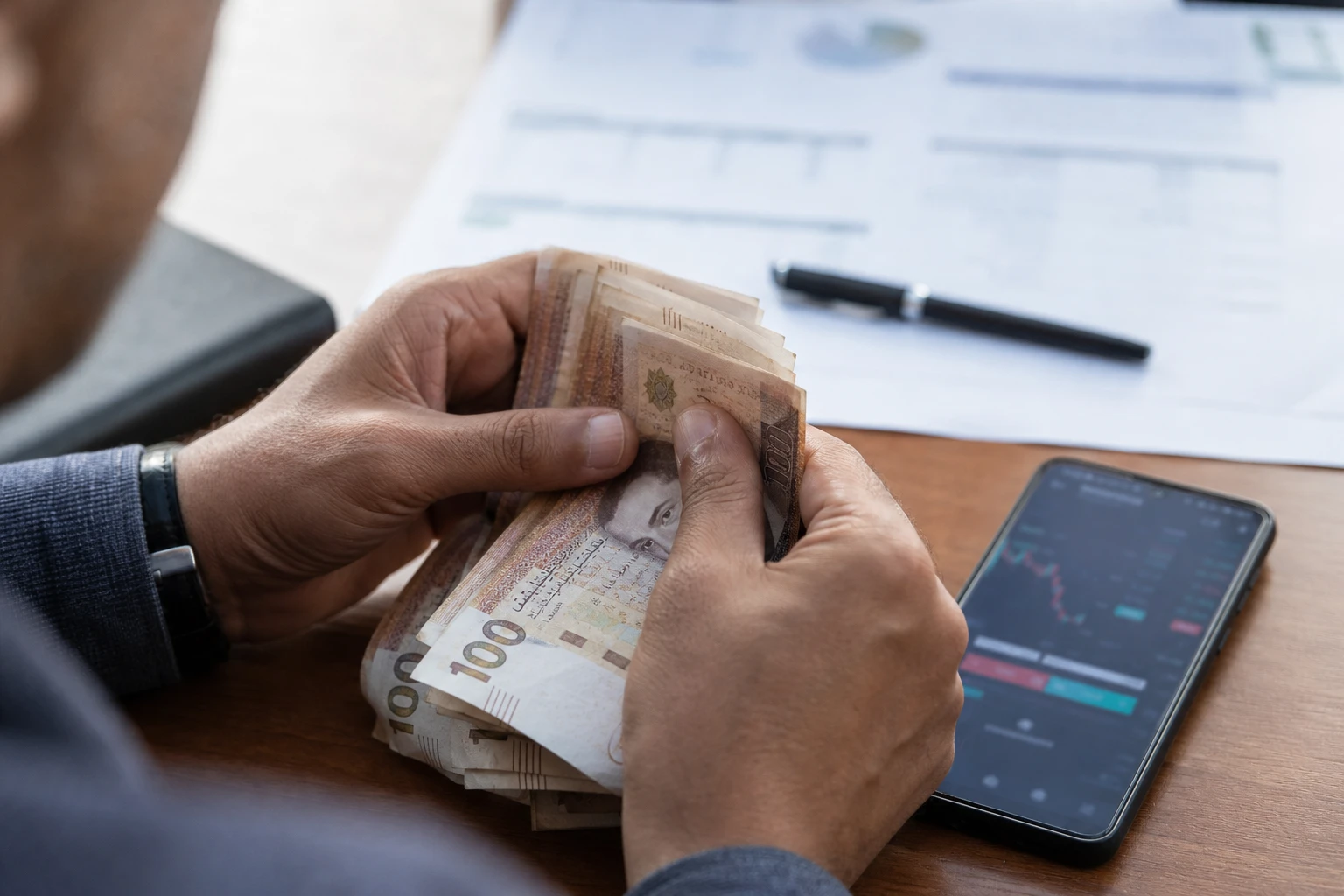
In Casablanca, the stock exchange is no longer just a barometer of major companies. It is also becoming a more visible financing tool for businesses seeking capital, and an increasingly watched investment option for Moroccan individuals. In a market that remains highly concentrated, the return of retail investors points to something broader: market finance is moving beyond the circle of insiders.
The Moroccan context is clearly helping. The International Monetary Fund now estimates Morocco’s real GDP growth at 4.4% in 2026, while other projections published in early 2026 put it at 4.9%, depending on the scenario and measurement period. In both cases, the diagnosis is the same: the Moroccan economy retains solid fundamentals, supported by public investment, infrastructure and agriculture, despite external tensions, particularly those coming from the Middle East.
This movement is also part of a regional trend. In North Africa, Morocco is seeking to consolidate its role as a financial hub between the Atlantic, the Mediterranean and the continent. The prospect of the 2030 World Cup, co-hosted with Spain and Portugal, adds a vote of confidence. The CAF hailed the award as a landmark moment for African football, with Morocco becoming the continent’s second host country after South Africa in 2010.
What the Casablanca market’s figures show
Official data published by the AMMC show a clear acceleration in 2025. Market capitalisation reached 1,040.7 billion dirhams, or 61% of GDP, with 80 listed companies. Over the year, the MASI rose by 27.6%, and total trading volume reached 161.1 billion dirhams. The market also recorded three initial public offerings, raising 6.1 billion dirhams. This is no longer just a technical rebound. It is a genuine phase of market expansion.
Crossing the symbolic threshold of 1,000 billion dirhams on 18 July 2025 marked a turning point for the Casablanca market. The milestone was covered by the Moroccan financial press, which sees it as one of the clearest signs of a market that has become more liquid and attractive. But the rise has not been linear. After two years of strong gains, the index entered a consolidation phase in 2026, with significant variations across sectors and in response to the geopolitical environment.
The return of individual investors is part of this momentum. In the first quarter of 2025, the AMMC reported that Moroccan individuals accounted for 24.9% of trading volume on the central equities market, behind UCITS and Moroccan legal entities. The same report notes that the number of orders jumped by 85.9% year on year. In other words, the rise is not based solely on a handful of large institutional orders. It is also supported by a broader base of savers.
Why retail investors are returning
The change is first and foremost technical. Trading platforms have made the market easier to access, and financial literacy is making slow but steady progress. Morocco has also improved the stock market’s regulatory environment, with a clearer framework for listings, capital increases and the disclosure of financial information. For many individuals, investing in shares no longer seems like an activity reserved for the very wealthy or the trading floors.
Confidence remains decisive, however. When major companies delist, as has happened over the years, the market loses depth. By contrast, new listings, capital transactions and rising volumes bring activity back. AMMC data also show that 2025 was more active than 2024 in terms of transactions, contracts and listings. This is not yet a mass market, but it is no longer a stagnant one.
For urban households, this opening changes the landscape. It offers another way to invest savings, beyond savings accounts or property. For private-sector employees and civil servants, it also provides a way to build capital. For small businesses and family-owned companies, however, listing requirements remain demanding. The stock exchange calls for transparency, sound accounts and more structured governance. It is both an opportunity and a discipline.
A signal for Morocco and Africa
Casablanca’s performance extends beyond the national context. Across Africa, financial markets are often small, fragmented and illiquid. Morocco stands out for the growing sophistication of its market, in a North Africa where capital is seeking stable frameworks, clear products and growth prospects. Casablanca now ranks behind Johannesburg in Africa, but has joined the group of the continent’s most structured markets.
This trajectory also chimes with Morocco’s ambition to make Casablanca a financial foothold for African flows. Market reforms, new listings and interest from individual investors are creating greater depth that can better serve the real economy. If this momentum continues, it could encourage more companies to list, increase equity financing and reduce reliance on bank lending. This is a very tangible issue for industry, services and infrastructure.
The next milestone to watch will be whether the market can turn euphoria into sustained flows. The 2030 World Cup, public investment and companies’ financing needs could support this trend. But the market will also have to prove that it can attract a steady stream of issuers, broaden its investor base and preserve liquidity. That is where the difference lies between a passing upswing and a lasting transformation of Moroccan finance.