Algeria
 Libya
 Morocco
 Sudan
 Tunisia
 Benin
 Burkina Faso
 Cabo Verde
 Côte d'Ivoire
 Ghana
 Guinea
 Guinea-Bissau
 Liberia
 Mali
 Mauritania
 Niger
 Nigeria
 Senegal
 Sierra Leone
 The Gambia
 Togo
 Cameroon
 Central African Republic
 Chad
 DR Congo
 Equatorial Guinea
 Gabon
 Republic of the Congo
 São Tomé and Príncipe
 Burundi
 Comoros
 Djibouti
 Eritrea
 Ethiopia
 Kenya
 Madagascar
 Malawi
 Mauritius
 Mozambique
 Rwanda
 Seychelles
 Somalia
 South Sudan
 Tanzania
 Uganda
 Angola
 Botswana
 Eswatini
 Lesotho
 Namibia
 South Africa
 Zambia
 Zimbabwe
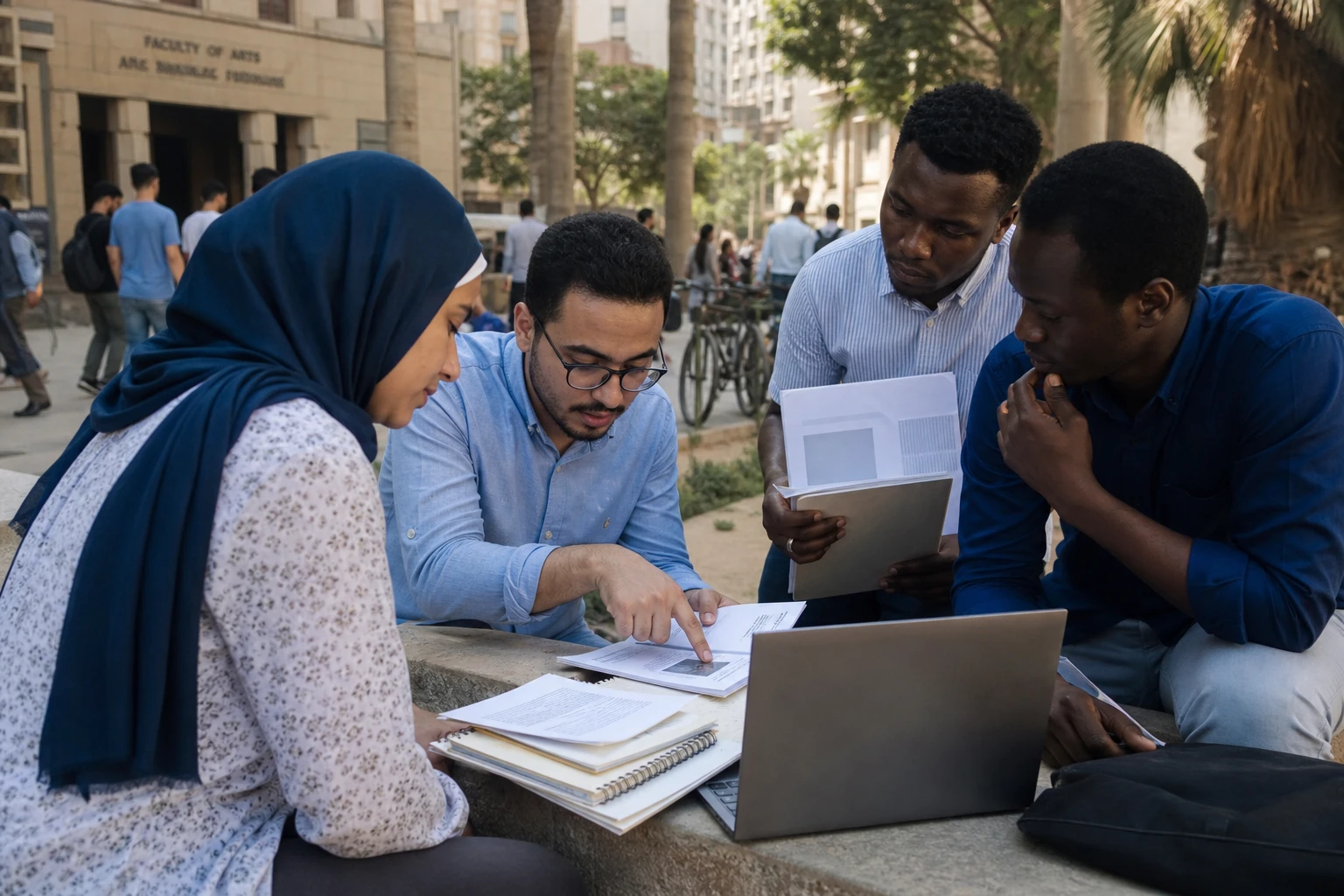
In Cairo, a scientific debate became an African touchstone
In 1974, Cairo was more than the setting for an academic symposium. Egypt’s capital hosted a discussion that raised a broader question: who writes Africa’s history, and with what tools? The subject may have seemed technical. Yet it concerned the place of ancient Egypt in the history of the continent, at a time when UNESCO was launching its ambitious General History of Africa project.
The symposium, held from 28 January to 3 February 1974, formed part of a broader series of UNESCO initiatives on the history of the continent. Its proceedings were later published in the collection devoted to the General History of Africa, showing that the meeting was not an isolated episode but part of a long-term intellectual programme.
The context: Egypt, the Nile and the battle of interpretations
In the mid-1970s, Egyptology remained dominated by analytical frameworks developed mainly in Europe. The symposium’s final report shows that participants worked on two themes: the population of ancient Egypt and the decipherment of Meroitic script, the language of the ancient kingdom of Meroë, in what is now Sudan.
The discussion was not confined to skulls, mummies or hieroglyphs. It raised a question of method. UNESCO’s preparatory report had already acknowledged that the issue of ancient Egypt’s population was complex and needed to be approached through several disciplines.
In this context, Egypt was not treated as separate from its African neighbours. The symposium also examined links between ancient Egyptian and the languages of the Nile basin and the Sudanese region. The issue therefore extended beyond the Nile Valley alone, touching on the history of movement between north-east Africa, Nubia and the Horn of Africa.
What unfolded at the symposium
The programme took place in two stages. From 28 to 31 January, discussions focused on the population of ancient Egypt. From 1 to 3 February, they turned to the decipherment of Meroitic script. The proceedings later published by UNESCO confirm this division.
Participants included specialists from Egypt, Europe, Canada, Sweden and other countries. Cheikh Anta Diop, then affiliated with the University of Dakar, and Théophile Obenga, of Marien Ngouabi University in Congo, advanced a distinctly African reading of ancient Egypt. Their approach went beyond an assertion of identity. It drew on physical anthropology, comparative linguistics, iconography and ancient sources.
The symposium proceedings also show that the discussions did not produce consensus on every point. The final report notes broad agreement on linguistic questions, but continued disagreement over the concept of “race”, a term that is now contested and historically charged. The conclusions also recommended further study of the concept.
This is what gave the symposium lasting significance. Diop presented a critique of theories that portrayed ancient Egypt as foreign to the black African world. Obenga, meanwhile, developed a structured comparison between ancient Egyptian, Coptic and modern African languages. Publishing this work in the UNESCO proceedings gave the controversy a lasting place in academic debate.
Why this episode still matters to Africa
For many African scholars, the Cairo symposium marked a turning point. It showed that an African scholar could take part in international debate at its centre, using scientific tools rather than being cast as a peripheral observer. This matters for Egypt itself, as well as for Senegal, Congo and the continent as a whole, where the production of knowledge remains tied to intellectual sovereignty.
The most lasting outcome was not the triumph of a fixed theory. Rather, it was the opening of a field of discussion in which Africa was no longer merely an object of study, but an epistemic subject. UNESCO subsequently continued to foreground this long history, noting that several prominent figures involved in the General History of Africa, including Cheikh Anta Diop and Théophile Obenga, helped bring about a continent-wide reading of African civilisations.
This legacy remains relevant in Egypt, where academic and heritage institutions continue to engage with debates over origins, movement and inheritance. It also remains relevant across Africa. The issue is a reminder that, between North Africa and sub-Saharan Africa, the boundaries of history do not always align with today’s political borders. The Nile Valley was long a space of contact, conflict and exchange.
An intellectual legacy, not a slogan
The Cairo symposium left a distinct academic legacy. It informed volume II of the General History of Africa. It also helped establish African Egyptology at universities across the continent, particularly in Senegal, where Cheikh Anta Diop University remains a central institution for teaching on these questions.
The debate is not over. But its importance lies elsewhere: it compelled international scholarship to look at ancient Africa from within Africa itself, rather than through a single lens. That is perhaps the most enduring lesson of Cairo in 1974.