
 Algeria
 Egypt
 Libya
 Morocco
 Sudan
 Tunisia
 Benin
 Cabo Verde
 Côte d'Ivoire
 Ghana
 Guinea
 Guinea-Bissau
 Liberia
 Mali
 Mauritania
 Niger
 Nigeria
 Senegal
 Sierra Leone
 The Gambia
 Togo
 Cameroon
 Central African Republic
 Chad
 DR Congo
 Equatorial Guinea
 Gabon
 Republic of the Congo
 São Tomé and Príncipe
 Burundi
 Comoros
 Djibouti
 Eritrea
 Ethiopia
 Kenya
 Madagascar
 Malawi
 Mauritius
 Mozambique
 Rwanda
 Seychelles
 Somalia
 South Sudan
 Tanzania
 Uganda
 Angola
 Botswana
 Eswatini
 Lesotho
 Namibia
 South Africa
 Zambia
 Zimbabwe
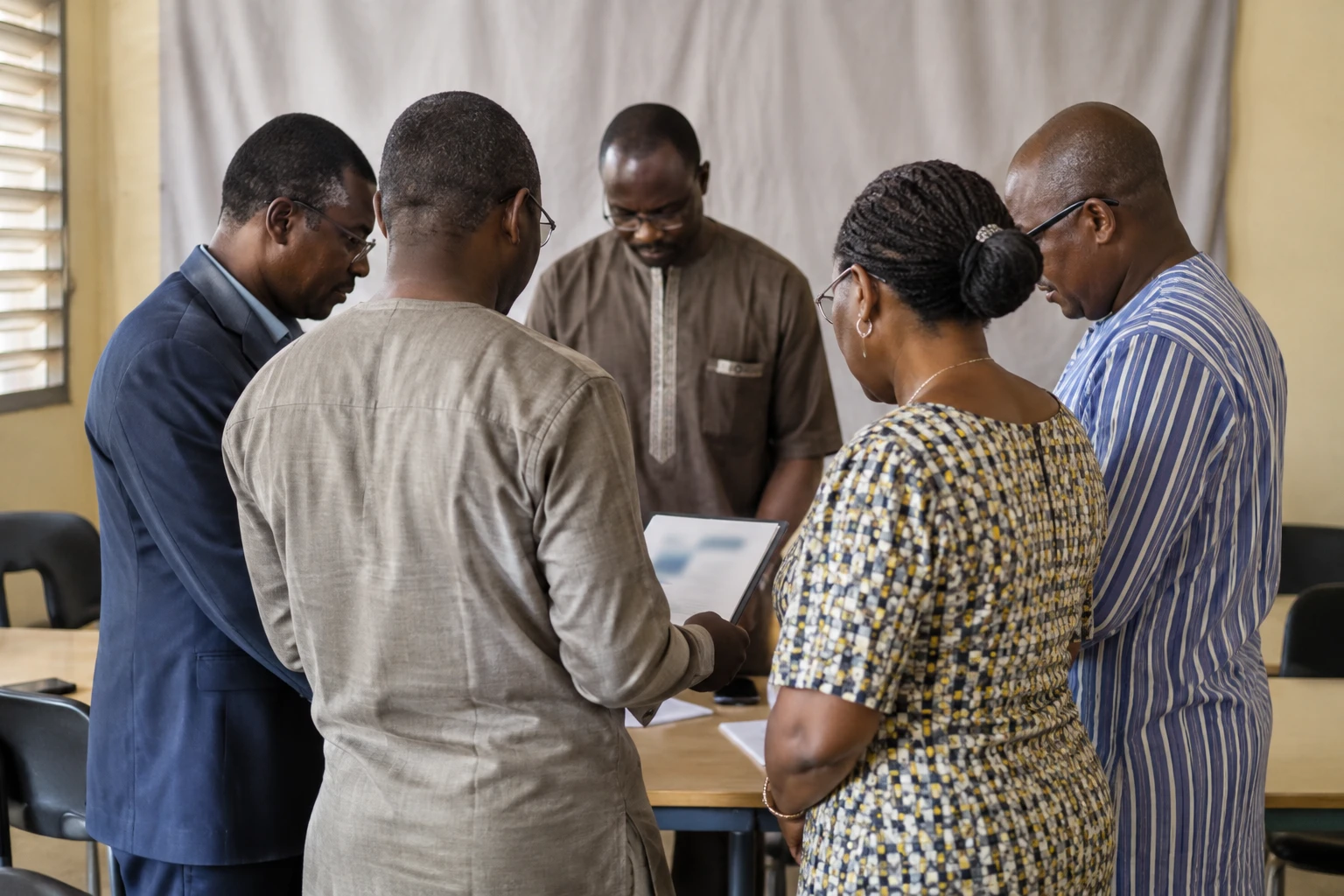
The words chosen in the classroom are never entirely neutral. In Burkina Faso, the announced revision of history, geography and civics lessons raises a practical question: how can the national past be recounted without perpetuating inherited perspectives, while giving pupils the tools to examine facts and their interpretations?
A reform led by the authorities in Ouagadougou
Burkina Faso’s Minister of Secondary Education, Moumouni Zoungrana, announced on 7 September 2026 that the relevant curricula would be revised. The changes are due to take effect in the 2026-2027 school year. The announcement, reported by the African Press Agency and Deutsche Welle, forms part of the government’s efforts to reorient school content around national history and issues.
Among the elements highlighted are new topics, including the Confederation of Sahel States, the alliance between Burkina Faso, Mali and Niger. A chapter on the “plundering of Faso’s natural resources by the West” has also been announced. The ministry also intends to change some of the terms used in class: “invader” rather than “coloniser”, or “spy” rather than “explorer”, depending on the role attributed to the actors being studied.
The reform also covers the vocabulary of geography and civic education. The reported recommendations favour “challenges” and “opportunities” over “weaknesses” or “problems”, and propose “socio-cultural group” in place of “ethnic group”. The expressions “poor country” and “indebted country” would be dropped in favour of wording considered less reductive. According to information published about the reform, a teaching guide of around 190 pages is to help teachers implement the changes.
Words change, but historical standards remain
Renaming a historical actor can correct an incomplete account. The term “explorer”, for example, can present as a simple scientific expedition a mission that also involved gathering information and colonial expansion. But “invader” should not become an automatic answer. Its use depends on established facts, context and documented aims of the person being studied.
The same caution applies to chapters on natural resources. Their exploitation during the colonial period and after independence is a legitimate historical and economic subject. To teach it rigorously, the periods, actors, resources involved and mechanisms of control must be specified. A chapter title cannot replace the examination of archives, data and the perspectives of the populations concerned.
In geography, speaking of “challenges” rather than “problems” can help avoid fixing a country in a deficit-based image. However, replacing one term is not enough to show the varied realities of the territory: the dynamics of towns and rural areas, formal and informal economic activity, access to services, resources and local constraints. Pupils need concepts that shed light on these differences, not a uniformly optimistic vocabulary.
The ministry has highlighted a guide for teachers. Its impact will also depend on training, the time available to prepare lessons and access to textbooks. The public teaching resources already available online in Burkina Faso show that curriculum reform is a long-term undertaking, affecting both content and classroom practice. Teachers will need to be able to distinguish established knowledge, interpretations under debate and official instructions.
A national debate in a regional context
The project forms part of a political trajectory in which sovereignty and the reclaiming of national narratives occupy an important place. Since the changes of power in 2022, the transitional authorities in Ouagadougou have reinforced this discourse. The rapprochement with Mali and Niger led to the creation of the Alliance of Sahel States, which became a confederation in 2024. Its appearance in the curriculum therefore links the history taught in schools to current diplomatic choices.
This direction is not unique to Burkina Faso. In several African countries, education officials, researchers and teachers are debating the place given to national and continental histories in curricula. UNESCO has, in particular, supported work to adapt the General History of Africa to school curricula. The challenge is to broaden sources and perspectives, not to replace one single narrative with another.
For pupils in Burkina Faso, the effects will be measured in classrooms: will the new content be taught in every region, and will teachers have suitable resources? The answers will matter as much as the new titles. The reform will also be watched across West Africa, as Burkina Faso and its Sahelian partners reorganise their regional relations outside ECOWAS, the Economic Community of West African States.
The challenge is therefore twofold: to make Burkinabe and African experiences more visible while preserving the historical method. For an education reform to earn the trust of families and teachers, choices of vocabulary must be grounded in documented content, diverse sources and sufficient training. These changes will be measured by their everyday use, rather than by the political announcement alone.
To understand the initiative, readers can consult the African Press Agency’s information on the curriculum revision in Burkina Faso, the Deutsche Welle report on the announced changes and the official Burkinabe resources on curriculum reform.



