Algeria
 Egypt
 Libya
 Morocco
 Sudan
 Tunisia
 Benin
 Cabo Verde
 Côte d'Ivoire
 Ghana
 Guinea
 Guinea-Bissau
 Liberia
 Mali
 Mauritania
 Niger
 Nigeria
 Senegal
 Sierra Leone
 The Gambia
 Togo
 Cameroon
 Central African Republic
 Chad
 DR Congo
 Equatorial Guinea
 Gabon
 Republic of the Congo
 São Tomé and Príncipe
 Burundi
 Comoros
 Djibouti
 Eritrea
 Ethiopia
 Kenya
 Madagascar
 Malawi
 Mauritius
 Mozambique
 Rwanda
 Seychelles
 Somalia
 South Sudan
 Tanzania
 Uganda
 Angola
 Botswana
 Eswatini
 Lesotho
 Namibia
 South Africa
 Zambia
 Zimbabwe
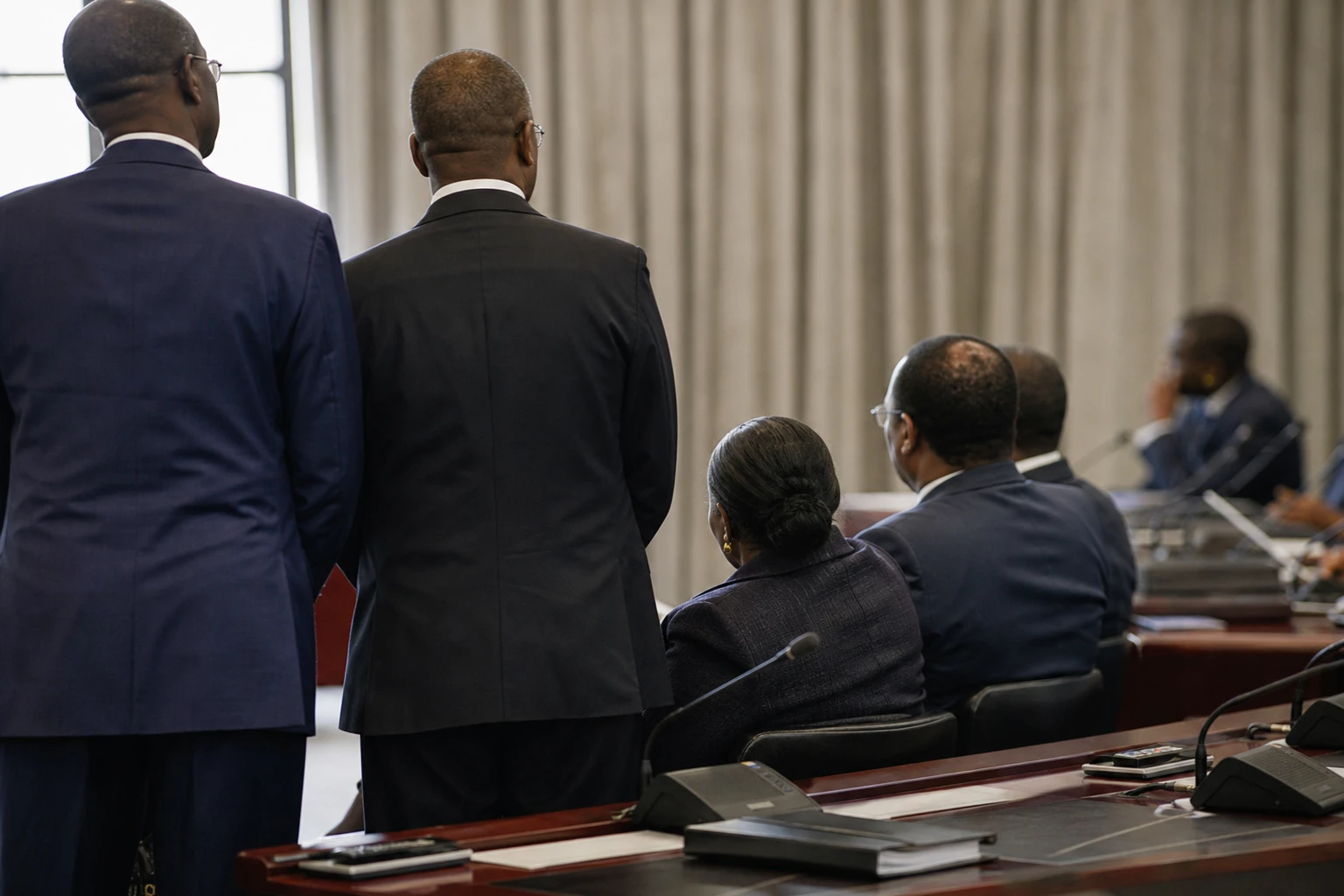
In Addis Ababa, a meeting that goes beyond the Sahel
In the central Sahel, the question is no longer only when voters will return to the polls. It is also who is still talking to whom, and on what terms. In Burkina Faso, where military rule has taken hold in Ouagadougou, the African Union’s forthcoming discussion of the Burkinabè and Nigerien transitions says much about the state of continental dialogue.
The meeting comes amid a profoundly reshaped regional landscape. Burkina Faso, Mali and Niger have left ECOWAS, with their withdrawal taking effect on 29 January 2025, although temporary arrangements have been made for movement, identity documents and trade. At the same time, the AU is maintaining its traditional doctrine: rejecting unconstitutional changes of government, calling for a return to constitutional order and advocating inclusive transitions.
On 27 July 2026, the African Union’s Peace and Security Council is therefore due to examine developments in the transitions in Burkina Faso and Niger, after months of tension between security imperatives and institutional demands. Addis Ababa is seeking a delicate balance: keeping a channel open with de facto authorities without appearing to endorse transitions with no clear electoral timetable.
Burkina Faso: institutional overhaul and an uncertain political horizon
In Ouagadougou, events took on clear political significance in 2026. On 29 January, the government announced the dissolution of political parties and formations and the repeal of the laws governing their activities, funding and the status of the opposition leader. Then, on 27 March, the Transitional Legislative Assembly unanimously adopted the Charter of the Popular Progressive Revolution, transforming the TLA into the People’s Legislative Assembly and giving legal force to the new political line championed by Captain Ibrahim Traoré.
These decisions are more than a simple change in terminology. They redraw the framework for representation, reduce the role of political formations and, for now, put any prospect of an imminent electoral timetable further out of reach. The authorities say the aim is to stabilise government action and align institutions with the “Popular Progressive Revolution”. For some civil society groups and political actors, the signal is the opposite: the transition is moving further away from a conventional return to pluralism.
The AU is aware of this shift. In July 2026, its Commission Chairperson, Mahmoud Ali Youssouf, visited Ouagadougou and met Burkina Faso’s Prime Minister, Rimtalba Jean Emmanuel Ouédraogo, followed by Foreign Minister Karamoko Jean-Marie Traoré. Official readouts described a “frank” exchange and a commitment to support the country’s efforts to achieve peace and stability. The visit shows that the AU is maintaining contact even as it criticises the course of the transitions.
Niger: security as a major political argument
In Niamey, the legal framework has also been extensively overhauled. The Charter of Refoundation, promulgated on 26 March 2025, set the transition at 60 months, or five years, adjustable according to the security situation, and dissolved political parties. This framework provided an institutional basis for General Abdourahamane Tiani’s junta while pushing back the prospect of elections.
Niger and Burkina Faso also remain suspended from African Union bodies following the military takeovers in Niger in 2023 and Burkina Faso in 2022. As early as September 2022, the AU had condemned Burkina Faso’s second coup and demanded a return to constitutional order by 1 July 2024 at the latest. That principled position has not changed. Its political effectiveness, however, is now being questioned, as both countries have consolidated their own mechanisms for securing domestic legitimacy.
The Sahel also remains under security pressure. In recent statements, the AU again condemned terrorist attacks in Niger and Mali on 20 July 2026, showing that the military situation continues to weigh on political decisions. In other words, security is not merely background. It shapes the duration of the transitions and gives the authorities in power greater room for manoeuvre.
Humanitarian needs, the economy and power dynamics: what the AU’s decision could change
The figures convey the scale of the social challenge. UNHCR data available at the end of June 2026 show that Burkina Faso has more than 2.1 million internally displaced people, while Niger has several hundred thousand. Across the central Sahel, UNHCR also highlights large-scale, protracted forced displacement, with protection needs extending beyond the humanitarian sphere alone.
The crisis affects more than the most exposed villages. It reaches capitals, secondary cities, markets, schools and public services. When security deteriorates, local authorities absorb the pressure, informal networks come under strain, and urban and rural economies alike operate under constraints. This is also why the AU now speaks as much about displacement, food assistance and development as it does about electoral processes.
In this context, the AU Commission’s “constructive engagement” strategy is aimed less at forcing the authorities to yield than at avoiding a complete breakdown in relations. The organisation wants to maintain pressure for a return to civilian rule while retaining a role in humanitarian, security and institutional affairs. This approach is also linked to West Africa’s new political geography, where ECOWAS remains active but no longer shapes relations with Ouagadougou and Niamey as it once did.
For Burkina Faso, this shift matters on three levels. First, it affects international recognition of the new institutions in Ouagadougou. Second, it influences the country’s ability to negotiate useful regional cooperation against armed groups. Finally, it tests the AU’s credibility as a continental body able to engage with regimes born of unconstitutional changes without abandoning its own principles.
A meeting to watch beyond West Africa
The implications reach well beyond Burkina Faso and Niger. If the AU manages to sustain useful dialogue, it may still be able to influence military transitions that are dragging on. If it fails, the risk is that long-term transitional governments will become normalised, with their own founding texts, institutions and institutionalised power struggles with regional organisations.
The issue is therefore continental. It challenges the AU’s normative authority, ECOWAS’s ability to manage the fallout from the withdrawal of the three Sahelian countries, and the growing role of security-based sovereignty in African governance. In the short term, the real question is not only the electoral timetable. It is the kind of state Burkina Faso, from Ouagadougou, intends to build in the years ahead.