
 Algeria
 Egypt
 Libya
 Morocco
 Sudan
 Tunisia
 Benin
 Burkina Faso
 Cabo Verde
 Côte d'Ivoire
 Ghana
 Guinea
 Guinea-Bissau
 Liberia
 Mali
 Mauritania
 Niger
 Nigeria
 Senegal
 Sierra Leone
 The Gambia
 Togo
 Cameroon
 Central African Republic
 Chad
 Equatorial Guinea
 Gabon
 Republic of the Congo
 São Tomé and Príncipe
 Burundi
 Comoros
 Djibouti
 Eritrea
 Ethiopia
 Kenya
 Madagascar
 Malawi
 Mauritius
 Mozambique
 Rwanda
 Seychelles
 Somalia
 South Sudan
 Tanzania
 Uganda
 Angola
 Botswana
 Eswatini
 Lesotho
 Namibia
 South Africa
 Zambia
 Zimbabwe
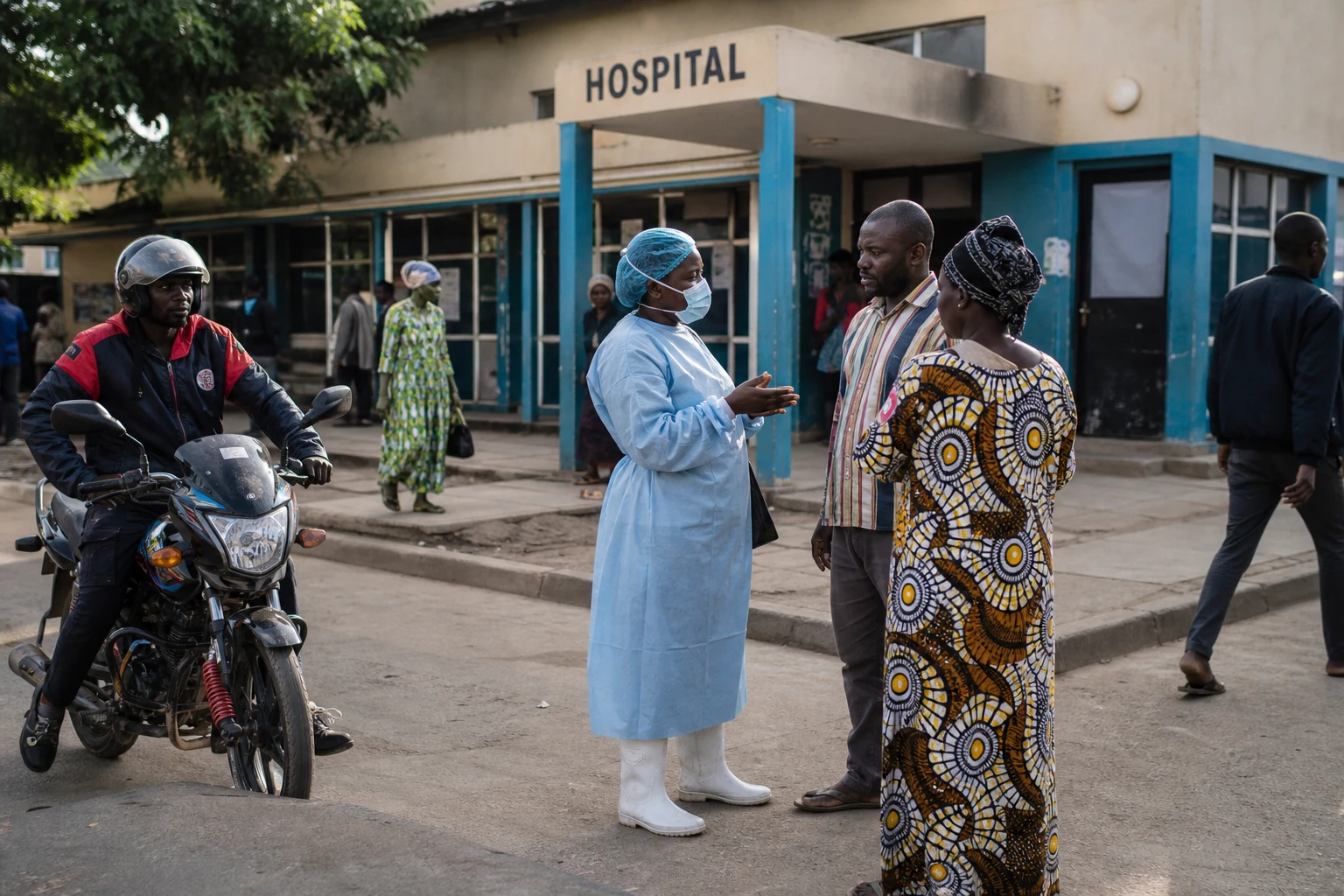
When a hospital city becomes the front line of an epidemic
In Bunia, in Ituri, the response to Ebola is not playing out only in laboratories or treatment centres. It is also unfolding in families, markets, churches and the daily journeys between the city and neighbouring health zones. In this kind of crisis, every bed counts, but every gain in trust counts even more.
This reality explains why the opening of a new care facility in Bunia is more than a simple logistical boost. It reflects a broader battle being fought in a province already marked by insecurity, population movements and pressure on health services. In Central Africa, where health borders are often porous, a local outbreak can quickly take on a regional dimension.
Ituri at the heart of DR Congo’s 17th Ebola outbreak
The Democratic Republic of the Congo has been facing its 17th Ebola epidemic since May 2026. It is caused by the Bundibugyo strain, first detected in Ituri before spreading to other health zones, including in North Kivu and South Kivu. The World Health Organization confirmed that the epidemic was declared on 17 May 2026 and that international coordination had been activated under a public health emergency of international concern.
The first warning signs appeared in early May in the Mongbwalu health zone in Ituri, with deaths among health workers. Situation reports published by the WHO subsequently described sustained transmission in several hotspots in the province, and then beyond. As of 21 June 2026, the organisation reported 1,048 laboratory-confirmed cases and 267 confirmed deaths in the three affected provinces. This tally, already several weeks old by the time the centre in Bunia opened, shows how quickly the outbreak was escalating.
The Congolese government and the WHO then stepped up joint missions to Bunia. Their shared message boiled down to a simple idea: strengthen surveillance, laboratory testing, care and coordination to break chains of transmission more quickly. This approach is a standard part of the fight against Ebola, but it requires resources, trained teams and community buy-in.
What the opening of the new centre in Bunia changes
On 13 July 2026, a new Ebola treatment centre was inaugurated at Bunia General Referral Hospital, in collaboration with the National Institute of Public Health. According to the account published in Kinshasa, the facility added 56 beds, bringing Bunia centre’s total capacity to 108, up from 52. The facility was part of a broader system already operating in Rwampara and Nizi, with further openings announced in Lopa and Lita.
This detail is crucial. In an Ebola outbreak, the number of beds is not just about admitting more patients. It also makes it possible to isolate suspected cases more quickly, protect health workers and reduce movement outside the care system. In practice, this can prevent patients from remaining hidden at home or moving between facilities, which complicates contact tracing. Provincial authorities have said so themselves: the tendency to conceal sick people remains a major obstacle.
Expanded capacity does not erase the challenges on the ground. A few weeks before the centre’s inauguration, several health facilities in Bunia had been temporarily closed after suspected cases were detected. Some centres had also needed to be sanitised and decontaminated before reopening. This shows that the response is not confined to one large hospital. It affects the entire local care network, from small urban clinics to faith-based and community facilities.
Care also depends on human resources. In Ituri, some health workers and safe burial teams have complained of delayed allowances and difficult working conditions. This aspect is often underestimated, even though it has a direct impact on continuity of care. When teams become exhausted, disperse or feel poorly supported, the health response becomes less effective.
A health crisis, but also a test of governance
In DR Congo, Ebola is never only a matter of virology. It is also a test of governance, public trust and territorial organisation. Ituri remains a province where population mobility, insecurity in some areas and the distance between urban centres and rural zones complicate the work of response teams. In Bunia, the provincial capital, the authorities can draw on a denser network of facilities. In remote localities, the response becomes slower, more costly and more fragile.
The Bundibugyo strain adds a further challenge. Health authorities and the WHO have recalled that there is currently no approved vaccine or authorised specific treatment for it, even though public health measures remain effective in curbing transmission. This makes it all the more important to focus on rapid isolation, contact tracing, community information and the protection of health workers.
In this context, the Congolese strategy is also part of a broader regional framework. Ituri is close to Uganda, and cross-border cases have already shown that public health in the Great Lakes region does not stop at an administrative boundary. The epidemic is therefore prompting cooperation not only beyond DR Congo, but also with neighbouring countries and regional health agencies. This is a familiar reality in Central Africa: health systems are strengthened less by slogans than by continuity, information-sharing and the capacity to respond quickly.
For Bunia’s residents, the stakes are very practical. They need to continue seeking treatment for other illnesses, maintain trust in the centres that remain open, avoid delays in seeking consultations and protect exposed families. For the authorities, the challenge is twofold: contain Ebola and prevent the response from further disrupting the normal functioning of healthcare. That is where, day by day, the difference is made between a hotspot being brought under control and an outbreak taking hold.
Across the continent, this outbreak is a reminder of a lesson that is well known but still relevant: African health security depends less on dramatic declarations than on strong facilities, protected staff and communities involved in the response. In DR Congo, every new treatment centre is useful. But it only reaches its full potential if it is part of a wider network capable of linking Bunia to Kinshasa, Ituri to the rest of Central Africa, and the emergency response to the lasting reconstruction of the health system.



