
 Algeria
 Egypt
 Libya
 Morocco
 Sudan
 Tunisia
 Benin
 Burkina Faso
 Cabo Verde
 Côte d'Ivoire
 Ghana
 Guinea
 Guinea-Bissau
 Liberia
 Mali
 Mauritania
 Niger
 Nigeria
 Senegal
 Sierra Leone
 The Gambia
 Togo
 Cameroon
 Central African Republic
 Chad
 Equatorial Guinea
 Gabon
 Republic of the Congo
 São Tomé and Príncipe
 Burundi
 Comoros
 Djibouti
 Eritrea
 Ethiopia
 Kenya
 Madagascar
 Malawi
 Mauritius
 Mozambique
 Rwanda
 Seychelles
 Somalia
 South Sudan
 Tanzania
 Uganda
 Angola
 Botswana
 Eswatini
 Lesotho
 Namibia
 South Africa
 Zambia
 Zimbabwe
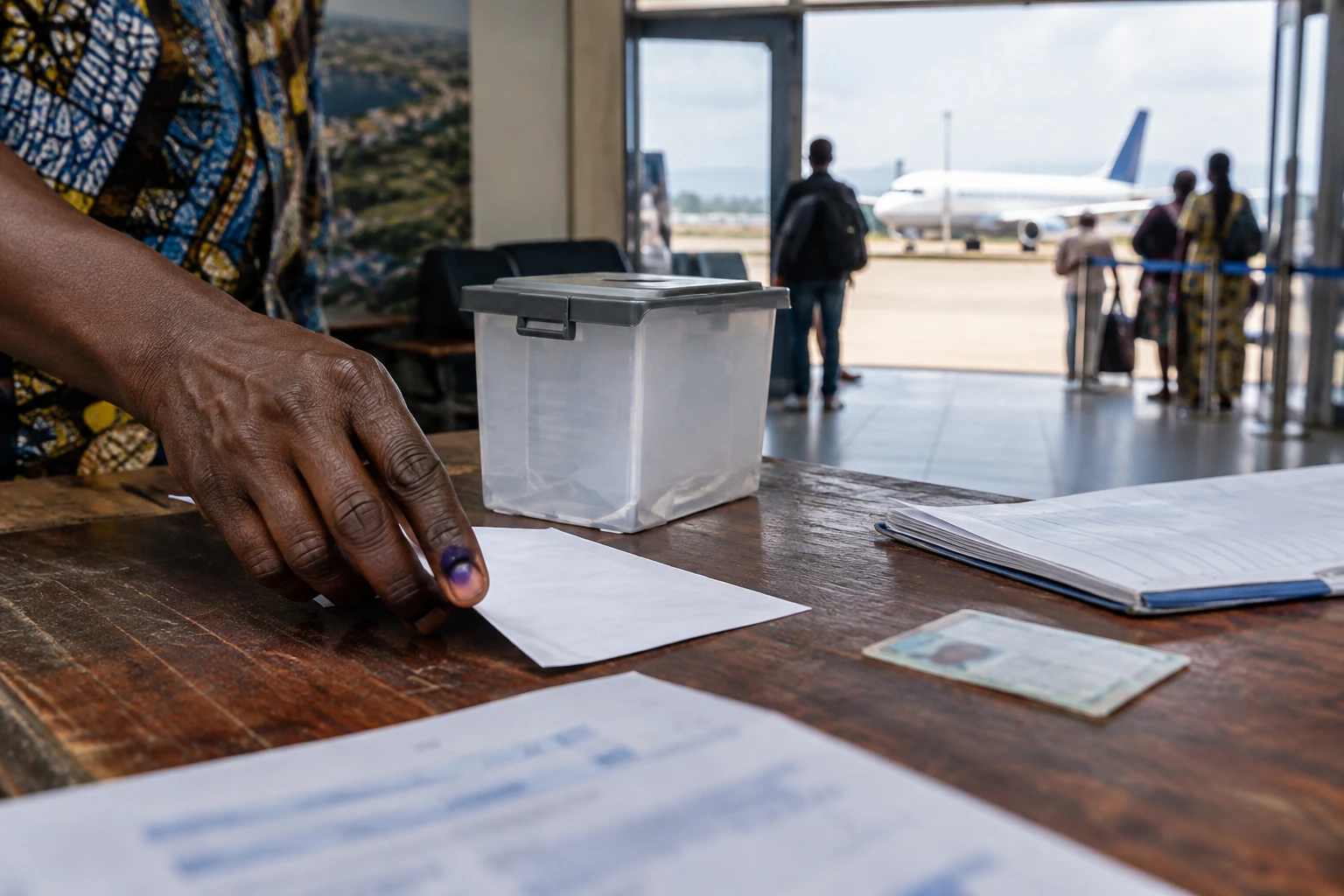
In Bunia, air travel remains a vital link with the rest of the Democratic Republic of the Congo. But for several months, residents have been unable to rely on commercial flights, while humanitarian rotations continue to bring in teams and equipment to fight Ebola. The distinction is crucial: the runway is not entirely inactive, but ordinary air access remains suspended.
Decision extended until February 2027
The Régie des voies aériennes (RVA), the public body responsible for managing airports in the DRC, has maintained the suspension of commercial flights to and from Bunia until 8 February 2027. The measure is set out in an aviation notice published on 8 November 2026. It applies to Murongo Airport from 8.45am on 8 November and is due to end at 11.59pm on 8 February, unless a new decision is made.
The suspension of commercial services began on 23 May, a few days after the 17th Ebola outbreak in the DRC was declared on 15 May. The disease is caused by the Bundibugyo virus and affects Ituri, in the country’s north-east, among other areas. The World Health Organization (WHO) has declared the outbreak a public health emergency of international concern.
The RVA notice does not detail the specific reasons for the new end date. Local authorities and business operators are therefore questioning how long the restriction will last, as commercial flights have been suspended for more than five months. Stakeholders in Ituri consider the measure damaging and are calling for it to be reviewed. These are their criticisms; they do not, in themselves, amount to an independent assessment of the health risk.
Humanitarian air bridge continues
The suspension of commercial flights does not mean that Bunia has been cut off from all air traffic. Humanitarian and medical services continue, with checks in place to limit the risk of infection. In September, the WHO said the United Nations Humanitarian Air Service (UNHAS) was operating five weekly rotations between Bunia and Kinshasa, as well as flights to other affected areas.
This network plays a central role in the response. By 9 September, UNHAS had made 876 flights in Ituri, carried more than 6,918 passengers and transported more than 100 tonnes of cargo, according to the WHO. The figures show that air activity linked to relief efforts is continuing, even though travellers and businesses do not have the same opportunities to get around.
The difference also matters for logistics. Kinshasa is about 1,790 kilometres from Bunia as the crow flies. The journey by road and river can take weeks, according to the WHO. Relief flights therefore speed up the transport of health workers, medicines and equipment. But they are no substitute for commercial services open to residents and businesses.
Unequal costs for residents and businesses
For travellers, the lack of commercial flights reduces travel options and complicates family or work emergencies. For businesses, it can lengthen delivery times and make staff travel more difficult. Local stakeholders fear an impact on trade and economic activity across the province. However, the available information does not make it possible to quantify precisely the economic losses caused by the suspension.
The consequences are not the same for everyone. Humanitarian organisations have flights dedicated to their operations. Residents without access to these arrangements must turn to overland routes, in a province where roads deteriorate during the rainy season and insecurity complicates some journeys. Formal businesses that depend on regular schedules and fast transport may also be affected differently from small traders, whose networks are often local.
The debate is therefore about balancing health precautions, mobility and equal treatment between provinces. Officials and operators in Ituri dispute the duration of the measure and compare it with the situation at other airports. Such comparisons, however, require detailed health and operational data: the epidemiological conditions, screening capacity and specific risks at each site must be examined before concluding that treatment is unequal.
Health decision must be clear
The outbreak also affects Uganda, which borders Ituri, and calls for coordination across borders. The WHO has stressed that the response is taking place amid insecurity, population displacement and cross-border trade. In this region, air transport serves both relief efforts and the continuity of economic activity. A prolonged restriction therefore requires a clear public explanation, as well as understandable criteria for lifting it.
The issue is not simply a choice between public health and the economy. Commercial services can increase travel, while humanitarian flights contribute directly to surveillance and care. An appropriate decision must take account of these distinct uses, the preventive measures that can be applied to passengers and the documented evolution of the outbreak.
For the people of Ituri in the DRC, the next deadline is 8 February 2027. That date marks the scheduled end of the current notice, not a guarantee that flights will resume. Whether the suspension is maintained or lifted will depend on further decisions by the RVA and the relevant authorities. Until then, the challenge will be to make public the reasons for any further extension and the specific conditions for safely resuming commercial flights.



