Algeria
 Egypt
 Morocco
 Sudan
 Tunisia
 Benin
 Burkina Faso
 Cabo Verde
 Côte d'Ivoire
 Ghana
 Guinea
 Guinea-Bissau
 Liberia
 Mali
 Mauritania
 Niger
 Nigeria
 Senegal
 Sierra Leone
 The Gambia
 Togo
 Cameroon
 Central African Republic
 Chad
 DR Congo
 Equatorial Guinea
 Gabon
 Republic of the Congo
 São Tomé and Príncipe
 Burundi
 Comoros
 Djibouti
 Eritrea
 Ethiopia
 Kenya
 Madagascar
 Malawi
 Mauritius
 Mozambique
 Rwanda
 Seychelles
 Somalia
 South Sudan
 Tanzania
 Uganda
 Angola
 Botswana
 Eswatini
 Lesotho
 Namibia
 South Africa
 Zambia
 Zimbabwe
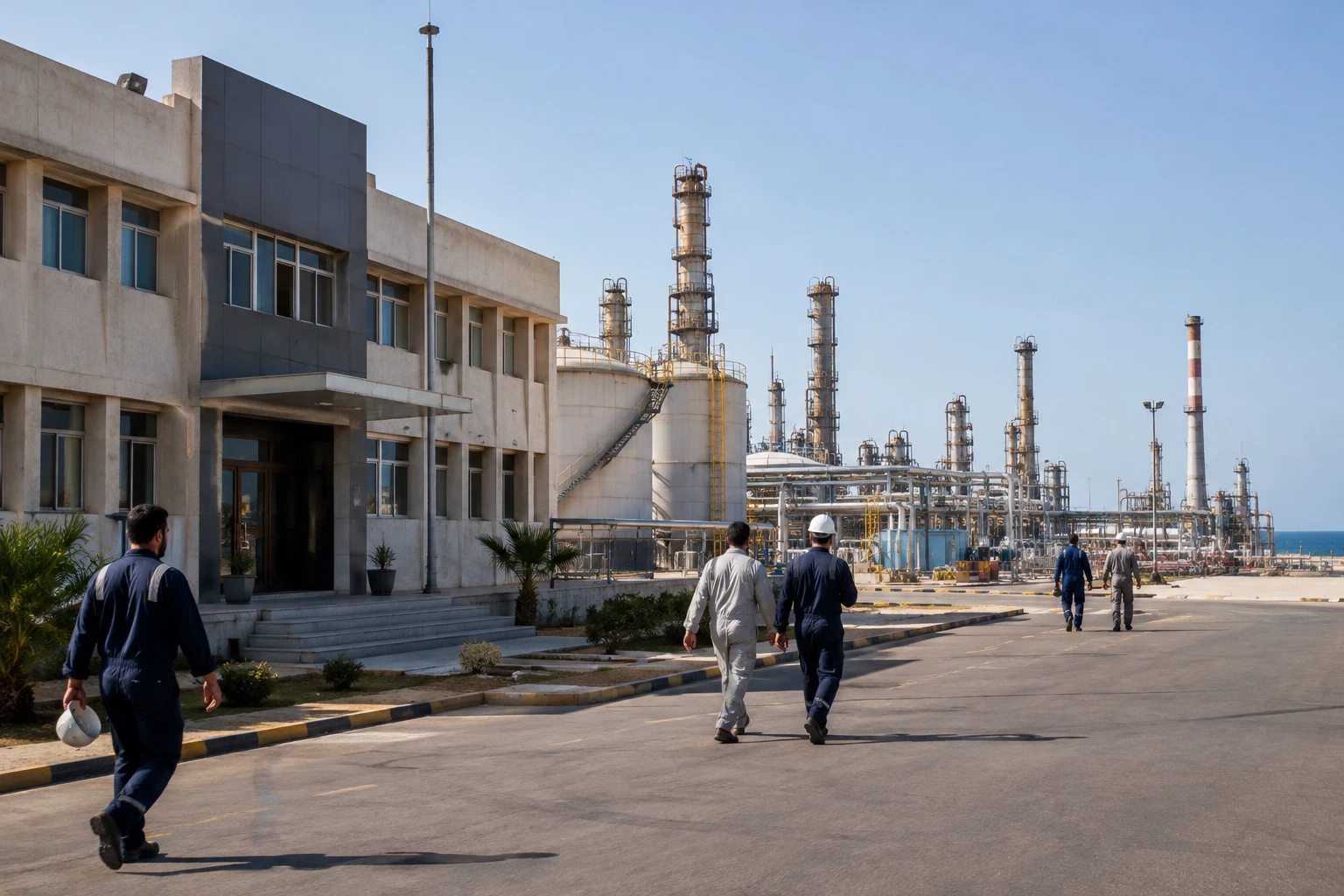
At Brega, the restart of oil facilities raises a practical question for Libyans: can local production reduce dependence on imported fuels while ensuring a regular supply? The restart announced on 25 October marks an industrial milestone. On its own, however, it is not enough to gauge the scale of the revival.
An industrial site restarted in stages
The National Oil Corporation (NOC), the state-owned company overseeing the sector, announced the resumption of operations at the Brega refinery and the full restart of the Sirte Oil Company’s two methanol units. The Libyan News Agency also reported that the refinery, located in the east of the country, had returned to service.
For the methanol units, the NOC says general maintenance work has been completed and the control system of the second unit has been replaced. That facility had been shut down in 2018. According to information released about its return to production, it resumed operations in October 2025 after the installation and testing of a natural gas heating system.
The refinery has also undergone rehabilitation. Work included replacing the catalyst, upgrading the control systems and building a new control room. The NOC has not specified the volume actually processed since operations resumed. The site’s stated nameplate capacity is about 10,000 barrels a day: this figure represents theoretical potential, not verified daily output.
These facilities serve different purposes. The refinery converts crude oil into petroleum products, while the Brega units produce methanol, a compound used in industries including chemicals. Their return to service therefore represents two distinct strands of the industrial restart.
Import dependence weighs on public finances
Libya has substantial oil resources, but its operational refining capacity does not meet its fuel needs. According to an International Monetary Fund document citing the Libyan Audit Bureau, the fuel import bill rose from an annual average of $3 billion between 2016 and 2019 to $9 billion in 2024. The IMF also estimates that direct energy subsidies accounted for 20% of gross domestic product in 2024, taking into account oil-for-fuel exchanges.
These figures illustrate the budgetary stakes, but they do not mean that every plant restart will automatically lead to lower imports. The actual volumes produced, product quality, operational continuity and delivery to consumers all need to be established.
Subsidies keep prices low for households and businesses. They also support activities that rely on transport and generators. But they tie up considerable public resources. More regular local production could limit some purchases from abroad. On its own, it does not resolve questions of distribution, spending oversight or access to fuel in every region.
The economic impact cannot therefore be assessed solely at NOC level. The authorities and formal-sector businesses need to know the volumes available and the costs. For residents, the effect will depend more on continuity of supply and product availability at filling stations, both in cities and in areas far from major industrial centres.
National ambitions face operational constraints
In January 2026, the NOC set a target of 660,000 barrels a day of refining capacity, up from a then-estimated nameplate capacity of about 380,000 barrels a day. These figures describe a national ambition, not current output. The African Press Agency and Libyan outlet The Libya Observer reported on the modernisation and capacity expansion plan.
Brega’s return to service is part of this strategy, but the site remains modest in scale compared with the country’s major refineries. Its importance also stems from its place in the Brega industrial complex, where facilities for processing, producing and exporting hydrocarbons sit side by side. Their proper functioning depends on the availability of spare parts, maintenance, facility security and access to inputs, particularly natural gas.
Since 2011, episodes of conflict and political instability have disrupted infrastructure and investment in the sector. The NOC remains a central institution in oil production, but the country’s political fragmentation complicates revenue governance and the implementation of sustainable projects. In this context, announcing a return to service is one verifiable step; demonstrating stable production over time is another.
An issue extending beyond Libya’s borders
Libya is a member of the Arab Maghreb Union (AMU), a regional organisation that also brings together Algeria, Morocco, Mauritania and Tunisia. The revival of its infrastructure could matter for energy supply and trade in North Africa. But the Brega announcement specifies neither additional exports nor new regional agreements: its immediate significance concerns Libya’s industrial capacity first and foremost.
Across the continent, Libya’s experience is a reminder that nameplate capacity does not guarantee an effective supply. Operational equipment, sustained investment and institutions able to account for their performance are also needed. The next indicators for assessing Brega’s results will be the volumes of methanol and fuel actually produced, continuity of operations and changes in imports.
The announcements of 25 October confirm that several activities at the site have resumed simultaneously. They do not yet detail the output achieved or the expected effect on the import bill. This distinction will be essential in assessing Brega’s actual contribution to Libya’s energy security and public finances.
Sources consulted: NOC announcement on the restart of the methanol units, Libyan News Agency LANA report on the Brega refinery, IMF analysis of energy subsidies and imports, African Press Agency report on refining targets, Libyan coverage of the refining capacity plan and overview of AMU member countries.