Algeria
 Egypt
 Libya
 Morocco
 Sudan
 Tunisia
 Benin
 Burkina Faso
 Cabo Verde
 Côte d'Ivoire
 Ghana
 Guinea
 Guinea-Bissau
 Liberia
 Mali
 Mauritania
 Niger
 Nigeria
 Senegal
 Sierra Leone
 The Gambia
 Togo
 Cameroon
 Chad
 DR Congo
 Equatorial Guinea
 Gabon
 Republic of the Congo
 São Tomé and Príncipe
 Burundi
 Comoros
 Djibouti
 Eritrea
 Ethiopia
 Kenya
 Madagascar
 Malawi
 Mauritius
 Mozambique
 Rwanda
 Seychelles
 Somalia
 South Sudan
 Tanzania
 Uganda
 Angola
 Botswana
 Eswatini
 Lesotho
 Namibia
 South Africa
 Zambia
 Zimbabwe
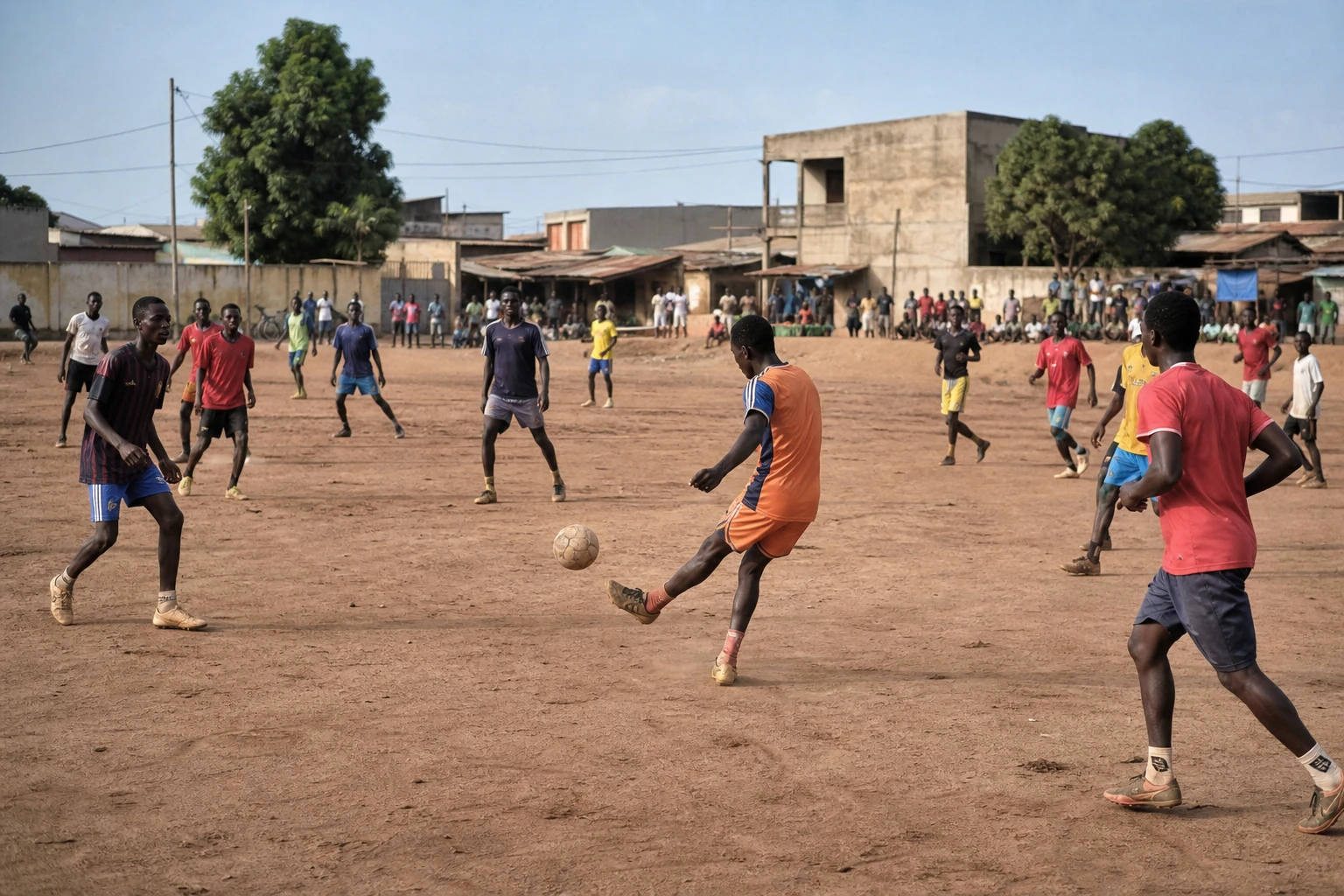
In Birao, football is not just about winning. In this town in Vakaga, in the north-east of the Central African Republic, every training session offers a rare chance for young people to meet, despite isolation, a lack of equipment and security tensions.
A dusty pitch, but an undiminished passion
At Birao’s municipal pitch, players contend with an uneven surface, worn-out boots and limited equipment. Yet around 20 young people regularly gather around the ball. Some wear shirts bearing the names of major European clubs. Others play in second-hand or borrowed kit.
Henri Maliavo, a young player, describes a game built on making do. The sessions are organised by enthusiasts themselves. Local matches often rely on contributions from participants and occasional support from a few residents.
“We really love football, but we lack the resources,” he says. The players train on difficult ground and hope one day to have regular coaching. Their professional dreams remain alive, even though local conditions make the path uncertain.
In Birao, the obstacles go beyond the state of the pitch. The town is more than 1,000 kilometres from Bangui, according to the United Nations Multidimensional Integrated Stabilization Mission in the Central African Republic. Road conditions and the distance from sports centres complicate travel, competitions and visits from qualified coaches.
Vakaga, a prefecture far from sporting circuits
Birao is the capital of Vakaga, a prefecture bordering Sudan and Chad. Its location gives the town strategic importance, but also distances it from the Central African Republic’s main administrative, economic and sporting networks.
Getting around remains difficult. Journeys to other Central African towns can take a long time and depend heavily on the season, road conditions and the security situation. For a local club, taking part in a regular league therefore requires spending and logistics that are rarely within reach.
The regional context also weighs on daily life. Recent humanitarian reports describe armed incidents and tensions in areas near the Sudanese border. Vakaga also hosts displaced people and refugees, adding pressure to essential services.
In this context, sport cannot replace security, education or development policies. It can, however, foster habits of dialogue and offer young people a structured group activity.
A gathering that brings residents together
On match days, Birao takes on a different pace. Exhibition matches draw residents from different neighbourhoods and communities. Spectators come together around an event whose rules are familiar to all.
Marcelin Ngandia, a sports inspector, believes these gatherings go beyond competition alone. A match, he says, allows residents to share a moment, despite the tensions affecting the region.
This social role of football matters in a town where opportunities to meet are scarce. The pitch becomes a place for discussion. Young people build relationships there that are not based solely on community or family ties.
This dynamic should not, however, be idealised. A match does not erase threats, economic hardship or divisions. It creates only a shared interlude. Its value lies precisely in its ability to sustain social ties in a fragile environment.
Talent without a regular league
Souleymane, another enthusiast, sums up the main difficulty: players have few structures to help them develop. The absence of a regular league limits talent scouting and reduces opportunities to face better-organised teams.
“We have talent, but there is no league or structure to support us,” he says. The young players want a playable pitch, equipment and regular competitions. Above all, they want their town to have the same opportunities as other parts of the country.
This demand points to a national challenge. In the Central African Republic, sports facilities remain heavily concentrated in Bangui and a few major towns. Efforts announced in recent years include the renovation of several facilities in Bangui, Berbérati, Bouar and Kaga-Bandoro, according to an official document on the state of the nation.
The question now is how to ensure continuity. Renovating a stadium is not enough. Provision must also be made for its upkeep, coach training, competitions and team travel. Without this follow-up, facilities risk being underused.
A stand under construction, but wider needs remain
In June 2023, MINUSCA documented the launch of construction work on a 300-seat stand at Am-Ngabo municipal stadium. The initiative shows that local investment can improve facilities for spectators and raise the profile of sporting activities.
It addresses only some of the needs, however. Players also mention the quality of the playing surface, access to footballs, shirts, changing rooms, lighting and regular matches. Training referees and coaches is another essential task.
Sport also concerns young women, who are often less visible in local competitions. A sports policy in Birao would do well to provide them with suitable time slots, equipment and support. The issue is not limited to men’s football.
From Birao to Central Africa
Birao’s experience is a reminder that sport cannot be viewed solely from capital cities. In outlying areas, a pitch serves as a place to play and socialise, and sometimes as a point of contact between communities divided by tensions.
The Central African Republic is part of the Central African Economic and Monetary Community, CEMAC, which brings together six countries in economic and monetary co-operation. It also takes part in competitions organised by the Central African Football Federations’ Union, UNIFFAC.
For young people in Birao, these regional frameworks remain distant as long as no competition concretely connects Vakaga with other prefectures. The next step will therefore be to build links between local initiatives and national structures: regular schedules, safe travel, transparent talent scouting and sustainable funding.
In Birao, football is not asking for special treatment. Players want normal conditions in which to play, develop and compete against other teams. Their message is simple: the talent is already there. What remains is to build the environment that will allow it to emerge.