
 Algeria
 Egypt
 Libya
 Morocco
 Sudan
 Tunisia
 Benin
 Burkina Faso
 Cabo Verde
 Côte d'Ivoire
 Ghana
 Guinea
 Guinea-Bissau
 Liberia
 Mali
 Mauritania
 Niger
 Nigeria
 Senegal
 Sierra Leone
 The Gambia
 Togo
 Cameroon
 Central African Republic
 Chad
 Equatorial Guinea
 Gabon
 Republic of the Congo
 São Tomé and Príncipe
 Burundi
 Comoros
 Djibouti
 Eritrea
 Ethiopia
 Kenya
 Madagascar
 Malawi
 Mauritius
 Mozambique
 Rwanda
 Seychelles
 Somalia
 South Sudan
 Tanzania
 Uganda
 Angola
 Botswana
 Eswatini
 Lesotho
 Namibia
 South Africa
 Zambia
 Zimbabwe
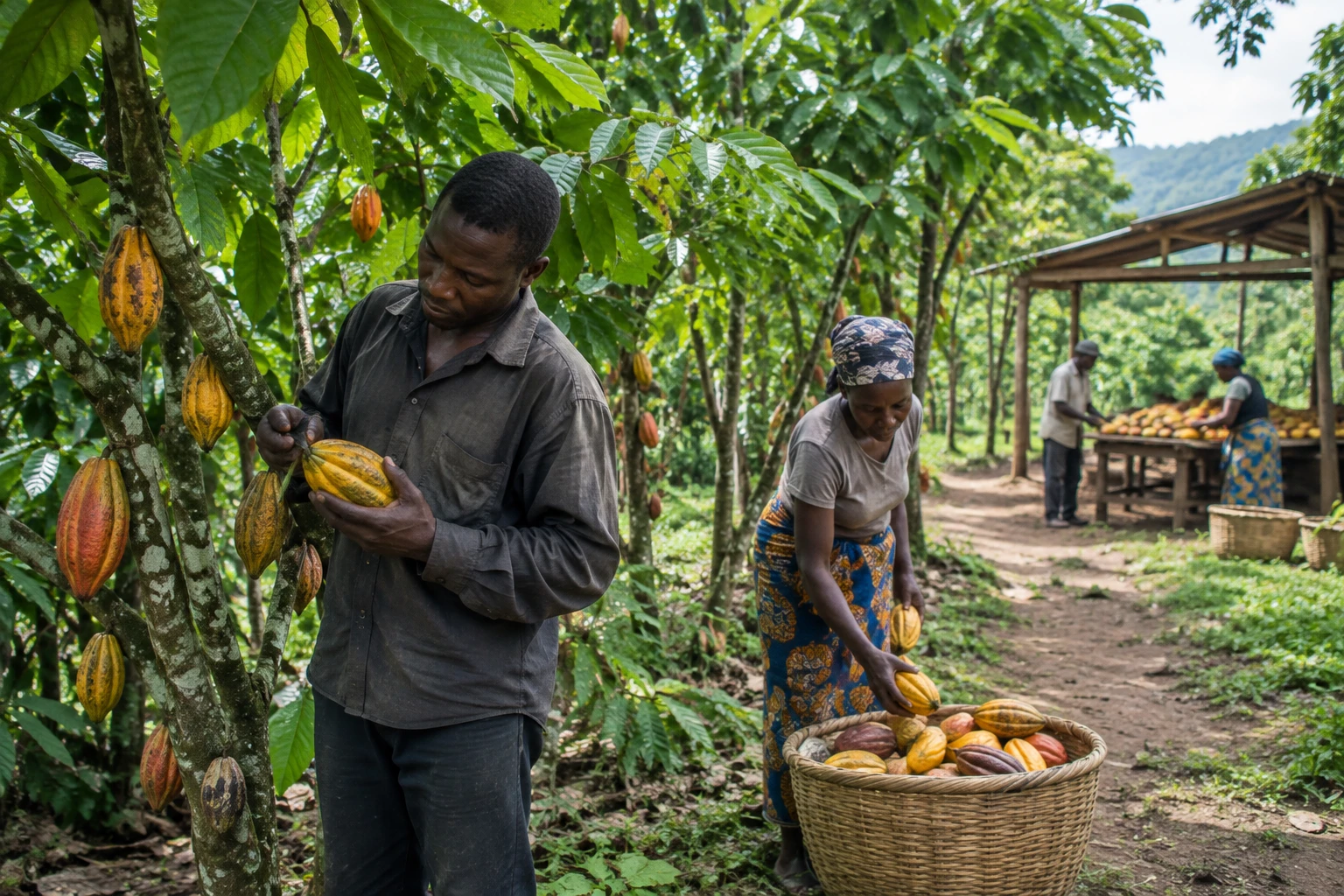
In Beni, a harvest can be lost before the pods are even picked. When farmers hesitate to travel to their plots, violence threatens not only their safety: it also cuts families off from an expected income and weakens a sector linking the countryside of North Kivu to regional markets.
Remote plantations, exposed incomes
In Beni territory, North Kivu, farmers say they fear travelling to their fields, which are often several kilometres from their villages. That concern has resurfaced after the attack on Cantine-Aloya, on the night of 5 to 6 November 2026, attributed to the Allied Democratic Forces (ADF), an armed group active in the east of the Democratic Republic of the Congo (DRC).
The death toll remains uncertain. Congolese media have reported local estimates ranging from around a dozen deaths to more than 40. The Associated Press reported on 6 November that local civil society had counted at least 33 bodies. In the absence of an independent and confirmed toll, these figures should be considered provisional. On their own, they do not confirm the death toll of 37 cited by the army in information initially released.
For cocoa farmers, the risk is not limited to attacks on homes. Isolated fields are also vulnerable to looting and incursions. Gilbert Kambale, a producer and former head of civil society in Beni, says some farmers have not returned to their plantations for months. He describes families deprived of income and forced to rethink their spending, particularly on their children’s schooling.
Kambale estimates that selling 200 to 300 kilos of cocoa can bring in about $1,200. This is his estimate, not a guaranteed income for every farm: harvest volumes, prices and costs vary from one producer to another. But when fear prevents harvesting or beans are taken from fields, the loss can directly affect day-to-day expenses.
An agricultural economy at the heart of insecurity
Cocoa is an important cash crop in Beni territory. The sector supports family farms, as well as traders, transporters, cooperatives and buyers. Production is therefore not simply a matter of exports: it sustains local economic activity, whose benefits depend on access to plots and the ability to transport the beans.
The November harvest is a small crop, ahead of a larger production period in May and June. Prolonged insecurity can therefore reduce available volumes and disrupt incomes long after an attack. The consequences are not the same for everyone: a household with no other farming activity has fewer options than a commercial operator able to diversify its purchases or sourcing areas.
Beni’s cocoa is also part of cross-border trade, particularly with Uganda. This proximity opens up markets, but makes it harder to track the origin of beans when supply chains are disrupted or informal. In this context, securing plantations and collection routes is a matter of protecting producers, paying them for their work and ensuring traceability across the sector.
The ADF are not the only source of risk for farmers. Crop theft and difficulties in marketing produce have also been reported in the region. A study of the cocoa value chain in Beni and Bingo finds that many producers sell beans without processing them, often to local intermediaries. When access to fields becomes dangerous, smallholders have little room to make up for the loss.
Security measures alone cannot guarantee access to fields
Congolese and Ugandan forces have been conducting Operation Shujaa against the ADF since November 2021. The military cooperation takes place in a border area where the armed group moves between eastern DRC and Uganda. Yet continued attacks are a reminder that an operation against armed positions does not automatically ensure lasting security for villages, roads and farms.
Civil society groups and farmers are calling for fields to be secured before they return. This raises a practical question: how can scattered plots, sometimes far from populated areas, be protected without putting civilians at greater risk or disrupting their work? The authorities must also take local warnings and the presence of forces on the ground into account. The response should be measured not only by the number of operations, but by whether families can work without fearing an incursion.
At regional level, the issue concerns cooperation between Kinshasa and Kampala, as well as agricultural trade in the Great Lakes region. The ADF have shown they can remain active despite military pressure. At the same time, the cocoa sector shows how rural activity can support incomes and trade while remaining exposed to armed groups and informal networks that extract resources.
The next harvest will therefore depend as much on the security situation as on the continuity of trade routes. For producers in Beni, the most tangible measure will be whether they can return to their plantations without abandoning their crops or being forced to lose their harvest. In Kinshasa, as in neighbouring capitals, the issue is a reminder that stability in eastern Congo is also at stake in its fields and household incomes.



