Algeria
 Egypt
 Libya
 Morocco
 Sudan
 Tunisia
 Benin
 Burkina Faso
 Cabo Verde
 Côte d'Ivoire
 Ghana
 Guinea
 Guinea-Bissau
 Liberia
 Mali
 Mauritania
 Niger
 Nigeria
 Senegal
 Sierra Leone
 The Gambia
 Togo
 Cameroon
 Chad
 DR Congo
 Equatorial Guinea
 Gabon
 Republic of the Congo
 São Tomé and Príncipe
 Burundi
 Comoros
 Djibouti
 Eritrea
 Ethiopia
 Kenya
 Madagascar
 Malawi
 Mauritius
 Mozambique
 Rwanda
 Seychelles
 Somalia
 South Sudan
 Tanzania
 Uganda
 Angola
 Botswana
 Eswatini
 Lesotho
 Namibia
 South Africa
 Zambia
 Zimbabwe
In Bangui, the crisis in Central African football is no longer measured solely by the standings in a qualifying group. It is now visible in the streets, amid whistles, placards and calls to reorganise a sport that struggles to offer players and clubs regular opportunities.
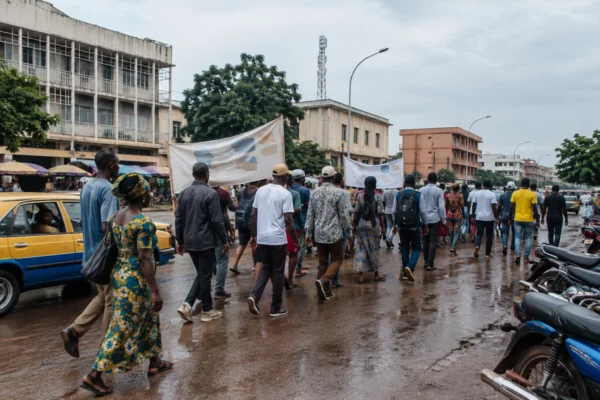
On 30 September 2026, former internationals and supporters demonstrated in the Central African capital after the Fauves du Bas-Oubangui lost twice in the qualifiers for the 2027 Africa Cup of Nations. Their anger is directed at the Central African Football Federation and the national team staff, but goes far beyond the question of a coach.
A national team already under pressure in Group F
The Central African Republic are in Group F, alongside Burkina Faso, Benin and Mauritania. The Confederation of African Football (CAF) divided the 48 participating teams into 12 groups of four. The first two rounds took place on 24, 25, 28 and 29 September 2026. The campaign will resume in November, before the final two rounds scheduled for March 2027.
The Fauves began with a 3-1 defeat to Mauritania on 24 September. Four days later, they lost 1-0 to Burkina Faso. The two results left them bottom of the group after two rounds, while Mauritania and Benin each had three points. The competition’s official schedule is available on the Confederation of African Football website.
The situation is difficult, but the outcome is not yet mathematically decided. The Central African team still have to face Benin twice and meet Mauritania and Burkina Faso again. However, the gap leaves them with very little room for error. Each of the next matches will therefore weigh both on their qualifying chances and on confidence in the sporting project.
In Bangui, protests target governance
The 30 September demonstration was organised by the Central African footballers’ union, which includes former Fauves players. The demonstrators called for the departure of the federation’s president, Célestin Yanindji, and national team coach Éloge Enza Yamissi. Radio Ndeke Luka reported that the march was met by a mobilisation of supporters of the president and the technical staff.
The gathering took place near the Barthélemy-Boganda sports complex. According to accounts carried by the local press, about 100 people took part. Motorcycle-taxi drivers joined the procession. However, the march did not reach the federation’s headquarters, as tensions flared between the two groups. Security forces intervened to disperse the participants.
The protesters are not only challenging decisions made during matches. They condemn what they see as management incapable of supporting the development of Central African football. Their demands also include renovating facilities, supporting clubs and enabling national teams to prepare for matches in stable conditions.
This view reflects a longstanding concern in Central African football: the difficulty of maintaining competitive activity between national team gatherings. Former players quoted by the local press believe that a better-structured domestic league is the essential foundation for a strong national team. Without regular competition, the team depends more heavily on players based abroad and occasional training camps.
Stadiums and clubs at the centre of the debate
Protesters say Central African stadiums have not been approved for several years. This forces the national team to play home matches in other countries or at venues that meet CAF standards. It also deprives the people of Bangui of a regular sporting fixture and limits potential revenue for the local football ecosystem.
Clubs are just as important to the debate. According to the organisers of the demonstration, no Central African club has recently represented the country in CAF club competitions. Such an absence limits players’ exposure, teams’ international experience and the financial resources generated by these campaigns.
For officials, the pressure is therefore about immediate results. For players and clubs, it concerns a longer chain: training, the league, facilities, refereeing, funding and technical support. For supporters in Bangui, meanwhile, the Fauves’ defeats have become a visible symbol of a system they consider inadequately organised.
The debate also reveals a divide between the capital and national sporting structures. Bangui is home to the main facilities, federation officials and most media attention. Yet the revival of football cannot rely on the national team alone. It will also have to involve clubs, academies and local pitches, particularly outside the capital.
A federation caught between protests and calls for calm
On the same day, young supporters gathered outside the federation’s headquarters to back Célestin Yanindji and Éloge Enza Yamissi. According to the Journal de Bangui, they called for unity behind the Fauves and asked that the president and coach be allowed to continue their work.
This counter-demonstration shows that the protests are not universally supported. Some members of the public are demanding immediate change. Others fear that a fresh institutional crisis could further destabilise a national team already facing a difficult campaign. Sports Minister Héritier Doneng and the federation president have called on stakeholders to set aside their differences.
However, this appeal for calm will not be enough to resolve structural problems. The federation will have to answer concrete questions: what is the schedule for domestic competitions? What resources will clubs receive? Which facilities can host international matches? What working conditions will be provided for the staff and players?
An issue extending beyond the Central African Republic
The Central African Republic is part of the Central African Economic and Monetary Community, or CEMAC, which brings together six countries that share, among other things, common economic and monetary mechanisms. In the region, football also serves as a means of raising the profile of countries, enabling professional mobility and fostering popular cohesion.
The Central African case is a reminder of a continent-wide reality: a national team’s qualification rarely depends only on the talent available. It rests on a complete environment capable of keeping clubs playing, developing young people, maintaining stadiums and ensuring transparent governance. The Fauves’ results have made this issue particularly visible in Bangui.
The next sporting fixture is on 11 November 2026, when the team travels to Benin. The Central African side will need a result to stay in contention. But beyond the score, attention will focus on the federation’s response to the protests and its ability to present a credible plan for national football.