Algeria
 Libya
 Morocco
 Sudan
 Tunisia
 Benin
 Burkina Faso
 Cabo Verde
 Côte d'Ivoire
 Ghana
 Guinea
 Guinea-Bissau
 Liberia
 Mali
 Mauritania
 Niger
 Nigeria
 Senegal
 Sierra Leone
 The Gambia
 Togo
 Cameroon
 Central African Republic
 Chad
 DR Congo
 Equatorial Guinea
 Gabon
 Republic of the Congo
 São Tomé and Príncipe
 Burundi
 Comoros
 Djibouti
 Eritrea
 Ethiopia
 Kenya
 Madagascar
 Malawi
 Mauritius
 Mozambique
 Rwanda
 Seychelles
 Somalia
 South Sudan
 Tanzania
 Uganda
 Angola
 Botswana
 Eswatini
 Lesotho
 Namibia
 South Africa
 Zambia
 Zimbabwe
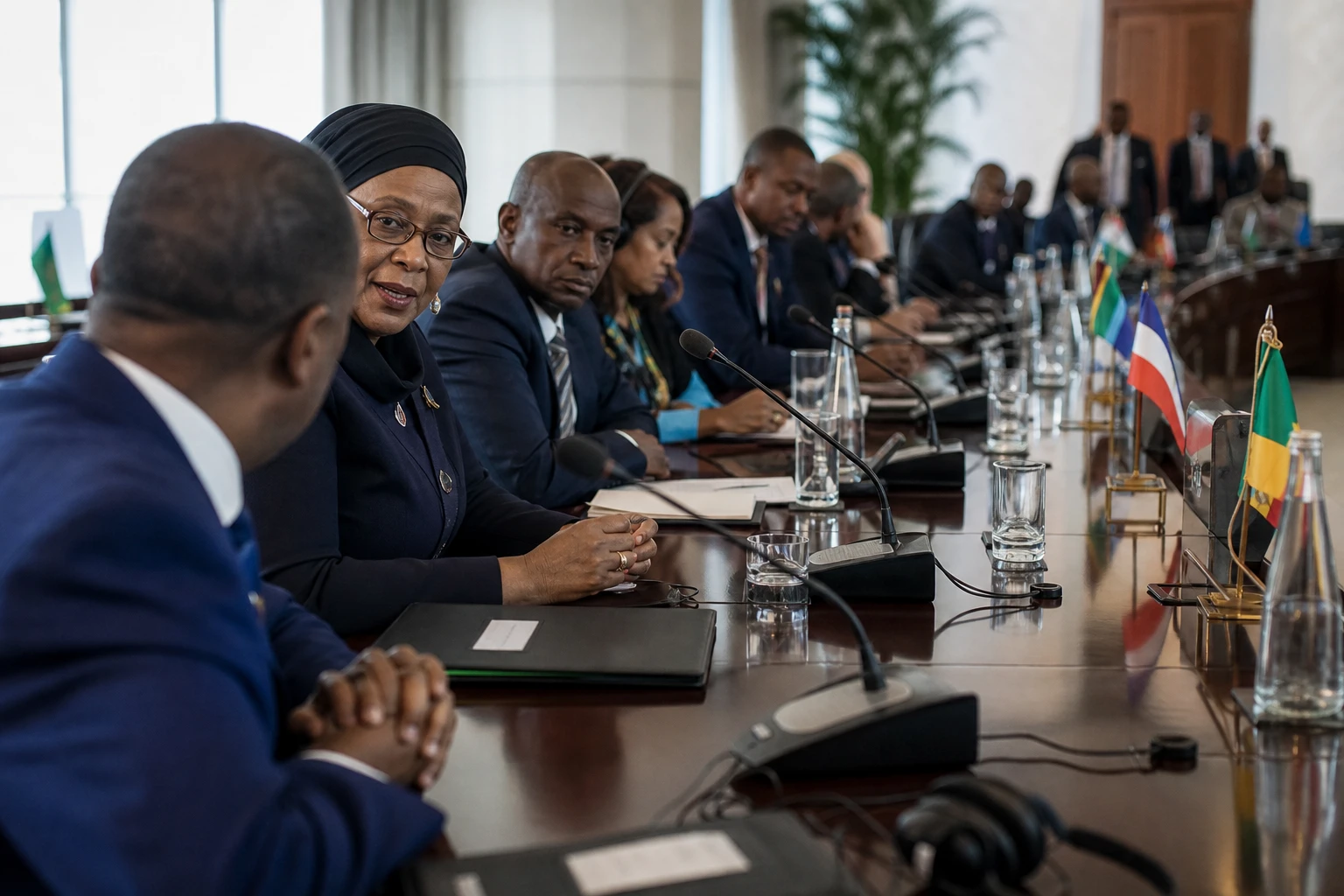
At the southern end of the Red Sea, one passage can weigh on entire budgets
When a strait becomes more unstable, it is not only shipowners who recalculate their routes. Ports, refineries, wheat importers and tax authorities also adjust their accounts. That is exactly what is happening around Bab el-Mandeb, at the entrance to the Red Sea, where the slightest military shift can turn into an economic shock far beyond Yemen.
In this region, geography speaks for itself. Bab el-Mandeb links the Red Sea to the Gulf of Aden. Further north, the Suez Canal remains the main shortcut between Asia and Europe. Further south, the Horn of Africa looks directly onto this maritime corridor. For Egypt, whose Suez Canal remains a pillar of foreign-currency revenues, every tension in the Red Sea has an immediate impact. For Djibouti, the same route underpins port and logistics activity. For landlocked Ethiopia, it remains the main maritime gateway to global trade.
A military advance increases pressure on trade routes
On Friday 11 September, Houthi forces took control of Mayyun Island, also known as Perim, after advancing along the Yemeni coast to Mokha and Dhubab. The volcanic island lies at the heart of Bab el-Mandeb and divides the narrowest part of the strait into two shipping channels. Its occupation gives the Houthis a more direct position from which to observe and threaten maritime traffic.
Precision is nevertheless essential. It would be excessive to speak of absolute control of the strait. The western shore belongs to Djibouti and Eritrea, and international waters remain open. But the new configuration gives the Houthis a genuine tactical advantage. It increases their ability to monitor ships passing through and raise the level of risk perceived by shipping companies.
The Yemeni movement says navigation remains safe for ships not targeted by its announced embargo against certain Saudi vessels. On the ground, however, shipowners are taking a cautious approach. Since the Houthi attacks in the Red Sea, insurers, logistics operators and major clients have known that a strait can be weakened without being officially closed.
Egypt, the largest economy directly exposed to the shock
No African country is more exposed than Egypt. The Suez Canal is not just a shipping route. It is also a strategic source of foreign currency, on a par with tourism and remittances from Egyptians abroad. When ships divert, the impact is not confined to shipping maps. It affects the balance of payments, public finances and investor confidence.
The figures have already shown this. In 2024, the number of ships passing through the canal fell to 13,213, from 26,434 in 2023. Revenues declined to $3.991 billion, from $10.250 billion the previous year. This fall of more than 60% was attributed to regional tensions in the Red Sea. For Cairo, the problem is not merely temporary. It adds to substantial external financing needs and an economy that depends heavily on foreign-currency inflows.
President Abdel Fattah al-Sisi, for his part, cited cumulative losses of close to $10 billion since November 2023 in spring 2026. The political message is clear: maritime security is no longer a peripheral issue. It directly affects Egypt’s macroeconomic stability, and therefore the government’s room for manoeuvre, the cost of debt and its ability to protect purchasing power.
Djibouti, Eritrea and the Horn of Africa face a Red Sea under strain
On the opposite shore, Djibouti is on the front line. Its economy relies heavily on port activity, transit and logistics services. The Addis Ababa–Djibouti corridor accounts for more than 95% of Ethiopia’s foreign trade by volume. In other words, when the Red Sea is disrupted, the entire land and maritime supply chain of the Horn of Africa comes under strain.
This exposure is not only a vulnerability. It can also bring short-term increases in traffic when ships seek alternative ports, bunkering or technical stops. But this benefit is fragile. It depends on a crisis-driven situation and can come with congestion, port delays and additional costs. The World Bank has also noted that revenues from transit and logistics services remain central to Djibouti’s economic model.
Further north, Sudan, already torn apart by war, and Eritrea are directly affected by any deterioration in maritime security. For these states, the Red Sea is not simply a horizon. It is an economic, military and diplomatic frontier. A prolonged crisis could weigh on imports, energy prices and the delivery of essential goods.
Effects that extend far beyond the African coastline
The most visible disruption is the diversion of ships around the continent via the Cape of Good Hope. According to UNCTAD, this detour adds about 12 days to the Shanghai–Rotterdam journey and significantly increases costs. The UN Trade and Development study also notes that diverted traffic puts pressure on African ports, already handling increased demand for bunkering, or refuelling ships.
The consequences are straightforward. Greater distances mean more fuel, more time at sea and higher freight costs. These additional costs then feed through to African imports: hydrocarbons, cereals, medicines, industrial equipment and manufactured goods. The most vulnerable households may not see the cause, but they often feel the price when goods arrive.
For South Africa, some observers have described the additional traffic as an opportunity. Here too, the picture needs qualifying. Not every ship that rounds the Cape necessarily calls at South African ports. And a rise in traffic can also cause congestion. Diverting ships around Africa therefore does not automatically bring gains. It mainly shifts the risks.
Across the continent, Bab el-Mandeb is a reminder of a simple reality: major maritime chokepoints are not abstractions. They determine public revenues, import prices, logistics costs and diplomatic calculations. In North Africa as in the Horn, every tension along this corridor reshapes the balance of power. That is why developments in the Houthis’ positions in Yemen, the flow of traffic through the Red Sea and the response of shipping companies remain signals to watch closely in the coming days.