Algeria
 Egypt
 Libya
 Morocco
 Sudan
 Tunisia
 Benin
 Burkina Faso
 Cabo Verde
 Côte d'Ivoire
 Ghana
 Guinea
 Guinea-Bissau
 Liberia
 Mali
 Mauritania
 Niger
 Nigeria
 Senegal
 Sierra Leone
 The Gambia
 Togo
 Cameroon
 Central African Republic
 Chad
 DR Congo
 Equatorial Guinea
 Gabon
 Republic of the Congo
 São Tomé and Príncipe
 Burundi
 Comoros
 Djibouti
 Eritrea
 Ethiopia
 Kenya
 Madagascar
 Malawi
 Mauritius
 Mozambique
 Rwanda
 Seychelles
 Somalia
 South Sudan
 Tanzania
 Uganda
 Botswana
 Eswatini
 Lesotho
 Namibia
 South Africa
 Zambia
 Zimbabwe
In Luanda, a legal case that goes beyond two passports
In Luanda, an intelligence case has become a political issue. It touches on domestic security, but also on the battle over narratives, the flow of money and Angola’s place in rivalries between powers. In a country where the public has already shown its capacity for social disruption, every suspicion of foreign influence carries particular weight.
A Luanda court sentenced two Russian citizens to 11 and eight years in prison on the evening of Tuesday 21 July 2026. Igor Ratchin was found guilty of criminal association, espionage, terrorism and currency retention. Lev Lakshtanov was convicted of criminal association, espionage and terrorism. Both the defence and the public prosecutor have appealed, keeping the case within Angola’s judicial system.
Angolan authorities describe the two men as operatives linked to a disinformation structure active in several African countries. The prosecution connects them to Africa Politology, an entity described by independent investigations as an extension of Russian influence networks that emerged after the dismantling of Wagner’s apparatus. African media outlets and fact-checking projects have also documented content in Angola imitating news websites and targeting the Lobito Corridor.
Why the case is sensitive in Angola
Angola is emerging from a period of social tension. In late July 2025, protests against a rise in diesel prices turned violent in Luanda. Police reported at least four deaths and more than 500 arrests over two days, while the Angolan presidency later gave a higher toll of 22 deaths and more than 1,200 arrests. Human Rights Watch and other observers condemned the excessive use of force.
It was against this backdrop that the two Russians were arrested in August 2025, according to evidence submitted to the court. Prosecutors accuse them of recruiting intermediaries, commissioning propaganda content and encouraging unrest, while seeking to establish a foothold in Angola’s political debate. The allegations remain disputed by the defence, but the court upheld serious charges.
The case also has an institutional dimension. In Angola, the MPLA has governed since independence in 1975, while UNITA remains the main opposition party. With the next presidential election expected in 2027, any alleged attempt to influence political parties, the media or youth movements is viewed through the lens of the struggle for power. The issue therefore goes beyond security: it concerns trust in institutions and the stability of an already highly polarised political system.
The Lobito Corridor, a strategic target and a continental concern
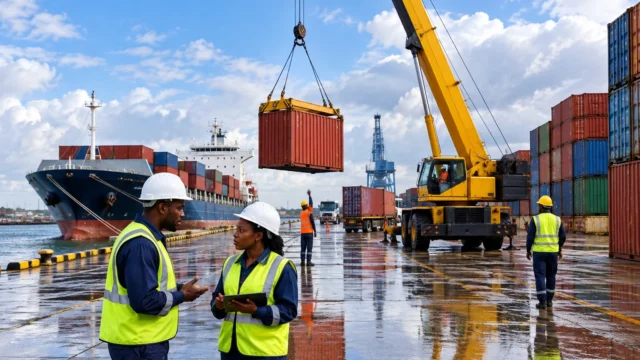
The case also centres on the Lobito Corridor, one of the most closely watched logistics projects in southern Africa. The rail and port corridor is intended to link Angola’s port of Lobito to mining areas in the Democratic Republic of the Congo and Zambia. Washington sees it as an alternative to routes controlled by other players, particularly China, and has provided a $550m loan to rehabilitate the line.
This dimension explains why the Angolan case is attracting attention well beyond Luanda. If influence networks are indeed trying to undermine the corridor, the stakes are not merely symbolic. They concern mineral exports, port revenues, transport-related jobs and Angola’s place in regional value chains. The corridor also links several parts of the Southern African Development Community, SADC, which has long sought to facilitate trade between the Atlantic and the continent’s interior.
Available documents and investigations describe a method now familiar in Africa: blurring the lines between cultural diplomacy, lobbying, fake media and the mobilisation of local intermediaries. In the Angolan case, the announced opening of a Russian House in Luanda is alleged to have provided cover for approaches to political officials, journalists and activists. Several independent investigations have already shown that this combination of culture, information and influence is a recurring feature of Russia’s strategy on the continent.
What Angola wants to protect, and what Africa is watching
For the Angolan authorities, the case has an obvious political advantage: it allows them to take a tough line against alleged foreign interference. But it also raises a broader question. How can ordinary cultural co-operation be distinguished from an influence operation in an environment where foreign powers are multiplying soft-power initiatives, economic partnerships and media channels? The answer matters to other African capitals facing the same patterns.
For the population, the stakes are even more tangible. Fuel price rises have hit urban transport, small traders and households dependent on shared taxis. By contrast, major projects such as Lobito promise economic activity, trade corridors and logistics revenues. Between these two realities, the battle for information matters as much as economic decisions, because it can calm, polarise or inflame the streets.
At continental level, the Angolan case recalls a trend already seen in the Central African Republic, Mali and Burkina Faso, as well as in debates about online disinformation: geopolitical narratives are increasingly shaped through hybrid operations, in which propaganda, social networks and local intermediaries play a central role. Angola, a southern African power and a key player on the Atlantic coast, thus finds itself at the intersection of two fault lines: domestic security and global competition for influence in Africa.
The next stage of the case now depends on the Luanda Court of Appeal. But beyond the criminal proceedings, the message is already clear: in Angola, as elsewhere on the continent, the battle to control public space, strategic infrastructure and public opinion begins well before election day.