Algeria
 Egypt
 Libya
 Morocco
 Sudan
 Tunisia
 Benin
 Burkina Faso
 Cabo Verde
 Côte d'Ivoire
 Ghana
 Guinea
 Guinea-Bissau
 Liberia
 Mali
 Mauritania
 Niger
 Nigeria
 Senegal
 Sierra Leone
 The Gambia
 Togo
 Cameroon
 Central African Republic
 Chad
 DR Congo
 Equatorial Guinea
 Gabon
 Republic of the Congo
 São Tomé and Príncipe
 Burundi
 Comoros
 Djibouti
 Eritrea
 Ethiopia
 Kenya
 Madagascar
 Malawi
 Mauritius
 Mozambique
 Rwanda
 Seychelles
 Somalia
 South Sudan
 Tanzania
 Uganda
 Botswana
 Eswatini
 Lesotho
 Namibia
 South Africa
 Zambia
 Zimbabwe
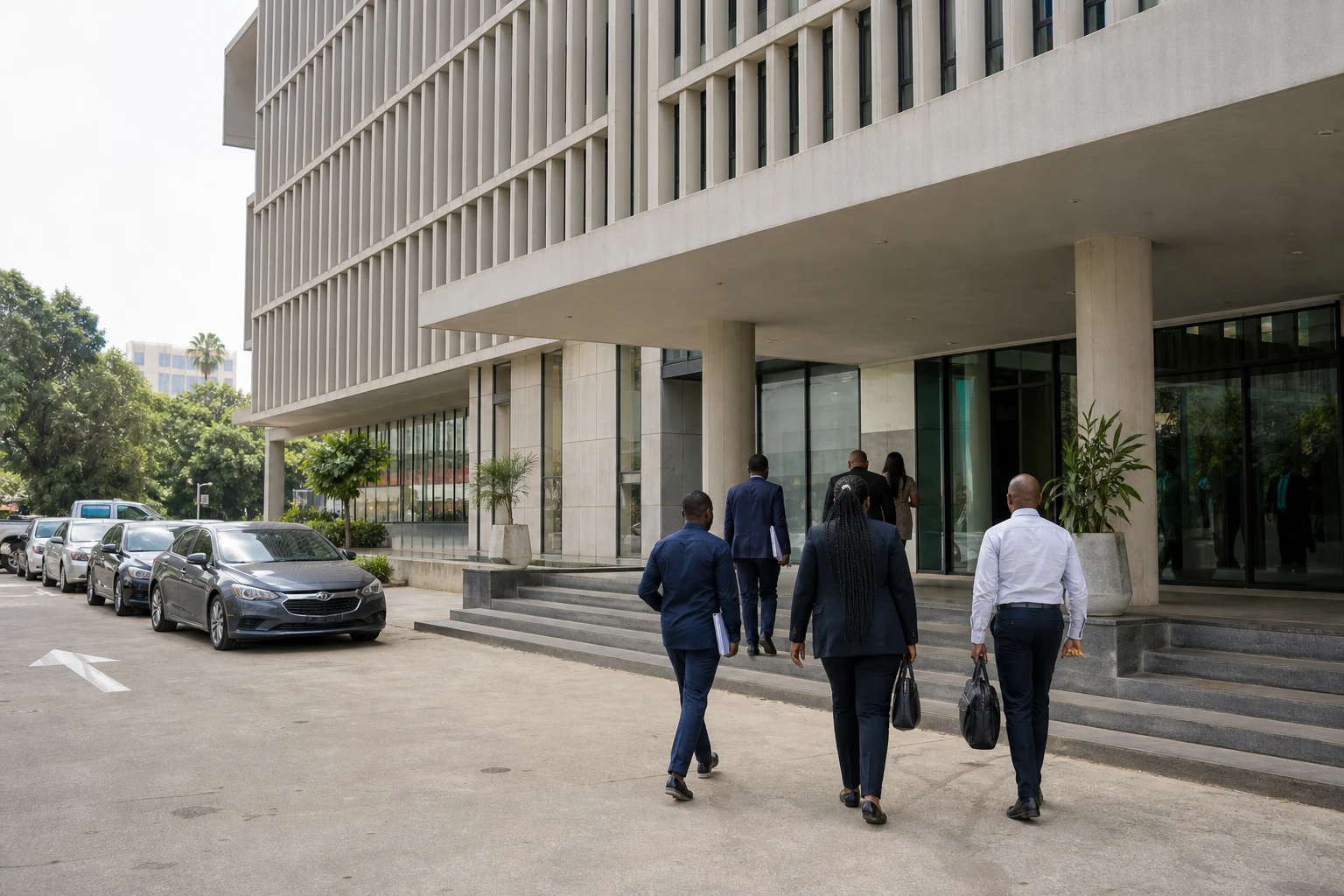
Linking the country’s interior, not just laying a road
In Angola, major transport projects are no longer just about moving goods. They also express a clear political ambition: to improve links between provinces, cut logistics costs and give Luanda greater weight in trade across Southern and Central Africa. The new road project fits into this approach as the country seeks to reduce its continued heavy dependence on oil and develop its growth corridors further.
This strategy is not emerging in a vacuum. The Angolan Regulatory Agency for Cargo Certification and Logistics (ARCCLA) already presents the national network of logistics platforms as a tool to connect strategic points across the country and position Angola as a continental gateway for goods. Meanwhile, the Ministry of Transport is highlighting the role of the Lobito Corridor and the modernisation of rail links, a sign that roads, railways and ports are now advancing together as part of territorial integration policy.
A road project still at the study stage
On 27 July, a $21 million agreement was announced to fund technical studies and the design of a future highway nearly 1,300 kilometres long. According to information made public, the route is to cross the provinces of Benguela, Huambo, Bié, Moxico and Moxico Leste, before extending towards the Democratic Republic of the Congo and Zambia. The agreement involves the National Road Institute of Angola (INEA) and the GAV Construções group, with the first phase set to last one year, during which economic, financial and traffic feasibility will be assessed.
One useful point should nevertheless be clarified for readers. In October 2024, the Angolan government had already announced another major national highway, then described as a north-south Soyo-Santa Clara link, also around 1,300 kilometres long. Official documents have therefore referred for some time to a major route spanning the country, but the names vary between announcements. The constant is the objective: to link the coast, the interior and the borders in order to facilitate trade.
This caveat is also necessary because transport infrastructure is becoming an instrument of economic strategy in Angola. The Ministry of Public Works says the country has a national road network of around 79,000 kilometres, of which 26,600 are operational, illustrating the scale of the backlog to be addressed before a genuinely continuous national network can be achieved.
What the highway could change, if it is built
On paper, the benefits are clear. A cross-country road of this scale could reduce the isolation of several inland provinces, particularly Bié and Moxico, where transport costs weigh heavily on agriculture, small-scale trade and the movement of manufactured goods. In a country where travel between urban centres, mining areas and border posts remains costly, the issue is not just speed. It also concerns the final price of goods, the safety of journeys and the reliability of supplies.
The project also has a cross-border dimension. Angolan authorities have already opened or prepared cross-border road transport services with the DRC at several points, including Luau in Moxico. A highway well connected to these posts could boost the legal movement of goods between Angola, the DRC and Zambia, two neighbours that matter to regional trade. Across Southern Africa, this aligns with the approach of SADC, the Southern African Development Community, which has long promoted multimodal corridors to open up landlocked hinterlands.
But the long timescale remains the real test. A first year of studies does not make a highway. The next steps will be to choose a financing model, allocate risks, weigh up a concession against public funding and private partners, and then secure the land required and future maintenance. The Angolan government has already said it wants to make greater use of public-private partnerships for large-scale projects, to ease pressure on the Treasury and improve project quality. This is one option, but it requires clear contracts and consistent delivery.
Beyond construction, a signal to Central and Southern Africa
The announcement says a great deal about how Angola wants to position itself in the region. Luanda is no longer relying only on its ports or the Lobito railway. The country is seeking to bring several routes together to become a transit point between the Atlantic, the continent’s interior and the markets of the DRC and Zambia. ARCCLA puts it plainly: the logistics network should help Angola become a continental platform for trade flows in the sub-region.
The stakes are also domestic. In the capital and the provinces, better connectivity can support construction jobs, transport services, agricultural markets and construction SMEs. But the benefits will not be automatic. They will depend on the quality of secondary access roads, maintenance, road safety and the state’s ability to prevent the main route from becoming an isolated showcase amid a still-disjointed network.
The timing is also consistent with other regional cooperation initiatives. In Luanda, Angolan and Congolese authorities recently reached a decisive milestone in implementing the Common Interest Zone offshore, showing that the country’s major economic balances are shaped as much on land as on the Atlantic. In this context, the road is not simply an engineering project. It is becoming a tool of economic sovereignty, regional connectivity and territorial redistribution.