Algeria
 Egypt
 Libya
 Morocco
 Sudan
 Tunisia
 Benin
 Burkina Faso
 Cabo Verde
 Côte d'Ivoire
 Ghana
 Guinea
 Guinea-Bissau
 Liberia
 Mauritania
 Niger
 Nigeria
 Senegal
 Sierra Leone
 The Gambia
 Togo
 Cameroon
 Central African Republic
 Chad
 DR Congo
 Equatorial Guinea
 Gabon
 Republic of the Congo
 São Tomé and Príncipe
 Burundi
 Comoros
 Djibouti
 Eritrea
 Ethiopia
 Kenya
 Madagascar
 Malawi
 Mauritius
 Mozambique
 Rwanda
 Seychelles
 Somalia
 South Sudan
 Tanzania
 Uganda
 Angola
 Botswana
 Eswatini
 Lesotho
 Namibia
 South Africa
 Zambia
 Zimbabwe
A rapprochement centred on energy, roads and security
In Algiers, diplomatic meetings were about more than exchanging courtesies. Above all, they highlighted a simple idea: in the central Sahara, borders matter less than the ability of neighbours to keep electricity, gas, data and security moving. The two-day visit to Algeria by Nigerien Prime Minister Ali Mahaman Lamine Zeine is part of this approach to practical neighbourhood relations, as Algeria seeks to consolidate tangible partnerships with Niger and, just before that, Mali.
The issue also goes beyond the bilateral framework. Niger, Mali and Burkina Faso have left ECOWAS, the Economic Community of West African States, and now form the Alliance of Sahel States, which has become a defining factor in regional dynamics. At the same time, Algiers continues to back trans-Saharan projects linking the Maghreb to the Sahel and, beyond it, to West Africa.
A flurry of exchanges between Algiers, Niamey and Bamako
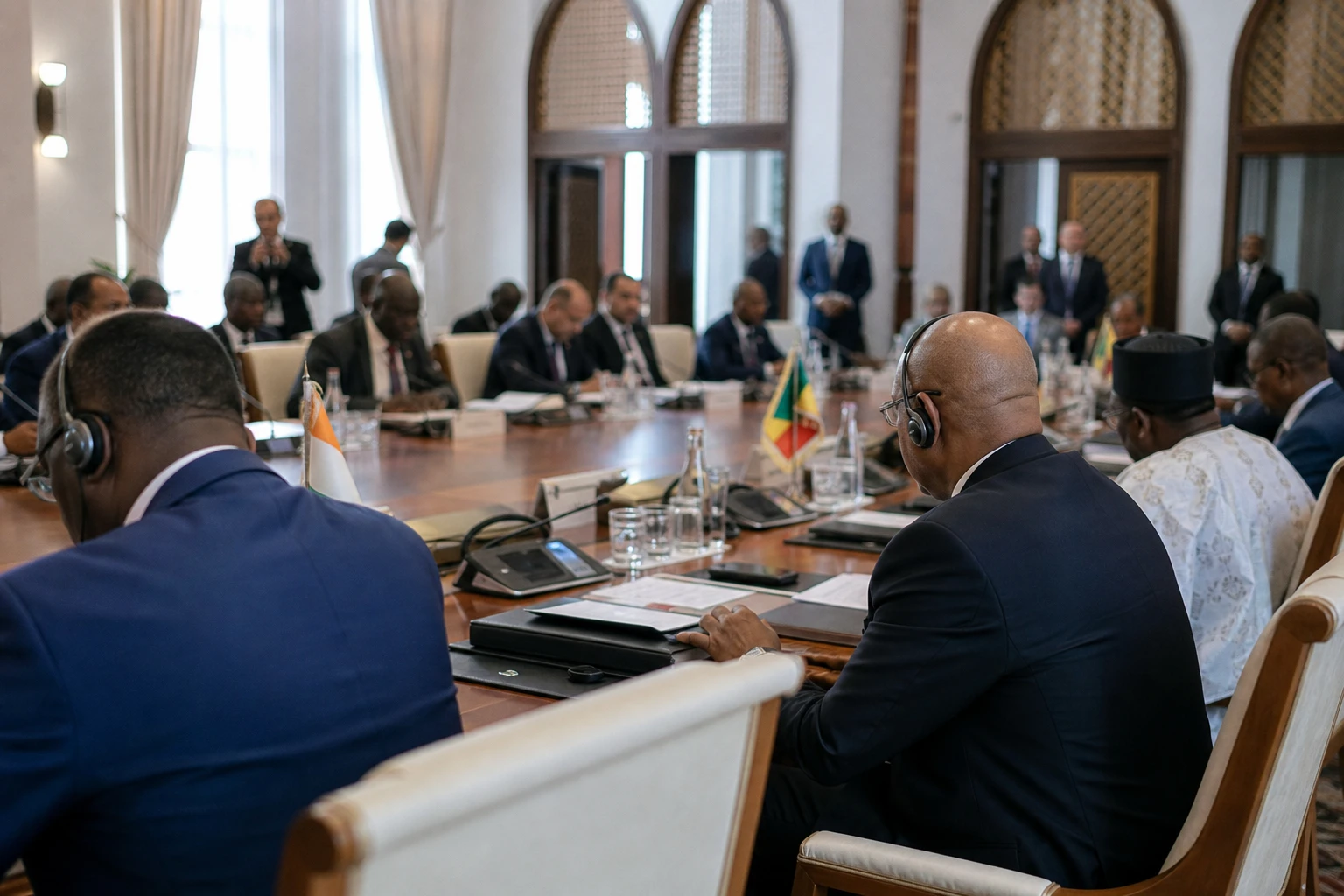
The Nigerien prime minister arrived in Algiers on the evening of Wednesday 26 August 2026, at the head of a large ministerial delegation, for a 48-hour working visit. He was welcomed by his Algerian counterpart, Sifi Ghrieb, in the presence of several members of the Algerian government, including the ministers responsible for hydrocarbons, finance, energy and telecommunications. The following day, the two heads of government held a one-to-one meeting before an expanded session on the state of bilateral cooperation and prospects for strengthening the partnership.
This sequence is no coincidence. Just days earlier, Malian Prime Minister Abdoulaye Maïga had also been received in Algiers, on 24 August 2026, amid a diplomatic thaw after more than a year of political discord between Bamako and Algiers. The Malian authorities confirmed that the visit was part of efforts to revitalise bilateral relations, with an exchange at the highest level between the two capitals.
In both cases, the interlocutors emphasised the same political vocabulary: mutual respect, sovereignty, good neighbourliness and pragmatic cooperation. The Malian government side even said that the head of government was carrying a message from transitional President Assimi Goïta to Abdelmadjid Tebboune, a sign that relations are now being handled at the highest level. On the Nigerien side, officials presented the visit as a way to consolidate a dynamic driven by Presidents Abdelmadjid Tebboune and Abdourahamane Tiani.
What was on the table
The issues discussed between Algiers and Niamey are familiar and highly practical. They included border security, economic cooperation, energy projects and infrastructure. Algeria and Niger have made progress on several projects in recent months, with the inauguration in June 2026 of a 40-megawatt power plant in Niamey, the commissioning of a drilling well at Kafra in northern Niger, and, in early August, an Algerian donation of four helicopters and military equipment to the Nigerien army.
These projects give an idea of the direction being pursued. For Niamey, they meet immediate needs: strengthening electricity supplies to the capital, developing oil exploration in the north, and supporting security capabilities in a country facing multiple threats along its borders. For Algiers, they serve a broader agenda: stabilising its Sahel-Saharan neighbourhood and turning security ties into tools of economic influence.
Major infrastructure projects were also on the agenda. The Trans-Saharan Gas Pipeline, often described as an energy corridor linking Nigeria, Niger and Algeria, reached a milestone in June 2026 with the launch of work on the Algerian section in Adrar. The African Union has long noted that the pipeline, which is about 4,200 kilometres long, and the roughly 4,500-kilometre Trans-Saharan fibre-optic link between Algeria, Niger, Nigeria and Chad are among the infrastructure projects capable of opening up the Saharan corridor over the long term.
The security backdrop remains bleak. In July 2026, the African Union condemned deadly attacks in Niger and Mali, recalling that the region remains one of the continent’s most exposed fronts. In this context, Algiers intends to retain a role as mediator and technical partner, without taking the place of Sahelian authorities or the regional organisations concerned.
Why Algiers is gaining ground with the AES
The rapprochement between Algeria and two AES states is about more than protocol. It reflects a deeper regional realignment. After withdrawing from ECOWAS, Mali, Niger and Burkina Faso are seeking partnerships that involve neither political coercion nor the prescriptive tone often criticised in outside organisations or capitals. Algiers, by contrast, offers a relationship built on a shared border, energy interdependence and long experience of Sahelian affairs.
This stance gives Algeria a symbolic advantage. It presents itself as a southern neighbour, not a patron. It is betting on visible projects, such as electricity in Niamey, exploration at Kafra, the Trans-Saharan Gas Pipeline and fibre optics, rather than general statements about stability. For people, especially in border areas and capitals facing pressure on energy and transport, the stakes are tangible: access to electricity, the movement of goods, jobs linked to construction projects, and better security coordination.
Mali and Niger also see this as a useful diplomatic signal. After periods of tension, direct talks with Algiers offer additional room for manoeuvre in a region where divisions remain numerous: between Saharan states and coastal countries, between security imperatives and development needs, and between sovereignist ambitions and technical constraints. The fact that Algiers received Bamako and then Niamey within three days shows that relations with the AES are no longer merely reactive; they are becoming an explicit pillar of foreign policy.
A regional significance that goes beyond the visit
The continental significance is clear. If the trans-Saharan projects move forward, they will further connect the Maghreb with the Sahel and West Africa. They could also serve as a model for other African corridors: fewer abstract speeches, more shared infrastructure and greater cooperation between neighbouring states. The African Union had already highlighted the strategic importance of these links for trade, integration and development in 2018.
One essential condition remains: continuity. The Trans-Saharan Gas Pipeline, fibre-optic link and security agreements will have lasting effects only if the three countries involved stay the course despite political uncertainty, border tensions and budget constraints. The next step to watch will therefore be the translation of these announcements into construction timetables, funding and monitoring mechanisms, at a time when Sahelian stability remains fragile and every tangible advance matters more than another communiqué.