Egypt
 Libya
 Morocco
 Sudan
 Tunisia
 Benin
 Burkina Faso
 Cabo Verde
 Côte d'Ivoire
 Ghana
 Guinea
 Guinea-Bissau
 Liberia
 Mali
 Mauritania
 Niger
 Nigeria
 Senegal
 Sierra Leone
 The Gambia
 Togo
 Cameroon
 Central African Republic
 Chad
 DR Congo
 Equatorial Guinea
 Gabon
 Republic of the Congo
 São Tomé and Príncipe
 Burundi
 Comoros
 Djibouti
 Eritrea
 Ethiopia
 Kenya
 Madagascar
 Malawi
 Mauritius
 Mozambique
 Rwanda
 Seychelles
 Somalia
 South Sudan
 Tanzania
 Uganda
 Angola
 Botswana
 Eswatini
 Lesotho
 Namibia
 South Africa
 Zambia
 Zimbabwe
A tragedy that goes beyond a single driving error
On a coastal road in Boumerdès, the crash did more than claim lives. It also reignited a simple, much broader question: how could a public transport coach have been on the road in such a condition, carrying too many passengers and with a driver suspected of being under the influence of drugs? In Algeria, where road safety remains a public health issue as much as an administrative one, this kind of accident lays bare the entire chain of checks, from departure in a wilaya to the final monitoring post.
This is not the country’s first warning sign. The Civil Protection service regularly publishes grim figures, week after week, and accidents involving buses or coaches continue to feature in reports of serious incidents. In Boumerdès province, the issue resonates particularly strongly: a densely connected area close to Algiers, crossed by busy roads where local traffic meets inter-provincial journeys.
Facts established by the preliminary investigation
On 31 July, at about 9.40am, a coach that had set off from Sétif overturned on the RN24, at a place known as El Kerma, between Boumerdès and Zemmouri. The authorities later revised the toll to 27 dead and 42 injured. The vehicle was carrying 64 people, although its regulated capacity was 51, including the driver. It was descending a slope at 121.63 km/h on a stretch where the speed limit was 60 km/h. The driver, aged 33 and killed in the accident, tested positive for several drugs; two psychotropic tablets were also found in his clothes.
These details carry significant weight, but they do not in themselves explain the tragedy. They point first to serious individual wrongdoing. They also indicate a collective failure: overloading accepted at departure, a vehicle allowed to operate, absent or inadequate roadside checks, and evidently deficient medical screening. In public transport, responsibility never ends at the steering wheel. It also involves the operator, intermediaries who sell seats and the services responsible for inspections.
The public prosecutor’s office attached to the Boumerdès Court of Appeal has not, at this stage, disclosed the exact nature or dosage of the substances. This is an important point. In criminal proceedings, precise classification matters as much as the initial findings, especially when a driver dies in the accident and can no longer respond. The justice system will therefore have to reconstruct the vehicle’s journey, the circumstances of the driver’s recruitment and the arrangements for the coach’s departure from Sétif.
A legal framework already tightened, but still unevenly enforced
The tragedy occurred after Algeria had already strengthened its legal arsenal. Law No. 26-09, published in the Official Gazette on 17 May 2026, requires drivers of public transport, school transport, goods vehicles and taxis to hold a professional certificate and a medical certificate, and to undergo tests confirming they have not used drugs. It also provides for periodic and unannounced tests while they are working. The same law allows medical, clinical and biological examinations after an accident involving bodily injury, including on the body of a driver who has died.
This change forms part of a political sequence that predates the tragedy. On 2 November 2025, President Abdelmadjid Tebboune called for the draft highway code to clearly establish the responsibilities of all parties concerned. He also stressed the need for more rigorous checks. In other words, the regulatory framework now exists. The real question is how it is enforced on the ground, from bus depots to inspection checkpoints.
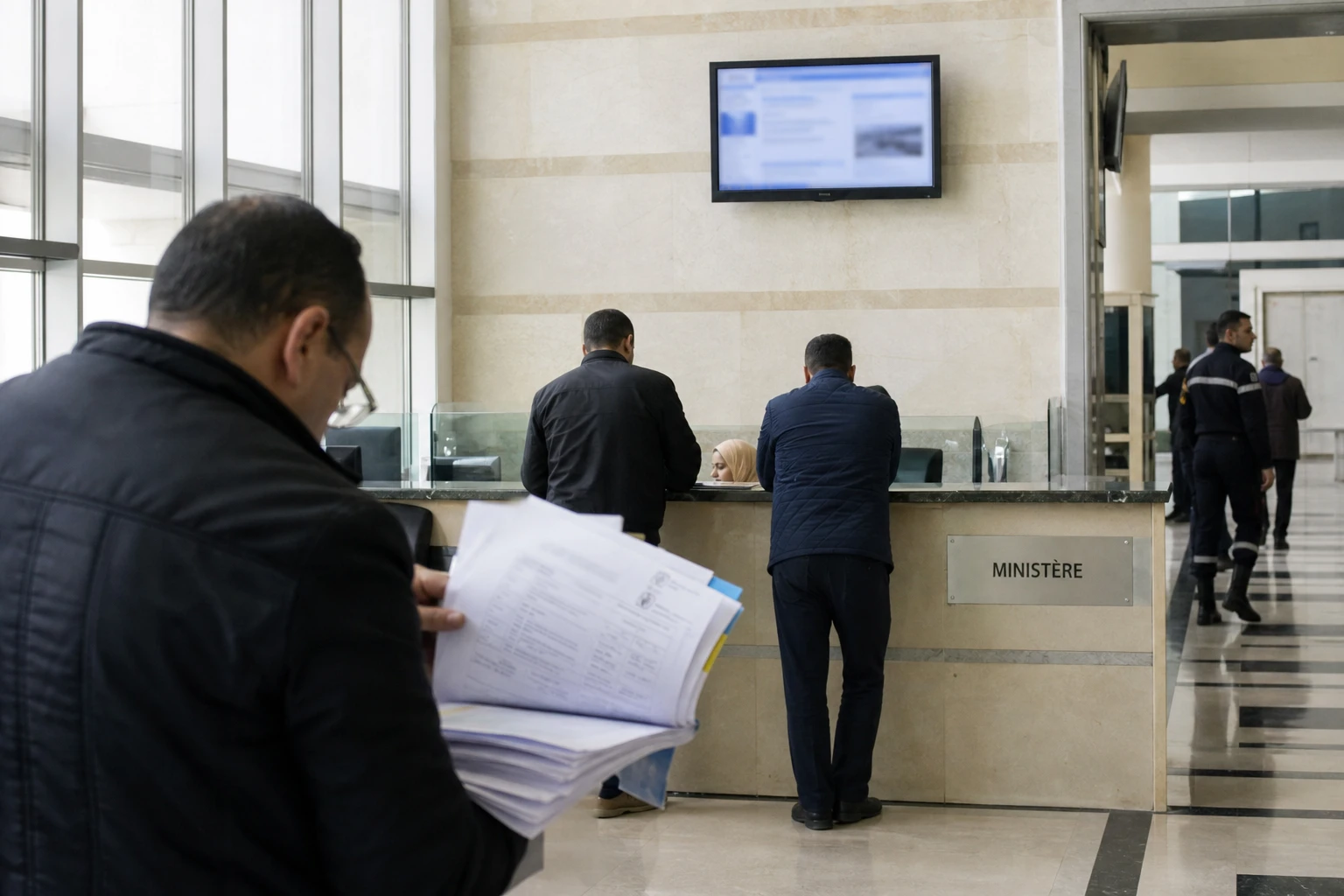
The Ministry of the Interior, Local Authorities and Transport, led by Saïd Sayoud, is at the centre of this requirement. The portfolio brings together oversight of the sector and some of the inspection services. In practice, this weakens the argument that there is a lack of co-ordination. What matters now are public figures: how many drug tests have been carried out, how many driving licences have been suspended, how many vehicles have been taken off the road for overloading, and in which wilayas. Without this data, the reform remains theoretical.
Beyond Boumerdès, a test for the entire prevention policy
The issue extends beyond Boumerdès province. In North Africa, trafficking in synthetic drugs and the diversion of psychotropic medicines remain genuine concerns, particularly along some cross-border corridors. The discovery of the tablets in the driver’s clothes does not, by itself, prove anything about their origin. But it is a reminder that road safety cannot be addressed without health policy, controls on substances and monitoring of supply networks.
For families, the impact is immediate and irreversible. For transport operators, the episode may herald tougher checks and therefore higher compliance costs. For passengers, particularly residents of inland wilayas who rely heavily on intercity transport, the issue is simple: to board a safer vehicle and know that checks take place before, during and after departure. That is where the reform takes on practical meaning.
At a regional level, Algeria is also sending the African Union a signal on a frequently overlooked issue: the safety of everyday mobility. Roads, coaches and shared taxis structure the daily lives of millions of Africans. When a state tightens its rules, it must also be able to enforce them. The next point to watch, then, will be less the political rhetoric than the publication in the coming weeks of verifiable inspection measures and quantified results.