Egypt
 Libya
 Morocco
 Sudan
 Tunisia
 Benin
 Burkina Faso
 Cabo Verde
 Côte d'Ivoire
 Ghana
 Guinea
 Guinea-Bissau
 Liberia
 Mali
 Mauritania
 Niger
 Nigeria
 Senegal
 Sierra Leone
 The Gambia
 Togo
 Cameroon
 Central African Republic
 Chad
 DR Congo
 Equatorial Guinea
 Gabon
 Republic of the Congo
 São Tomé and Príncipe
 Burundi
 Comoros
 Djibouti
 Eritrea
 Ethiopia
 Kenya
 Madagascar
 Malawi
 Mauritius
 Mozambique
 Rwanda
 Seychelles
 Somalia
 South Sudan
 Tanzania
 Uganda
 Angola
 Botswana
 Eswatini
 Lesotho
 Namibia
 South Africa
 Zambia
 Zimbabwe
Hospitals under pressure, families in shock
In several African countries, health and social news points to the same reality: when care systems falter, the most vulnerable are the first to suffer. In the east of the Democratic Republic of the Congo, Ebola is resurging amid exhausted medical teams and pressure on treatment centres. In Algeria, a deadly fire at a facility for children has starkly highlighted the safety requirements facing care institutions.
In both cases, the issue is not simply a news incident or an epidemic. It concerns the ability of states to protect, treat and provide assistance quickly, especially when a crisis unfolds away from the spotlight and far from political capitals.
In the DRC, Ebola spreads as an emergency response takes shape
The World Health Organization has confirmed that the Ebola outbreak in the Democratic Republic of the Congo, declared in spring 2026, has spread to several health zones and remains under close surveillance. The WHO Regional Office for Africa says it is the 17th outbreak recorded in the country since the virus was identified in 1976 in Yambuku. The organisation also reported in early July that the alert had been extended to three additional health zones in the affected province.
The WHO director-general warned on 16 July that the disease was spreading faster than in previous outbreaks. That assessment says it all: in a vast country marked by population displacement, the speed with which cases are detected and isolated matters as much as the medical resources available. The WHO and its partners have stressed the importance of treatment centres, rapid isolation and prevention in health facilities.
The fragility of the response is not down to the virus alone. In Rwampara, in the north-east of the country, treatment-centre employees went on strike on 13 July to demand unpaid wages and bonuses, according to reports carried by the press. This kind of labour dispute, at the heart of an emergency health response, is a reminder that an epidemic also depends on budgets, pay, logistics and trust between teams and authorities.
For residents, the stakes are immediate. Health centres, displaced families and rural areas dependent on a single medical facility do not have the same capacity to cope. When health workers and resources are lacking, the response chain quickly becomes fragile. In eastern Congo, where crises often overlap, Ebola is therefore as much a test of public governance as a health challenge.
Algeria, Morocco, Senegal and Sudan: four episodes, four power dynamics
In Mohammadia, in the eastern suburbs of Algiers, a fire killed 11 children and injured 19 others at a care facility, according to Algeria’s Civil Protection agency and the public news agency APS. The authorities said the fire broke out at dawn. President Abdelmadjid Tebboune offered his condolences, while rescue teams continued to monitor the injured.
This tragedy raises a simple but weighty question: how can adequate safety standards be ensured in facilities that care for children most dependent on the state? Here, responsibility does not end with emergency services. It encompasses building maintenance, inspections, evacuation plans and day-to-day vigilance. In such circumstances, child protection ceases to be an administrative slogan. It becomes a material obligation.
In Morocco, the Franco-Moroccan high-level meeting in Rabat confirmed the return to smoother political relations between Paris and Rabat. Official French and Moroccan websites say that Sébastien Lecornu took part in the 15th high-level meeting on 16 July, as the two countries work on a bilateral treaty described as unprecedented in France’s relationship with a country outside the European Union. France’s foreign ministry, for its part, spoke of a “reinforced exceptional partnership” after the 2024 state visit.
This episode goes beyond diplomatic language. For Rabat, it bolsters a strategy of diversifying partnerships and upgrading economic, academic and cultural exchanges. For Paris, it also helps consolidate a useful relationship in the Mediterranean, the connected Sahel, and migration and trade networks. The prospect of a visit to France by King Mohammed VI, reported in several media outlets, fits into this logic of strengthened normalisation.
In Senegal, the announced visit by Macky Sall to Dakar to meet Bassirou Diomaye Faye adds another layer. The former president said the trip was part of his efforts related to his candidacy for the post of UN secretary-general, while the public news agency APS notes that the meeting comes at a time of political realignment in the country. Senegal has only just emerged from an intense electoral period, with a new majority and persistent tensions between the head of state and his former political camp.
In Sudan, meanwhile, a court in an area held by the army has sentenced Mohamed Hamdan Daglo, known as Hemedti, the head of the Rapid Support Forces, to death in absentia for war crimes, crimes against humanity and genocide linked to West Darfur, according to the Sudanese press and the UN. At the same time, the United Nations has warned that the city of El-Obeid, in North Kordofan, remains exposed to heavy drone attacks, with civilians caught in a de facto siege.
A continent facing interconnected crises and new uses of technology
The Boko Haram issue adds another dimension to this week’s African news. Research by the University of Cambridge, reported by several specialist media outlets, indicates that members of the jihadist group have used artificial intelligence tools for planning, logistics and certain operational tasks. Other academic and security publications note that AI has become an arena of both civilian and military competition, with non-state armed actors putting it to illicit uses.
For Nigeria and the Lake Chad Basin, this means the threat is evolving. Armed groups are innovating not only with weapons. They are also testing tools for translation, information retrieval, writing and tactical support. The response from the countries bordering the lake will therefore need to combine security, intelligence, digital regulation and the prevention of radicalisation.
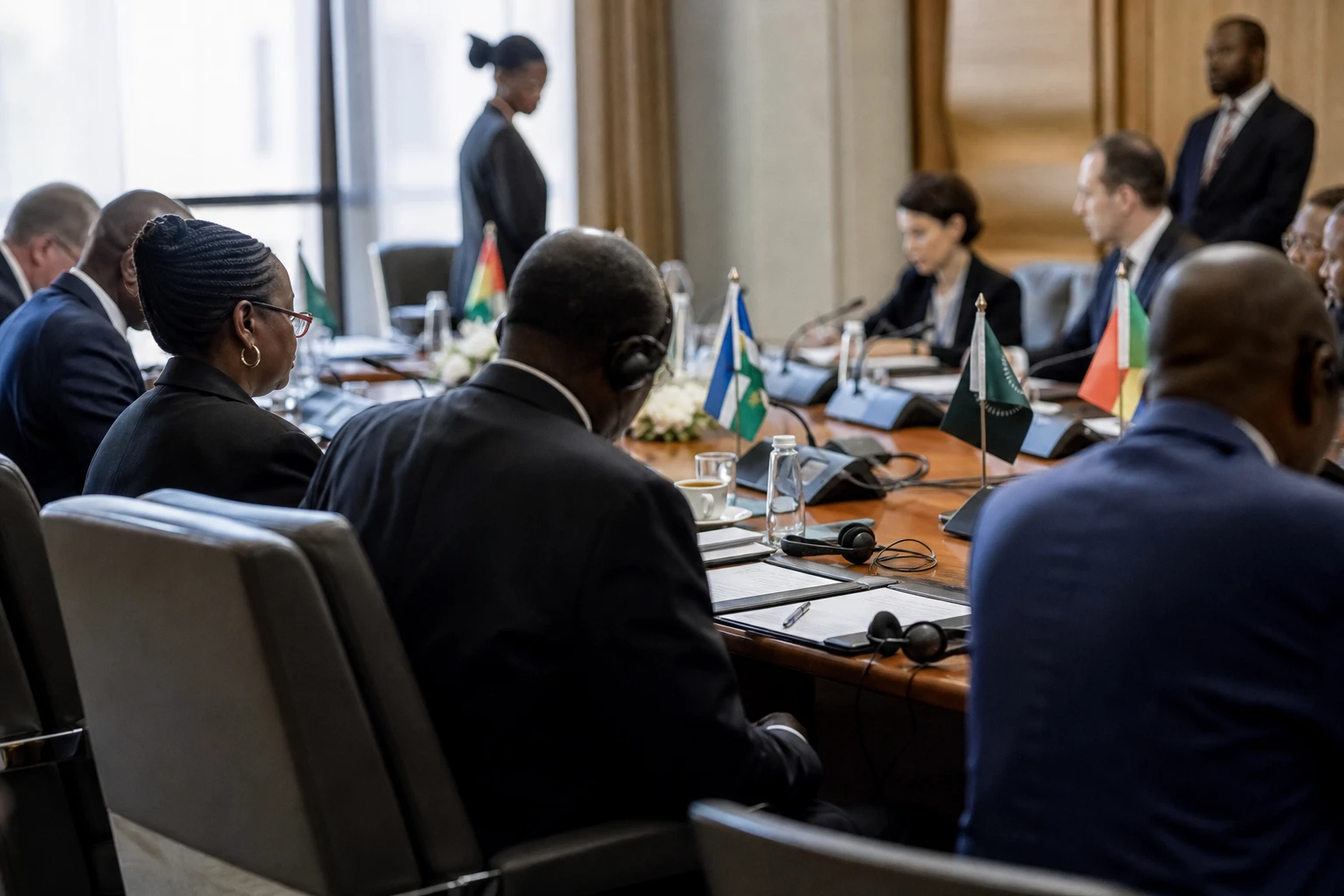
Taken together, these events sketch out the same picture: an Africa where health emergencies, civilian tragedies, diplomatic recalibrations and armed conflicts no longer follow separate paths. The Democratic Republic of the Congo, Algeria, Morocco, Senegal, Sudan and Nigeria do not occupy the same political space, but each reveals one piece of the continental puzzle. The African Union, the regional communities concerned and national institutions will be judged on one common measure: their ability to respond without delay, with concrete resources, to crises that spread quickly and combine even faster.