Algeria
 Egypt
 Libya
 Morocco
 Sudan
 Tunisia
 Benin
 Burkina Faso
 Cabo Verde
 Côte d'Ivoire
 Ghana
 Guinea
 Guinea-Bissau
 Liberia
 Mali
 Mauritania
 Niger
 Nigeria
 Senegal
 Sierra Leone
 The Gambia
 Togo
 Cameroon
 Central African Republic
 Chad
 DR Congo
 Equatorial Guinea
 Gabon
 Republic of the Congo
 São Tomé and Príncipe
 Burundi
 Comoros
 Djibouti
 Eritrea
 Ethiopia
 Kenya
 Madagascar
 Malawi
 Mauritius
 Mozambique
 Rwanda
 Seychelles
 Somalia
 South Sudan
 Tanzania
 Uganda
 Angola
 Botswana
 Eswatini
 Lesotho
 Namibia
 South Africa
 Zambia
 Zimbabwe
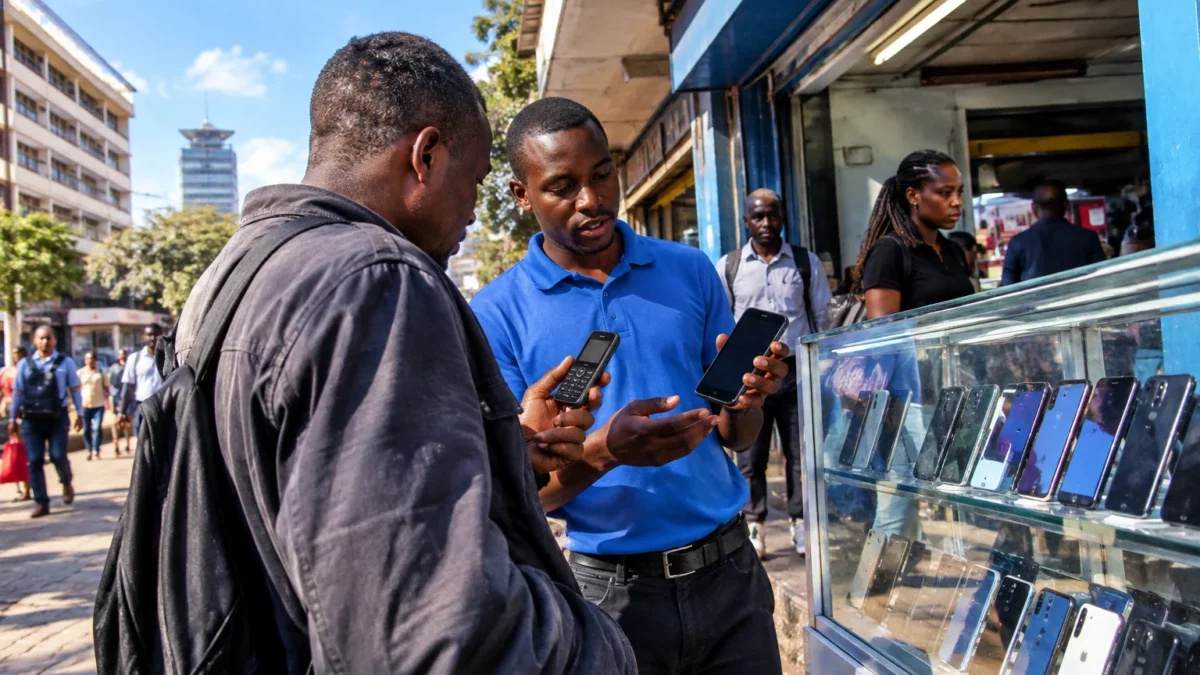
A connected phone is becoming harder for many African households to replace. The rise in the average price masks a more immediate reality: the cheapest devices are disappearing from the market, while some buyers are putting off upgrades or returning to basic phones.
Entry-level segment slumps
Between July and September 2026, smartphone shipments to Africa fell by 40% year on year, to 13.7 million units from 22.8 million. This was the sharpest quarterly decline in three years, following three years of third-quarter growth. The figures, published on 23 November by research firm Omdia, were also reported by South African media outlet ITWeb Africa.
The slump is concentrated in the lower end of the market. Shipments of smartphones selling for less than $100 fell by nearly 70%. At the same time, shipments of basic phones, which offer limited access to the internet and apps, rose by 27%.
The average price of a smartphone reached $222, its highest level for a third quarter in ten years. Yet the market’s total value fell by 15%. This combination does not mean consumers are choosing more expensive models: it mainly reflects falling sales and the growing share of more costly devices in the purchases that remain.
Omdia links this pressure to rising component costs, particularly memory, as demand from data centres dedicated to artificial intelligence increases. Selling at low prices is becoming less profitable for manufacturers. They are cutting or revising some offers rather than sacrificing their margins to gain market share.
Same trend, different national constraints
The contraction is affecting several major markets, but its scale varies. In Nigeria, shipments fell by 47%. Omdia cites pressure on purchasing power linked to fuel costs after subsidies were removed, as well as difficulties accessing the dollars needed to pay for imports.
In Egypt, the decline reached 41%. The weakness of the Egyptian pound and inflation have made imported and locally assembled devices more expensive. In Kenya, shipments fell by 35%, while those of models priced below $150 dropped by 44%. Credit purchases and instalment payments are taking on a growing role, without removing the total cost borne by households.
South Africa recorded a more limited decline of 20%. More established operator retail networks, contract upgrades and a diverse range of retailers helped cushion the fall. But household budgets remain under pressure and replacement cycles are lengthening.
These differences show how a continental figure encompasses markets with distinct currencies, distribution channels and financing options. Consumers who pay cash and cannot access operator offers are particularly exposed. Some keep their devices for longer; others turn to refurbished phones or basic handsets.
Brands adapt to a more selective market
Transsion, the Chinese group that markets TECNO, Infinix and itel, among other brands, remains the continent’s largest supplier by volume. Its shipments nevertheless fell by 43%, to 6.6 million units, and its market share dropped from 51% to 48%. Its strong presence in affordable models leaves it more exposed to the contraction in the segment below $100.
Samsung held up better than the other leading suppliers. Its shipments fell by 8%, while its market share rose to 23%. Omdia attributes this to its relationships with operators and its Galaxy A range. The A07 4G and A17 4G models together accounted for 56% of the group’s shipments in Africa during the quarter.
Other results show that the downturn is not affecting all brands in the same way. Xiaomi recorded a 49% decline, HONOR 14% and OPPO 69%. For OPPO, Omdia cites a reorganisation linked to the integration of Realme. These figures refer to shipments to distributors, not directly to sales made in shops.
Tax and credit will shape what comes next
Omdia forecasts a 23% decline in smartphone shipments for 2026 as a whole, followed by a 25% fall in 2027. These are projections, not confirmed results. Their trajectory will depend in particular on component costs, national currencies and households’ ability to finance a device.
Possible responses vary by country. Morocco has cut import duties on smartphones from 17.5% to 2.5%. In South Africa and its other African markets, Vodacom offers financing for prepaid devices. In Nigeria, Vivo has partnered with lender Credit Direct; in Kenya, M-KOPA is continuing to develop its financing model.
These schemes can reduce the amount payable upfront, but credit does not necessarily make a device cheaper over time. The central question therefore remains the availability of affordable offers: prices, availability, import costs and financing solutions must come together without placing an excessive burden on households.
For African countries, the issue goes beyond one quarter’s sales. Access to a smartphone underpins some digital uses, services and economic activities. The decline in entry-level devices therefore makes national tax choices and operator strategies worth monitoring, without treating a continental market as a uniform situation.