Algeria
 Egypt
 Libya
 Morocco
 Sudan
 Tunisia
 Benin
 Burkina Faso
 Cabo Verde
 Ghana
 Guinea
 Guinea-Bissau
 Liberia
 Mali
 Mauritania
 Niger
 Nigeria
 Senegal
 Sierra Leone
 The Gambia
 Togo
 Cameroon
 Central African Republic
 Chad
 DR Congo
 Equatorial Guinea
 Gabon
 Republic of the Congo
 São Tomé and Príncipe
 Burundi
 Comoros
 Djibouti
 Eritrea
 Ethiopia
 Kenya
 Madagascar
 Malawi
 Mauritius
 Mozambique
 Rwanda
 Seychelles
 Somalia
 South Sudan
 Tanzania
 Uganda
 Angola
 Botswana
 Eswatini
 Lesotho
 Namibia
 South Africa
 Zambia
 Zimbabwe
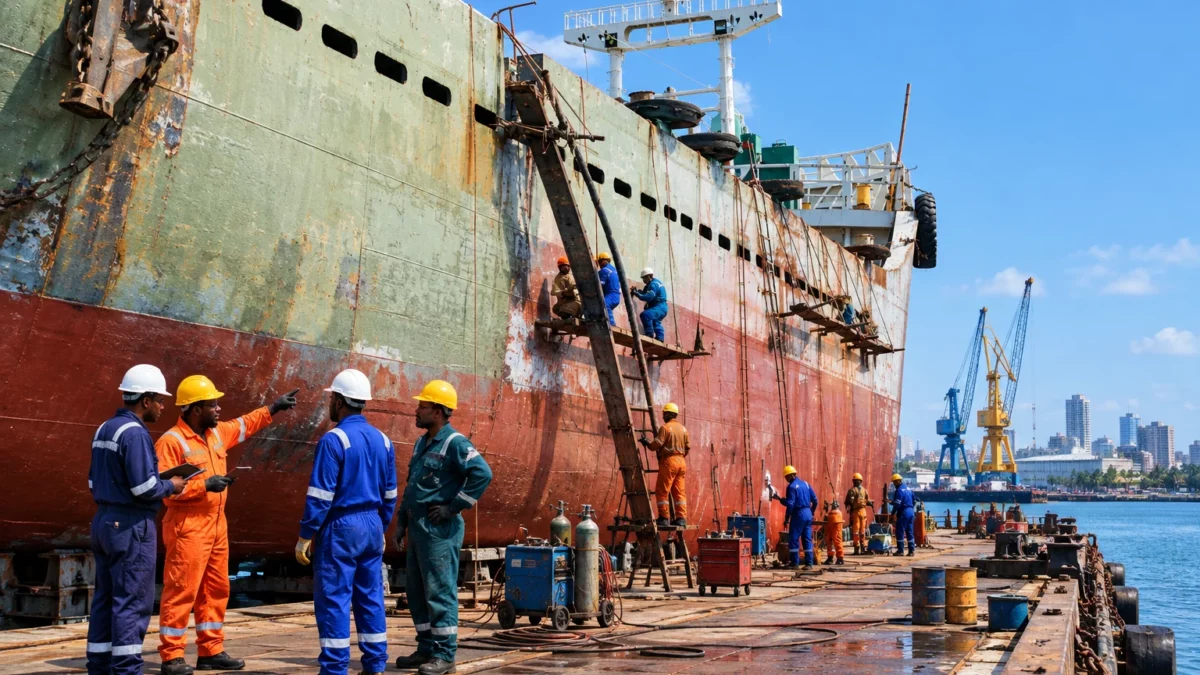
Repairing a ship far from its home port can cost time and complicate a shipowner’s operations. In Abidjan, new equipment aims to keep more of this work in the region while strengthening industrial skills in Côte d’Ivoire.
New capacity in an expanding port
The Port of Abidjan plays a major role in trade for Côte d’Ivoire and its landlocked neighbours. Burkina Faso, Mali and Niger, in particular, rely on West African port corridors to move their goods. Côte d’Ivoire is a member of ECOWAS, the Economic Community of West African States, which brings together countries linked by regional trade and infrastructure.
The port complex saw activity increase in 2024. Côte d’Ivoire’s transport ministry says cargo traffic reached 40.1 million tonnes, up from 34.7 million in 2023. The number of port calls rose from 2,482 to 2,595. These volumes cover the entire port, not ship repair alone. They nevertheless give an indication of the demand that port services must meet. Port statistics published by the transport ministry also report the commissioning of a second container terminal and work on the Vridi Canal.
In this context, ship repair is a less visible but essential link. A floating dock allows a vessel to be lifted out of the water so its hull can be inspected and maintenance or repair work carried out. The greater the lifting capacity, the larger the vessels the yard can handle.
Twenty ships reported in 12 months
CARENA, a shipyard based in Abidjan and a subsidiary of the AGL and SOFIA groups, took delivery of a 12,000-tonne floating dock in October 2025. The Port of Abidjan says the facility measures 144 metres by 48 metres and represents an investment of 12.5 billion CFA francs. It joins two existing docks, with capacities of 2,000 and 10,000 tonnes. The port’s statement on the dock’s delivery says it is intended to handle larger vessels and boost the shipyard’s capacity.
One year after it entered service, CARENA says it has handled 20 ships using this facility alone, accounting for nearly 800,000 working hours. The company also says it received 20 more ships than in the previous year. These figures come from the company’s own account; they could not be found in an independent publication that would allow them to be verified separately. They should therefore be read as figures reported by the operator, rather than as an audited record.
The work cited includes repair, maintenance and dry-docking, meaning work on a ship’s hull. CARENA chief executive Jean-François Arhant describes the first year as confirmation of the investment and highlights the role of the teams. The work draws on specialist trades including mechanics, propulsion, metal fabrication, pipefitting and surface treatment.
Benefits beyond the shipyard
For shipowners, repair capacity available in the region can reduce journeys to more distant yards and make it easier to schedule time out of service. The dock alone does not guarantee shorter turnaround times or lower costs: these outcomes also depend on the availability of spare parts and teams, port access and the workload. Technical capacity is nevertheless an important condition for retaining a share of operations locally.
The skills involved can also benefit Côte d’Ivoire’s industrial sector. Ship repair brings together specialisms that serve other port and industrial activities. CARENA says the work has helped develop the skills of its Ivorian teams. However, the company’s account does not detail the number of employees trained, qualifications gained or share of local suppliers. These indicators would help provide a more precise measure of the impact on employment and the national economy.
The benefits are not automatically shared among all stakeholders. Maritime operators and companies based in the port area are the first to benefit from access to maintenance capacity. For employees, the issues are training, safety and continuity of employment. For local businesses, the outcome depends on their ability to win subcontracting contracts and join the shipyard’s supply chains.
Regional competition is the next test
The dock strengthens Abidjan’s technical offering in a West African region where ports are seeking to attract calls and associated services. Port performance is therefore measured by more than cargo volumes. It also depends on the range of services available nearby, the reliability of operations and the ability to meet the needs of ships of different sizes. The Port of Abidjan presents ship repair as a lever for its regional positioning; CARENA is a private operator in this port ecosystem.
What happens next will depend on sustained use of the facility: the number and profile of ships received, the regularity of operations, workplace safety and technician training. Publishing detailed data would also make it possible to distinguish activity directly linked to the new dock from that of CARENA’s other facilities. For now, the figures of 20 ships and 800,000 hours point to a start that the company describes as strong, while the port context confirms growing regional demand.