Algeria
 Egypt
 Libya
 Morocco
 Sudan
 Tunisia
 Benin
 Burkina Faso
 Cabo Verde
 Côte d'Ivoire
 Guinea
 Guinea-Bissau
 Liberia
 Mali
 Mauritania
 Niger
 Nigeria
 Senegal
 Sierra Leone
 The Gambia
 Togo
 Cameroon
 Central African Republic
 Chad
 DR Congo
 Equatorial Guinea
 Gabon
 Republic of the Congo
 São Tomé and Príncipe
 Burundi
 Comoros
 Djibouti
 Eritrea
 Ethiopia
 Kenya
 Madagascar
 Malawi
 Mauritius
 Mozambique
 Rwanda
 Seychelles
 Somalia
 South Sudan
 Tanzania
 Uganda
 Angola
 Botswana
 Eswatini
 Lesotho
 Namibia
 South Africa
 Zambia
 Zimbabwe
When a billboard stops selling
In Accra, an advertising space can now tell a story other than the promise of a new product. It can show what comes afterwards: clothes already worn, sorted, discarded and then dumped on the coast or in landfills. In this Ghanaian city, artist and civil engineer Emmanuel Aggrey Tieku has chosen to turn commercial imagery towards reality.
The gesture takes on meaning in a country where the second-hand clothing market is both a resource and a dead end. Ghana belongs to ECOWAS, the Economic Community of West African States, which has 12 member states today, and Accra occupies a central political and commercial position within it. But the capital has also become a focal point for a textile flow that is difficult to absorb.
A project born between Accra and Paris
Emmanuel Aggrey Tieku, born in Cape Coast and based in Ghana, works between Accra and Paris. Ellipse Art Projects describes him as the 2025 winner of the Prix ellipse, dedicated this year to Ghana’s art scene. The institution says he presented a series of works around a long-term project, How to Heal a Broken World.
His approach is based on a simple but powerful idea: to use textiles not as decoration, but as evidence. In his installations, fabrics collected from beaches, dumps and Kantamanto market become raw material and social document. In them, the artist reads the effects of a global economy of overconsumption, as well as the traces of a colonial legacy that continues to weigh on the movement of goods.
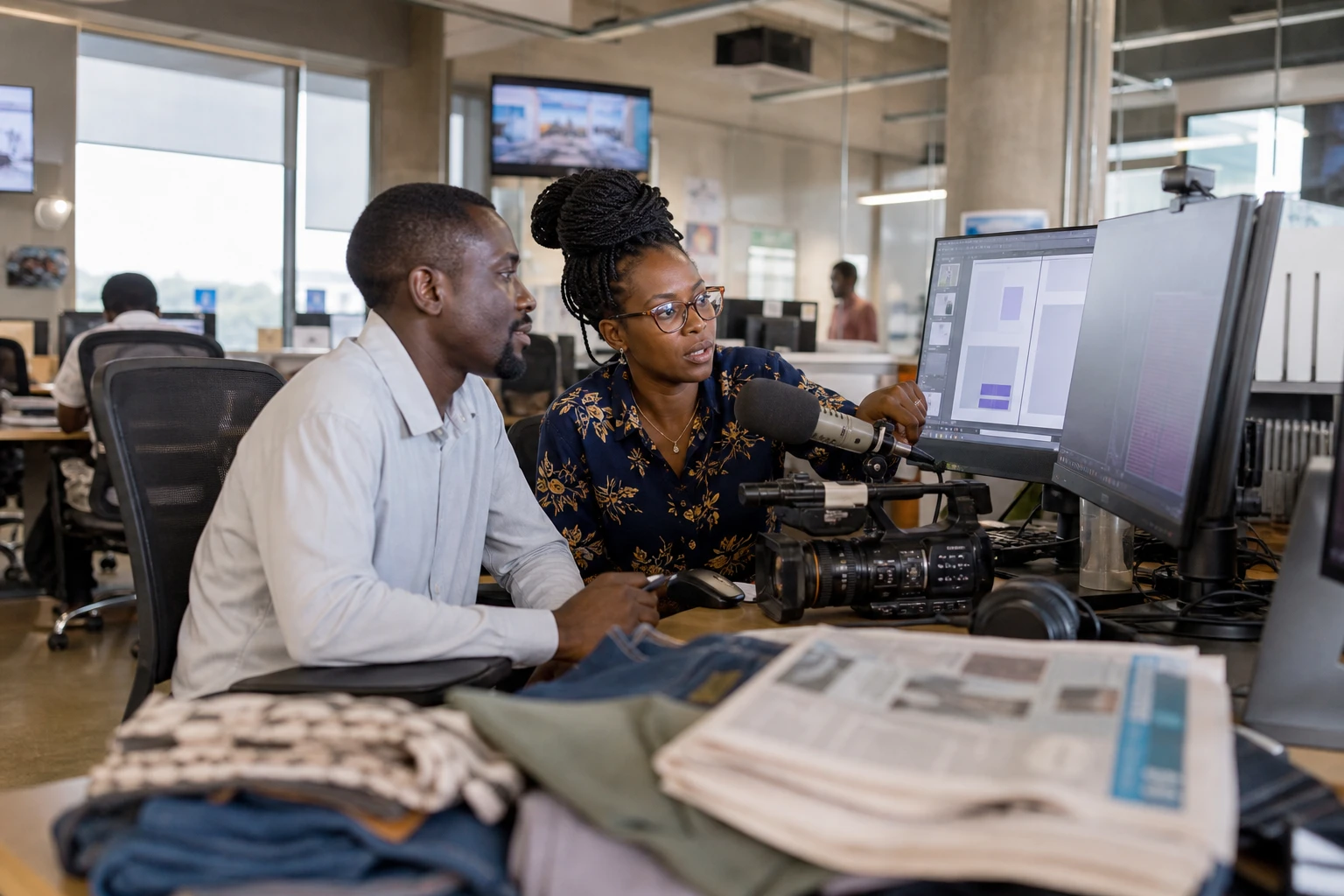
It was in this vein that Baleboards was born, a blend of bale and billboards. The project repurposes a tool of commercial persuasion to display raw material: shirts, T-shirts and worn fabrics assembled in a monumental cascade. The message is no longer “buy”, but “look at what remains”.
Kantamanto market, shop window and dumping ground
In Accra, Kantamanto market is one of the main centres for the resale of second-hand clothes in West Africa. Estimates vary by source, but several investigations point to a common figure: about 15 million second-hand items arrive there each week, and a significant share quickly becomes unusable. Some sources say 40% of textiles cannot be sold; others describe a mass of clothing that ends up each week in open spaces, drains, dumps or on beaches.
This reality affects more than just sellers. It impacts repairers, seamstresses, informal waste pickers and residents of coastal neighbourhoods. Accra’s beaches already bear the scars of this globalised trade: textiles tangled in the sand, synthetic fibres dispersed in the water, and waste that eventually reaches the Gulf of Guinea. Ghana’s Environmental Protection Agency and Accra’s municipal authorities have also called for more sustainable approaches to textile waste management.
The paradox is well known in Ghana. Second-hand clothing sustains a popular economy, offers affordable prices and supports a chain of sorting, sewing and resale. But the rise of fast fashion produces clothes that are less durable, more numerous and often harder to reuse. The system’s most vulnerable players are therefore bearing the brunt: lower margins, more waste and higher management costs.
An artwork, but also an economic diagnosis
Tieku’s work does not seek merely to shock. It shows how public space can once again become a place for political interpretation. Rather than concealing reality, a billboard makes it visible here. Viewers are not invited to admire a perfect image, but to observe a chain of production and consumption whose costs land elsewhere, often in African cities already under pressure.
This interpretation resonates with African debates on extended producer responsibility, or EPR, a mechanism that obliges manufacturers to fund waste management. In Accra, workshops and public statements have already called for the real costs of used textiles to be shared more equitably between importing countries and the territories that receive the waste. The debate is therefore not just artistic. It is also fiscal, urban and industrial.
It is also worth considering what the installation says about Africa’s place in the global economy. The continent is often presented as a consumer market or an outlet. Here, Ghana turns the gaze back. It does not just receive waste: it also produces responses, narratives and forms. The artist’s gesture is part of this local ingenuity, visible among creators, waste pickers and collectives that turn textile waste into material for work and a critical language.
What this image says about West Africa
Baleboards is not limited to Accra. The project is intended to travel, first through several African countries, then to Europe. This reverse journey matters. It reminds us that textile pollution is not a peripheral problem. It is a direct consequence of a global model linking consumers in the North, West African intermediary markets and coastlines that absorb the surplus.
Across West Africa, the issue also touches on economic sovereignty. ECOWAS has long worked towards the region’s trade integration. But the case of second-hand textiles shows that integration driven by global flows is advancing faster than regional public policy. Ghana, like its coastal neighbours, must therefore weigh affordability for households, informal jobs, overstretched infrastructure and environmental protection.
That is the strength of Emmanuel Aggrey Tieku’s project: it speaks neither of fashion nor of poverty, but of the economy, territory and collective choices. By covering a billboard with used clothes, he turns a symbol of desire into a space of memory. And he reminds us that in Accra, as elsewhere in West Africa, modernity is measured not only by what we buy, but also by what we finally agree to look at.