Algeria
 Egypt
 Libya
 Morocco
 Sudan
 Tunisia
 Benin
 Burkina Faso
 Cabo Verde
 Côte d'Ivoire
 Ghana
 Guinea
 Guinea-Bissau
 Liberia
 Mali
 Mauritania
 Niger
 Nigeria
 Senegal
 Sierra Leone
 The Gambia
 Togo
 Cameroon
 Central African Republic
 Chad
 Equatorial Guinea
 Gabon
 Republic of the Congo
 São Tomé and Príncipe
 Burundi
 Comoros
 Djibouti
 Eritrea
 Ethiopia
 Kenya
 Madagascar
 Malawi
 Mauritius
 Mozambique
 Rwanda
 Seychelles
 Somalia
 South Sudan
 Tanzania
 Uganda
 Angola
 Botswana
 Eswatini
 Lesotho
 Namibia
 South Africa
 Zambia
 Zimbabwe
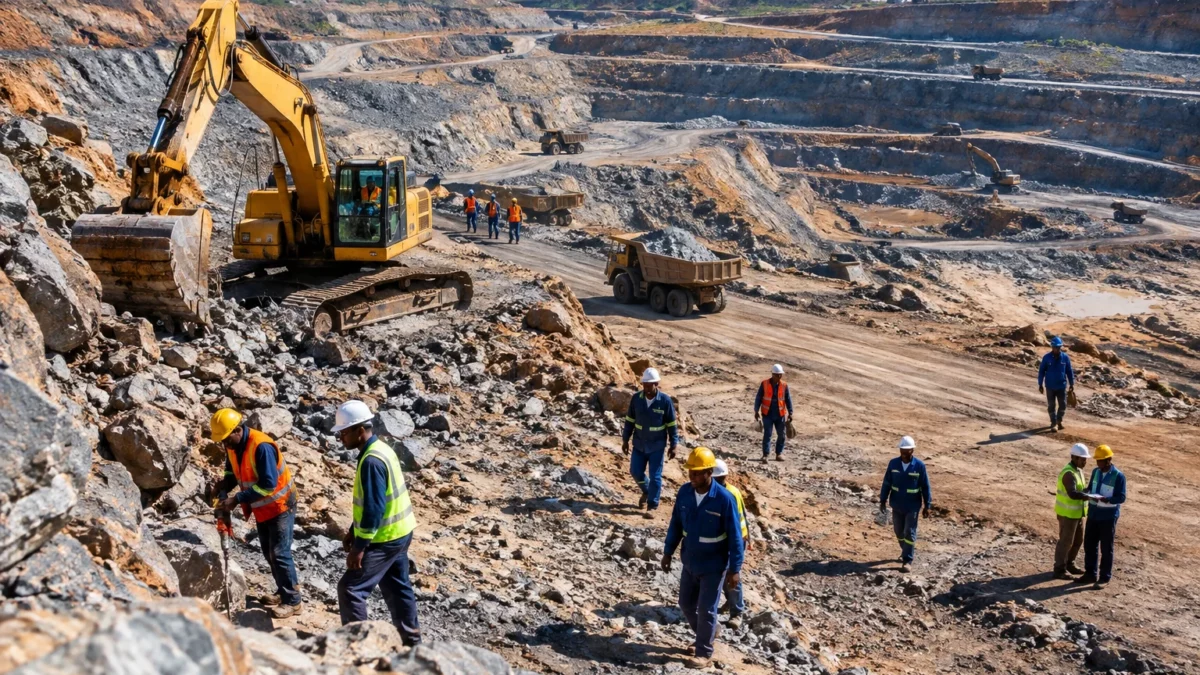
In the Copperbelt, copper and cobalt are already being mined on a large scale. But turning these minerals into battery materials, and then into industrial products, remains a step yet to be taken. Five years after the political launch of cooperation between the Democratic Republic of the Congo and Zambia, the two countries have identified potential sites and signed agreements. Production, however, has not yet begun.
Two countries, an industrial project still in preparation
The ambition emerged in November 2021, when Presidents Félix Tshisekedi and Hakainde Hichilema championed a joint battery and clean energy industry. The stakes go beyond building a factory: the aim is to process more minerals locally, develop industrial skills and capture a greater share of the value created.
In April 2022, Kinshasa and Lusaka signed a cooperation agreement. A year later, the United Nations Economic Commission for Africa (ECA) and Afreximbank joined the framework for work on special economic zones, areas dedicated to hosting industrial activities. The two selected sites are Musompo, in the Congolese province of Lualaba, and Ndola, in Zambia’s Copperbelt. The ECA confirmed the signing of the bilateral agreement and Afreximbank’s planned role in preparing the project (DR Congo-Zambia agreement on the battery industry).
The project initially targets precursors, intermediate materials used in battery manufacturing. The political ambition then extends to batteries and even electric vehicles. These are distinct stages, however, each requiring different investments, technologies, infrastructure and industrial customers.
An agreement on paper therefore does not guarantee that a production chain will be viable. The report published on 6 October 2026 by the Intergovernmental Forum on Mining, Minerals, Metals and Sustainable Development (IGF), hosted by the International Institute for Sustainable Development, primarily assesses the two zones’ ability to attract investors. It identifies shared obstacles: insufficient or unreliable electricity, logistical difficulties, procedures that need simplifying and a lack of co-ordination between government departments (IGF assessment of the Musompo and Ndola zones).
Musompo and Ndola are at different stages
In the Democratic Republic of the Congo, the Musompo zone, near Kolwezi, is being presented as a future processing hub. The site was officially launched in March 2025. The authorities then announced an area of more than 900 hectares. Provincial officials put the development cost at more than $200 million, while the stated aim was to attract additional private investment.
Speaking at Makutano Mining in Kinshasa on 24 November 2026, Congolese Mines Minister Louis Watum Kabamba reiterated the value of producing battery materials at Musompo. He also cited other areas of co-operation with Zambia: geological mapping, electricity exchanges, the manufacture of mining equipment and improvements to the Kasumbalesa border crossing. His remarks demonstrate continued political support, but do not in themselves amount to an announcement that production is starting.
The Congolese timetable now aims for the gradual establishment of the first processing companies at Musompo in June 2027. This deadline concerns companies arriving at the site. It does not set a date for a precursor plant to start operating or for the first battery to be produced. The distinction matters to workers, local suppliers and communities in Lualaba, whose benefits will depend on activities actually getting under way.
Ndola, for its part, already has an industrial environment and infrastructure that the DRC still needs to develop at Musompo. In 2023, the ECA reported that a site of about 300 hectares had been identified in the city’s industrial zone, with access to electricity and water and a railway line nearby. This advantage does not mean that a battery industry is already operating there. The two sites still need to define their activities and how they will complement each other.
The practical requirements remain unmet
The IGF’s assessment highlights a gap between the political agreement and operational arrangements. It recommends that the two governments clarify responsibilities, stages, deadlines and monitoring indicators. It also calls for a joint industrial offer to be defined: which materials will be produced in each zone, using which inputs, and for which markets?
Electricity is a central issue. A battery materials plant needs a stable power supply, as well as reliable transport to move minerals, processed products and equipment. Delays at the Kasumbalesa border can increase the cost of trade between the two hubs. Technical training, knowledge transfers and predictable tax and administrative rules will also influence investment decisions.
Funding requires the same clarity. In 2026, Congolese authorities referred to support from Afreximbank and accelerated the creation of a company tasked with developing Musompo. But publicly available information does not specify how much funding has actually been secured or the terms on which it will be disbursed. Funding announced to prepare or develop a zone is not equivalent to full financing for the factories that could be established there.
Finally, the two countries do not alone possess all the minerals, industrial capacity or market size needed for a complete battery supply chain. The IGF therefore advocates broader co-operation with neighbouring countries. Success will not depend solely on leaders and investors: it will also be measured by skilled jobs, contracts accessible to local businesses and benefits for mining areas.
A test for regional economic integration
The project is part of a broader ambition: to make southern Africa a hub for processing and trade, rather than merely a supplier of minerals. The African Continental Free Trade Area, which aims to facilitate trade between African countries, could support the movement of processed materials. But it will not replace power lines, railways or effective customs co-ordination.
For the African Union, the DR Congo-Zambia initiative is therefore a concrete test of cross-border industrial co-operation. The next indicator will not be another statement of principle. It will be the publication of a joint timetable, clarification of funding, resolution of questions about where activities will be based, and the first industrial construction work. The establishment of companies at Musompo in June 2027 will be a milestone to watch. The processing of minerals into battery products, however, remains to be demonstrated.