Algeria
 Egypt
 Libya
 Morocco
 Sudan
 Tunisia
 Benin
 Burkina Faso
 Cabo Verde
 Côte d'Ivoire
 Ghana
 Guinea
 Guinea-Bissau
 Liberia
 Mali
 Mauritania
 Niger
 Nigeria
 Senegal
 Sierra Leone
 The Gambia
 Togo
 Cameroon
 Central African Republic
 Chad
 Equatorial Guinea
 Gabon
 Republic of the Congo
 São Tomé and Príncipe
 Burundi
 Comoros
 Djibouti
 Eritrea
 Ethiopia
 Kenya
 Madagascar
 Malawi
 Mauritius
 Mozambique
 Rwanda
 Seychelles
 Somalia
 South Sudan
 Tanzania
 Uganda
 Angola
 Botswana
 Eswatini
 Lesotho
 Namibia
 South Africa
 Zambia
 Zimbabwe
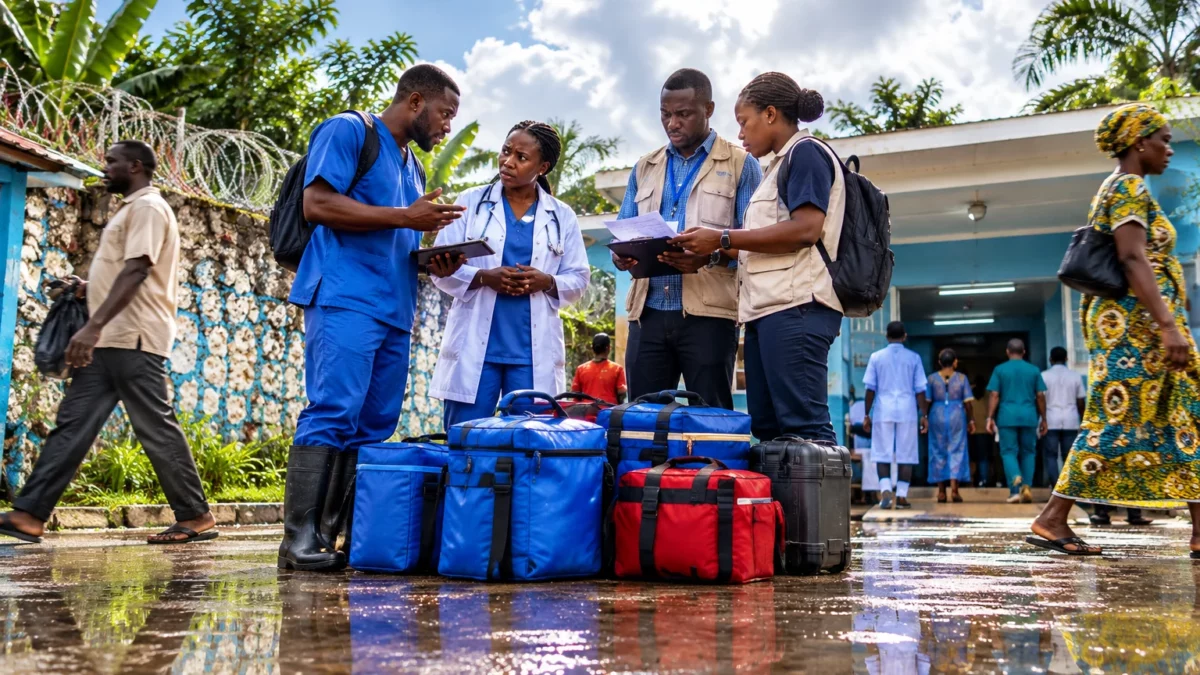
When health teams have to operate in hard-to-reach areas, timely information matters as much as vaccine availability. In the Democratic Republic of the Congo (DR Congo), the Bundibugyo virus disease outbreak is putting this reality to the test. Across the continent, new digital tools and vaccination campaigns are also seeking to address delays in detection and prevention.
Making data more accessible to monitor polio
The World Health Organization (WHO) Regional Office for Africa has added artificial intelligence features to its polio dashboards. Teams can ask questions in everyday language and obtain maps, charts or summaries from the available data. The programme receives information every week from 47 countries in the WHO African Region, including poliovirus detections, laboratory results and vaccination data.
The tool is intended to make it easier to identify areas where surveillance or campaigns have gaps. It can also flag delays in supplementary campaigns and the reasons reported. WHO says, however, that AI does not replace epidemiological analysis or human verification. No quantified time savings or health outcomes have been reported so far. WHO explains how AI is being used in its polio surveillance dashboards.
Technology alone is not enough without field teams and regular vaccination. In Ethiopia, a campaign launched on 21 November aims to reach more than 11.3 million children in five regions. The country remains free of wild poliovirus, but circulating type 1 polioviruses have been detected this year in several regions. A second round of vaccination is planned from 18 to 21 December. The campaign combines vaccination with identifying children who have not received all routine doses. Details of Ethiopia’s polio vaccination campaign.
Fighting hampers Ebola operations in DR Congo
Bundibugyo virus disease, a form of Ebola, continues to mobilise Congolese health authorities and their partners. The joint continental plan by Africa CDC, the African Union’s public health agency, and WHO covers the period from November 2026 to May 2027. It estimates needs at $1.576 billion, within a range of $1.509 billion to $1.648 billion. The document provides, among other measures, for strengthening surveillance, care, community protection, and safe and dignified burials. The continental Bundibugyo virus preparedness and response plan.
But the scale of need does not guarantee that interventions reach the people concerned. On 24 November, WHO said its teams, those of the Congolese health ministry and partners had been evacuated from a hospital in Akwe, Ituri, after taking refuge there for several days because of fighting. Operations in the Mongbwalu area have been relocated, including to Bunia, until security improves.
The figures must be dated and attributed. In its plan published on 25 November, Africa CDC reported 11,613 confirmed cases and 5,678 deaths in DR Congo as of 17 November. WHO’s risk assessment, published on 25 November, reported 10,990 confirmed cases and 5,354 deaths as of 8 November. These figures refer to different cut-off dates and should therefore not be presented as simultaneous estimates. WHO assesses the risk as very high in DR Congo and high in Kenya and Nigeria. WHO’s risk assessment of the outbreak in DR Congo.
The response also depends on corridors and funding
In eastern DR Congo, fighting, population displacement and access difficulties complicate contact tracing, the delivery of supplies and continuity of care. The effects extend beyond national borders: population movements and trade link affected areas with neighbouring countries. DR Congo is a member of the East African Community (EAC) and the Southern African Development Community (SADC), two regional frameworks where health and logistics coordination can matter. WHO highlights the need for cross-border cooperation and sustained surveillance.
Funding is another challenge. A plan costed at continental level establishes a common framework, but its effectiveness will depend on the funding actually mobilised, how it is tracked and whether teams can reach communities. People living in conflict zones face increased health risks and disrupted services. For healthcare workers, safety determines whether they can work. For authorities and their partners, the challenge also involves maintaining routine care rather than diverting it entirely to the emergency.
Malaria vaccination also illustrates the importance of predictable funding. Gavi has announced a grant of up to $214 million, subject to approval by its board. The stated aim is to restore coverage of its support from 70% to 85% in African areas with moderate or high transmission. The funding is intended to maintain and expand access, while ensuring that all doses are administered remains a challenge for national programmes.
Local production remains a strategic priority
Meeting in Addis Ababa from 23 to 27 November for the International Conference on Public Health in Africa, officials and partners also focused on maternal and child health and vaccine manufacturing. A regional collaboration strategy for vaccine production, planned for 2028-2032, has an announced budget of $35 million. It is intended to support the preparation of bankable projects, technical assistance and cooperation between regions.
This initiative forms part of the African Union’s goal of producing 60% of the continent’s vaccine needs locally by 2040. In the short term, however, emergencies such as the outbreak in DR Congo require resources available without delay, verified data and teams able to reach populations. The next immediate milestone will be implementation of the Bundibugyo plan through May 2027; in Ethiopia, the second round of polio vaccination is due to begin on 18 December 2026.