Algeria
 Egypt
 Libya
 Morocco
 Sudan
 Tunisia
 Benin
 Burkina Faso
 Cabo Verde
 Côte d'Ivoire
 Ghana
 Guinea
 Guinea-Bissau
 Liberia
 Mauritania
 Niger
 Nigeria
 Senegal
 Sierra Leone
 The Gambia
 Togo
 Cameroon
 Central African Republic
 Chad
 DR Congo
 Equatorial Guinea
 Gabon
 Republic of the Congo
 São Tomé and Príncipe
 Burundi
 Comoros
 Djibouti
 Eritrea
 Ethiopia
 Kenya
 Madagascar
 Malawi
 Mauritius
 Mozambique
 Rwanda
 Seychelles
 Somalia
 South Sudan
 Tanzania
 Uganda
 Angola
 Botswana
 Eswatini
 Lesotho
 Namibia
 South Africa
 Zambia
 Zimbabwe
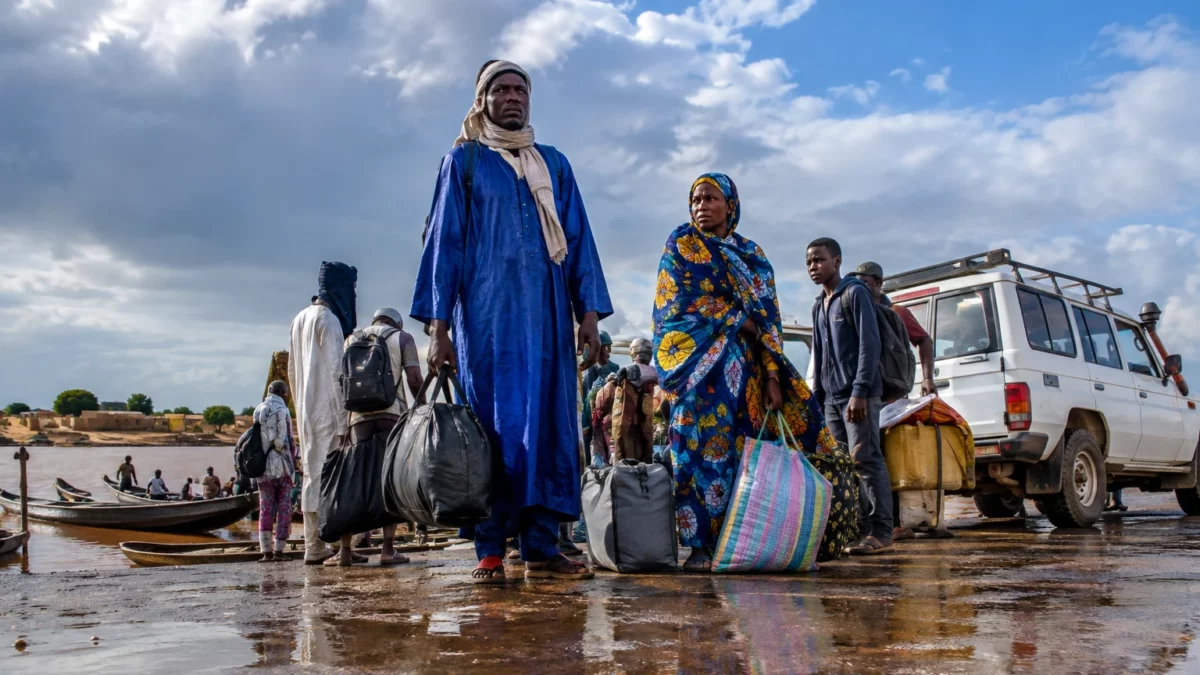
In Tonka, in the Timbuktu region, residents face a stark choice: leave before access routes are cut, or stay when a blockade could prevent movement and the delivery of supplies. The deadline announced is Friday 27 November 2026. But the conditions for leaving and the guarantees of safety remain uncertain.
A threat targeting roads and the river
Tonka lies about 100 kilometres south-west of Timbuktu, on the banks of the River Niger. River routes, along with roads, are important for travel and trade there. According to information reported by several media outlets, the Group for the Support of Islam and Muslims (JNIM), affiliated with al-Qaeda, circulated audio messages in several national languages on 22 November.
The armed group is said to have given residents who wish to leave the town until 27 November to do so. It then threatens to prevent vehicles from entering or leaving and canoes from mooring. Those who tried to cross the blockade would, according to the messages, be considered “military targets”. The threat is attributed to JNIM: by itself, it does not establish how the group intends to carry it out.
The announcement comes after a detachment of the Malian Armed Forces and Russian Africa Corps partners was deployed at the entrance to Tonka. Available reports differ on the exact date of the deployment: some point to the end of summer, others to a presence since October. The military authorities and the governorate of Timbuktu had not publicly confirmed the reported details by the time of the first publications. Cross-checked information on the ultimatum in Tonka therefore describes a threat documented by media outlets, although several operational details remain to be established.
A population facing a difficult choice
The military presence is said to have been reinforced after local requests for protection, amid targeted killings. Media outlets report at least four civilian killings in Tonka between November 2025 and July 2026, attributed to JNIM. The victims were allegedly accused by the group of supporting the army. Such an accusation is not proof of collaboration.
The dilemma is therefore not simply whether to stay or leave. Leaving the town may mean abandoning work, crops, possessions or relatives. Staying may expose residents to the consequences of a blockade or to violence. Families with a vehicle are not in the same situation as those dependent on public transport or the river. Older people, children and the sick may face additional obstacles.
One resident interviewed by Deutsche Welle said that some people had already left, while others remained, including civil servants and teachers. He also mentioned the harvest season. This individual account cannot establish the scale of departures, and no verified figures on population movements linked to the current ultimatum are available in the information cross-checked. The testimony gathered in Tonka and information on the military presence nevertheless highlight that decisions are being made under duress, while daily activities continue.
A blockade could disrupt access to markets, healthcare, transport and essential goods. Traders, transport operators and households dependent on small-scale activities would be directly affected. The consequences could also reach neighbouring communities if families move or trade routes are diverted. For now, there are no reliable data with which to measure the economic impact of the current threat.
Previous cases in northern Mali
The use of blockades and threats of displacement forms part of a strategy already documented in the country. In its 2025 annual report, Mali’s National Human Rights Commission describes the blockade of the Léré-Niono route, which began in October 2025, followed by an ultimatum issued to the population. Citing data from the Mali Red Cross, the Commission reports that 1,869 households, or 13,693 people, were displaced between 8 and 15 November 2025 in several localities, including Tonka.
These figures relate to an earlier episode. They should not be confused with any departures linked to the November 2026 ultimatum. They nevertheless show that movement restrictions can trigger rapid displacement and test the capacity to receive and assist people. The report by Mali’s National Human Rights Commission also identifies urgent needs for food, healthcare and support for people displaced during that earlier episode.
For the authorities in Bamako, the immediate challenge is to protect civilians while keeping routes to Tonka passable. Deploying a detachment may respond to a security request. But its presence alone does not guarantee movement, supplies or the protection of residents. Roads and river access require particular attention in this area.
An issue extending beyond Tonka
The threat comes at a time when armed groups are increasing pressure on towns, roads and supply networks. The strategy is not limited to attacking a military position: obstructing movement can also weaken links between communities and the state. For residents, this means making immediate decisions about safety, work, school and access to services.
Across West Africa, a local crisis can lead to displacement to other towns or across borders, particularly into Mauritania, with consequences for host communities and regional trade. Mali is a member of ECOWAS, the organisation for economic and political co-operation among West African countries. Relations between Bamako and the organisation have deteriorated sharply in recent years, but the human and commercial effects of cross-border insecurity remain a shared concern.
Friday 27 November is therefore a concrete deadline: it will be necessary to establish whether the announced blockade is actually imposed, whether residents can move safely and whether aid can reach the town. At this stage, the available facts confirm the existence of the ultimatum and the reported deployment, but not the outcome of the threat or the scale of displacement.