Algeria
 Egypt
 Libya
 Morocco
 Sudan
 Tunisia
 Benin
 Burkina Faso
 Cabo Verde
 Côte d'Ivoire
 Ghana
 Guinea
 Guinea-Bissau
 Liberia
 Mali
 Mauritania
 Niger
 Nigeria
 Senegal
 Sierra Leone
 The Gambia
 Togo
 Cameroon
 Central African Republic
 Chad
 Equatorial Guinea
 Gabon
 Republic of the Congo
 São Tomé and Príncipe
 Burundi
 Comoros
 Djibouti
 Eritrea
 Ethiopia
 Kenya
 Madagascar
 Malawi
 Mauritius
 Mozambique
 Rwanda
 Seychelles
 Somalia
 South Sudan
 Tanzania
 Uganda
 Angola
 Botswana
 Eswatini
 Lesotho
 Namibia
 South Africa
 Zambia
 Zimbabwe
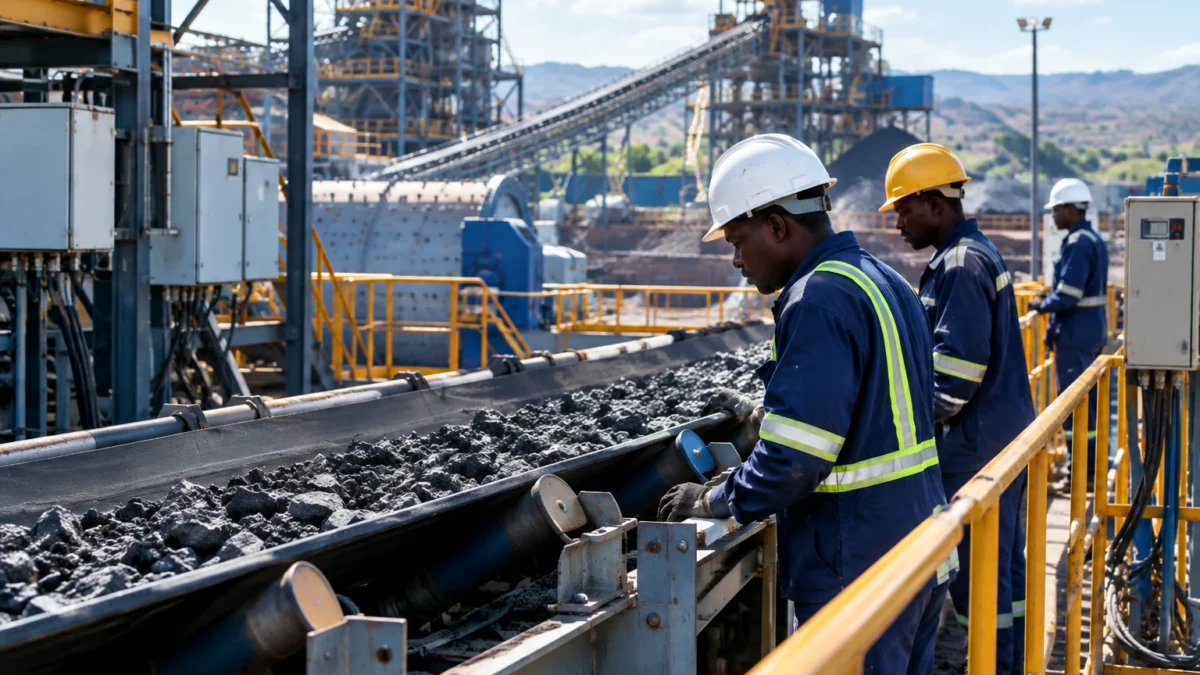
In Kinshasa, the debate on mining is no longer limited to how much copper or cobalt the Democratic Republic of the Congo can extract. It is also about what will remain in the country after mining: skilled jobs, businesses able to supply industry and processing stages that create more value.
This ambition featured at the Makutano Mining Forum, held in the Congolese capital from 23 to 25 November 2026. But it faces a practical equation: processing minerals locally requires markets, electricity, infrastructure and sustainable financing. Underground wealth alone cannot guarantee these conditions.
From mineral exports to value creation
The 12th edition of Makutano, devoted this year to critical minerals, brought together public officials, investors and industrialists to discuss mining sovereignty and industrialisation. President Félix Tshisekedi opened the forum in Kinshasa on 23 November, calling for investment and partnerships to support this transformation. The event forms part of a broader debate about the place of producing countries in global value chains.
DR Congo has significant copper and cobalt resources, as well as lithium deposits. These minerals are used, among other things, to manufacture electrical components, digital equipment and batteries. Yet extracting ore and processing it into an intermediate product that industry can use are two distinct activities. The latter requires facilities, reliable energy, technical skills and customers.
The debate is not starting from scratch. The government has already introduced measures to regulate cobalt exports. In 2025, a temporary suspension was followed by a quota system designed to control export volumes. On 24 November 2026, the Congolese Press Agency reported a new suspension of exports from 30 November. According to the regulator, the decision aims to respond to falling prices and review the quota mechanism.
An export restriction can give the state leverage in the market. It does not, by itself, create a refining plant or a battery industry. The outcome will depend on how long the measure lasts, how it is implemented and whether operators can process the ore locally.
Markets, energy and jobs at the heart of the challenge
Speaking on a panel on 24 November, economist Marit Kitaw of the United Nations Economic Commission for Africa stressed the need to study markets before launching processing projects. Her warning is particularly relevant to cobalt: some lithium iron phosphate batteries, which are expanding rapidly, do not use it. An industrial strategy must therefore take account of technological change and actual markets.
The choices also affect the population. Local industry can create more specialised jobs and open up markets for Congolese businesses. But these benefits are not automatic. It is necessary to assess the share of workers trained locally, the role of domestic suppliers and the revenue actually received by the state and affected communities. The mining areas in the south-east, particularly Haut-Katanga and Lualaba, are directly affected by these choices; decisions made in Kinshasa alone do not determine how benefits will be distributed among the regions.
Energy is a central constraint. Industrial processing consumes more power than extraction alone. Transport infrastructure and access to a steady electricity supply will therefore determine which projects can operate at scale, and at what cost. Without this investment, a processing requirement risks leading to delays, additional costs or underused facilities.
DR Congo and Zambia are also working on a proposed cross-border special economic zone linked to batteries and electric vehicles. A special economic zone is a designated area designed to attract business through infrastructure and tailored rules. The objective outlined by ECA and Afreximbank is to develop intermediate production stages in both countries. This cooperation could expand the market and pool some capacity, but it will depend on investment decisions and coordination between the two states.
A regional challenge beyond copper and cobalt
For DR Congo, a member of the Southern African Development Community (SADC), local processing extends well beyond a single forum. Its proximity to Zambia offers the chance to build regional industrial chains rather than treating each country as an isolated supplier. At continental level, this approach aligns with efforts to better connect African resources to the industries that use them, notably through the African Continental Free Trade Area (AfCFTA).
Competition among foreign partners for access to minerals and for infrastructure financing gives Kinshasa room to negotiate, but also presents difficult choices. Transport corridors and supply agreements can support industrialisation if they also serve producers and local economies. Conversely, they can preserve a system in which minerals pass through the country without the most profitable stages taking root there.
The test will come after the announcements: which projects will be financed, where will they be built, what energy will power them and what share of the value will go to Congolese businesses and workers? The new suspension of cobalt exports, due to take effect on 30 November, is an immediate deadline. Its implementation and the rules governing any resumption will show whether the regulatory lever is supporting real industrial capacity or remains mainly a tool for managing volumes.