Egypt
 Libya
 Morocco
 Sudan
 Tunisia
 Benin
 Burkina Faso
 Cabo Verde
 Côte d'Ivoire
 Ghana
 Guinea
 Guinea-Bissau
 Liberia
 Mali
 Mauritania
 Niger
 Nigeria
 Senegal
 Sierra Leone
 The Gambia
 Togo
 Cameroon
 Central African Republic
 Chad
 DR Congo
 Equatorial Guinea
 Gabon
 Republic of the Congo
 São Tomé and Príncipe
 Burundi
 Comoros
 Djibouti
 Eritrea
 Ethiopia
 Kenya
 Madagascar
 Malawi
 Mauritius
 Mozambique
 Rwanda
 Seychelles
 Somalia
 South Sudan
 Tanzania
 Uganda
 Angola
 Botswana
 Eswatini
 Lesotho
 Namibia
 South Africa
 Zambia
 Zimbabwe
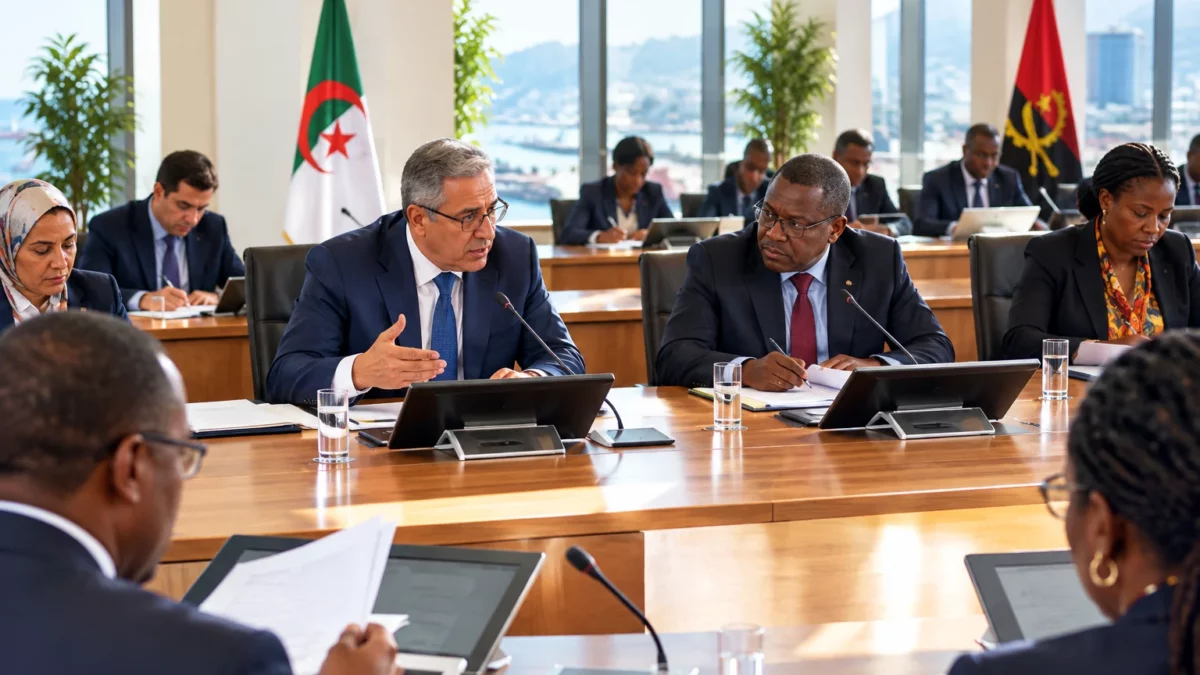
For Algeria and Angola, the energy challenge is not limited to extracting oil and gas. It also involves transforming resources, developing skills and building lasting commercial ties between two economies seeking to broaden their partnerships.
This ambition took concrete shape in Algiers on 23 and 24 November 2026. But the agreements concluded at the end of the fifth session of their joint commission cover several sectors: on their own, they are not proof that new oil projects are already under way.
Two producers, different priorities
Algeria, in North Africa, and Angola, in southern Africa, occupy important positions in the continent’s hydrocarbons sector. Their relations are nevertheless framed by distinct regional structures: Algeria is a member of the African Union and the Arab Maghreb Union, while Angola participates, among other bodies, in the Southern African Development Community (SADC).
This geographical distance makes the exchange of expertise and links between companies particularly important. It also brings practical challenges: organising transport, bringing economic actors closer together and turning political statements into viable contracts.
The two countries had already signalled their determination to strengthen ties during Angolan President João Lourenço’s state visit to Algeria on 11 and 12 May 2026. Announcements during the visit included agreements in several areas, including hydrocarbons. The November commission was expected, in particular, to review their implementation.
Commitments to be turned into projects
The Algiers meeting was co-chaired by Mohamed Arkab, Algeria’s Minister of State for Hydrocarbons, and Diamantino Pedro Azevedo, Angola’s Minister of Mineral Resources, Petroleum and Gas. Discussions covered prospects for cooperation in exploration, production, refining and petrochemicals, as well as training, expertise and renewable energy.
At the close of the meeting, Algeria and Angola signed four cooperation agreements and a memorandum of understanding. Areas including plant protection, tourism, youth and culture were among the sectors covered. The meeting also resulted in an agreement on launching a direct air link between Algiers and Luanda, as well as on establishing a joint business council, according to Algeria Press Service (APS).
These outcomes broaden the channels for cooperation, but do not yet set out a timetable, funding or production volumes for any potential joint oil projects. This is an important distinction: a declaration of intent opens a path, while an industrial project requires investment decisions, identified partners and operational follow-up.
The ministers also stressed the need to turn agreements into concrete partnerships. The next steps will therefore depend on follow-up mechanisms and the involvement of companies, particularly in activities where technical expertise can be shared.
Cooperation beyond hydrocarbons
For Angola, exchanges with Algeria could open up opportunities for training and industrial cooperation. Diamantino Pedro Azevedo recalled Algeria’s historic role in training Angolan officials and developing the country’s oil sector. This reference underlines that the partnership is not starting from scratch, even if the recent announcements still need to be translated into sustained programmes.
For Algeria, the aim is also to consolidate economic relations with a partner in southern Africa and diversify areas of cooperation. Training, refining and petrochemicals could help move beyond a relationship centred on raw material exports. But results will depend on the ability of institutions and companies to define specific projects.
The impact will not be measured only at government or national company level. A direct air link, if it is actually launched, could make business travel and contacts between companies easier. The benefits for workers, local suppliers and consumers will depend on the investments that are actually made and how they are integrated into national economies.
Next step expected in Luanda
The two governments agreed to hold the sixth session of their joint commission in Luanda. No date has yet been officially set. The meeting will provide a checkpoint: the parties will be able to clarify the status of the agreements, the responsibilities of institutions and the steps needed to launch the announced projects.
This sequence is part of a broader movement towards cooperation among African energy-producing countries. It does not, by itself, create a common continental energy policy. It does, however, show how bilateral partnerships can seek to link expertise, training and local processing, as several countries on the continent seek to capture more value from their resources.
In the short term, the most tangible outcomes are the multisectoral agreements signed in Algiers, the proposed business council and the prospect of a direct air link. To assess the energy significance of closer ties, it will be necessary to follow announcements of industrial projects, collaboration between companies and decisions taken at the next session in Luanda.