Algeria
 Egypt
 Libya
 Sudan
 Tunisia
 Benin
 Burkina Faso
 Cabo Verde
 Côte d'Ivoire
 Ghana
 Guinea
 Guinea-Bissau
 Liberia
 Mali
 Mauritania
 Niger
 Nigeria
 Senegal
 Sierra Leone
 The Gambia
 Togo
 Cameroon
 Central African Republic
 Chad
 DR Congo
 Equatorial Guinea
 Gabon
 Republic of the Congo
 São Tomé and Príncipe
 Burundi
 Comoros
 Djibouti
 Eritrea
 Ethiopia
 Kenya
 Madagascar
 Malawi
 Mauritius
 Mozambique
 Rwanda
 Seychelles
 Somalia
 South Sudan
 Tanzania
 Uganda
 Angola
 Botswana
 Eswatini
 Lesotho
 Namibia
 South Africa
 Zambia
 Zimbabwe
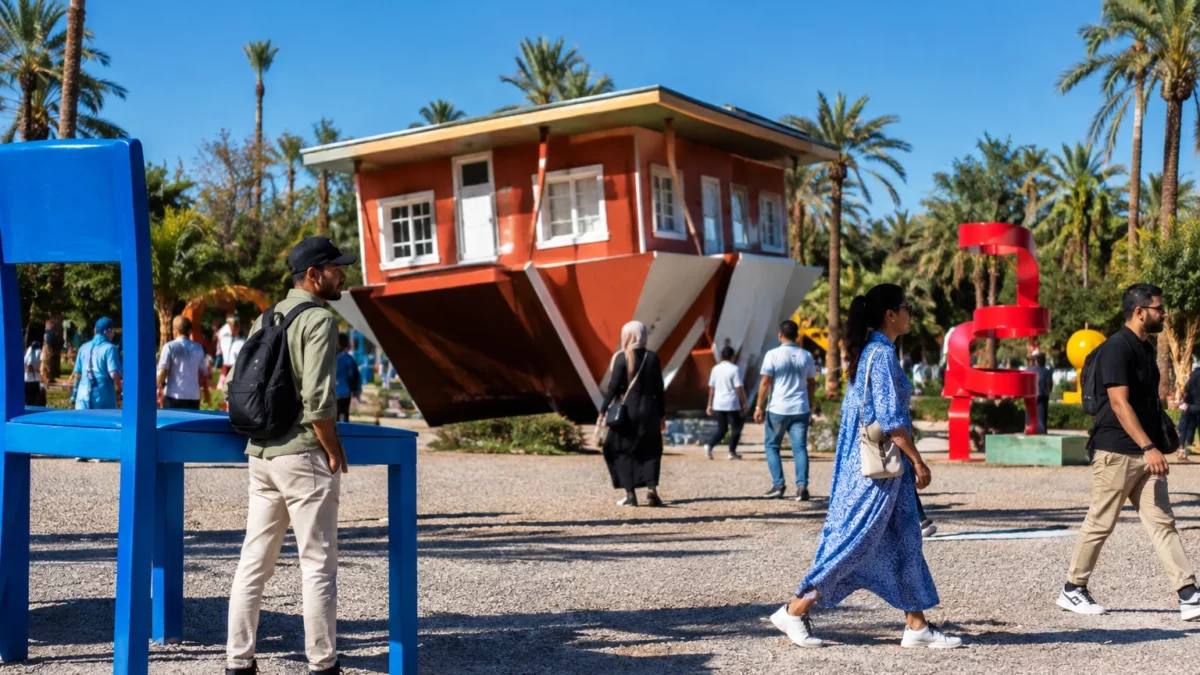
In Marrakech, some works are not just looked at: they make you change scale. A house resting on its roof, furniture too large for an adult and creatures combining human and plant forms make up the route through Ramakech, an art park where family memories become a place to walk through.
The project is part of the cultural landscape of a Moroccan city known for its historic sites, as well as for an evolving contemporary art scene. It does not tell the story of Morocco through the artist’s memories: it takes shape in Marrakech, in contact with its surroundings, and invites the public to experience space and everyday objects differently.
A studio becomes a place to visit
Jean-François Fourtou, a French artist born in Paris in 1964, settled in Marrakech in 1999 and developed his studio there. The site, long associated with his personal practice, opened to the public in 2024 under the name Ramakech. The park brings together works developed over more than two decades. The presentation of Ramakech park and a report by SNRT News confirm its opening and place it in the Palmeraie district of Marrakech.
The most immediately disconcerting installation is “The House Fallen from the Sky”. Reconstructed from a family holiday home in Charente-Maritime, it appears to have tipped over onto its roof. Inside, the furniture and everyday objects turn familiar bearings upside down. The tilted structure heightens this sense of imbalance.
This work, conceived around 2010, carries an intimate story. Fourtou imagined it as a tribute to his grandfather, who played an important role in his childhood. In an interview published by Moroccan media outlet Femmes du Maroc, the artist explained that the upside-down house evoked for him a building sent down from the sky by his grandfather. A private memory thus becomes an experience open to visitors, without losing its family roots.
Changing size, changing perspective
The “Giant House” plays on a different kind of disorientation. Chairs, tables, wardrobes and school supplies take on unusual proportions. Adults find themselves at a child’s height, as if the furniture had grown around them. Fourtou has linked this installation to his stays with his great-grandmother, when he explored a house that seemed enormous to him.
The park is not limited to indoor memories, however. Hybrid characters, halfway between human figures and vegetation, evoke gardeners and farmers. Other works feature monumental ants, oversized beds and colourful structures. Nature is not merely a backdrop: it enters the sculpted forms and blurs the boundaries between the living, objects and architecture.
The diversity makes it difficult to count the works, according to information shared about the park. It also reflects an approach that favours accumulation and the transformation of the site over a fixed route through a conventional exhibition. Visitors move around, enter some installations and physically experience differences in scale, balance and perspective.
Memories are sometimes inscribed in familiar details. “Tidy your room”, a phrase associated with the artist’s childhood, is part of this world. The emotion sought therefore does not rest solely on spectacle. It arises from the connection between a personal experience and scenes that many people may recognise, even if their own memories are different.
An artistic offering rooted in Marrakech
Ramakech adds an immersive visitor experience to Marrakech’s cultural offering. This activity takes place in a city that welcomes local and international audiences, although the park alone cannot represent Moroccan creativity or the city’s entire cultural life. Its perspective remains that of Fourtou, a French artist who has settled in Morocco; nevertheless, its location, opening to the public and engagement with the Marrakech landscape give it a tangible place in the local cultural ecosystem.
The project also invites visitors to distinguish between tourism and access to culture. The works are designed to be explored, including by families, but the available information does not make it possible to establish precisely who visits them, or what proportion of Moroccan and foreign audiences they attract. Such data would be needed to assess the park’s local impact beyond its visibility as a new artistic destination.
At a regional level, Ramakech is a reminder that North African cities host a variety of artistic practices, led by artists with different backgrounds and connections to place. The site is neither a museum dedicated to Moroccan art nor an institutional initiative of the Arab Maghreb Union. Rather, on its own scale, it contributes to the diversity of cultural experiences on offer in Marrakech.
The question now is how the park will build a lasting relationship with its audiences and local cultural players. Its opening in 2024 marked the transition from a space shaped over several years to a place accessible to visitors. It remains to be seen how this collection will evolve and become part of the city’s artistic life, beyond a one-off encounter with its monumental sculptures.