Algeria
 Libya
 Morocco
 Sudan
 Tunisia
 Benin
 Burkina Faso
 Cabo Verde
 Côte d'Ivoire
 Ghana
 Guinea
 Guinea-Bissau
 Liberia
 Mali
 Mauritania
 Niger
 Nigeria
 Senegal
 Sierra Leone
 The Gambia
 Togo
 Cameroon
 Central African Republic
 Chad
 DR Congo
 Equatorial Guinea
 Gabon
 Republic of the Congo
 São Tomé and Príncipe
 Burundi
 Comoros
 Djibouti
 Eritrea
 Ethiopia
 Kenya
 Madagascar
 Malawi
 Mauritius
 Mozambique
 Rwanda
 Seychelles
 Somalia
 South Sudan
 Tanzania
 Uganda
 Angola
 Botswana
 Eswatini
 Lesotho
 Namibia
 South Africa
 Zambia
 Zimbabwe
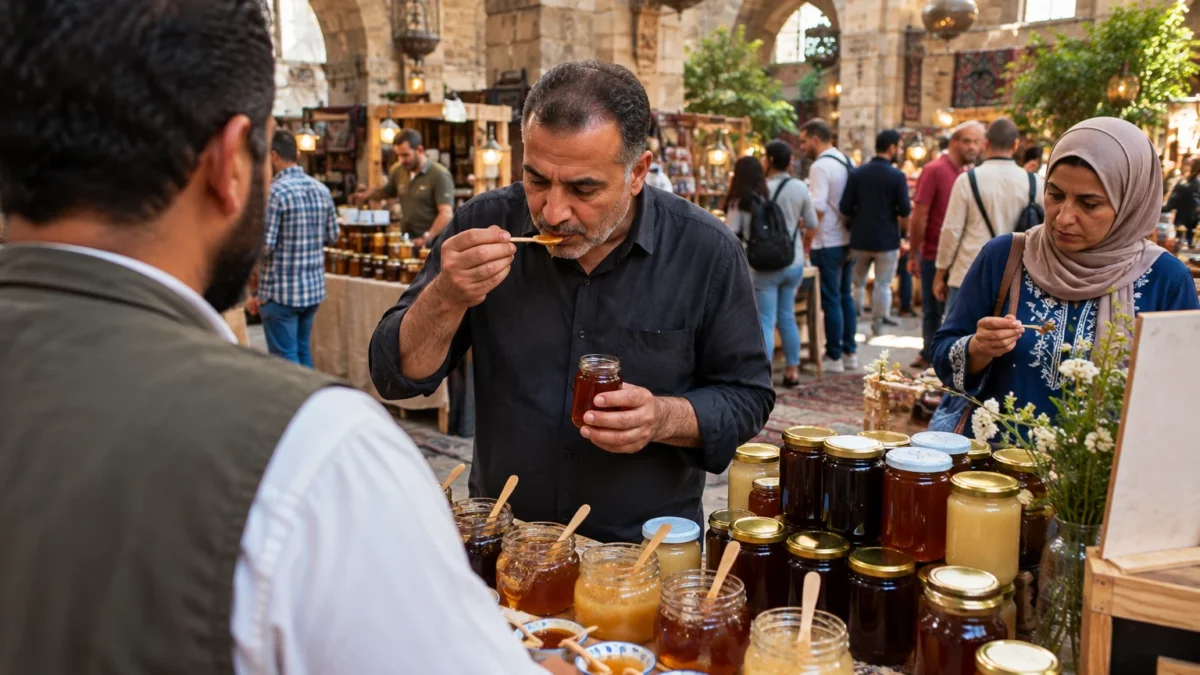
In the aisles of a festival, a spoonful is enough to reveal the differences between Egyptian honeys. But behind the tasting, a more practical question faces producers and consumers in Cairo: how can a quality product be recognised, and what role can beekeeping play in the country’s agricultural economy?
From taste to product recognition
The ninth edition of the Egyptian Honey Festival was held in Cairo from 19 to 22 November 2026. Visitors were able to taste several varieties and compare their aromas. Producers presented their products and offered samples.
Khaled Ezz, owner of the al-Shahin brand, said the event aims to familiarise the public with the different honeys available in Egypt and help people distinguish quality products. He believes knowledge of honey remains limited in the country.
This effort goes beyond promoting a brand. For beekeepers, having the origin and characteristics of a honey recognised can help set it apart in a market where consumers do not always have simple points of reference. The festival thus brings producers and buyers together in a sector where trust matters as much as product diversity.
Figures to treat with caution
Mahmoud Hassan, the festival’s head, put Egyptian production at more than 20,000 tonnes and exports at more than 4,000 tonnes. These figures should, however, be attributed: available official data do not confirm them for the same period.
Egypt’s Ministry of Agriculture reports honey production of 3,838 tonnes in 2023. Meanwhile, World Bank trade data, based on national declarations of international trade, record about 1,319 tonnes of natural honey exports in 2024. The periods and methods may differ, but the gap is substantial. The festival’s figures therefore cannot be presented as established national data.
These discrepancies highlight a fundamental issue: regular, comparable statistics would help measure the sector’s size and development more accurately. Reliable data could also inform producers’ decisions on processing, marketing and access to foreign markets.
Prices, quality and consumer access
A visitor, Ashraf Tawfik, said prices had risen and some had doubled compared with the previous year. His account reflects his experience, but does not amount to a general measure of honey prices in Egypt.
The perceived increase may nevertheless affect households differently. Consumers make purchasing decisions according to their budgets, while producers must maintain sales without devaluing their work. Tasting stalls partly address this tension: trying honey before buying makes comparison possible, but does not replace precise labelling or accessible quality controls.
Honey also has a cultural and religious place in many Muslim households. The Quran mentions it in a passage associated with healing. This reference contributes to its symbolic importance. It does not, however, remove the need to distinguish traditional uses from medical claims: a health promise is not clinical proof.
A local sector in a regional market
Egypt is a North African country and a member of the Arab Maghreb Union (AMU), a regional organisation bringing together five North African states. This membership provides a possible framework for cooperation, but does not in itself mean that beekeeping sectors have an integrated market. Trade also depends on standards, logistics costs and the commercial rules of each destination.
Across the continent, beekeeping takes varied forms depending on available plants, territories and markets. The FAO notes that African honey production grew on average over the last decade covered by its data. This general trend does not describe every country in the same way; rather, it points to the potential of local sectors able to supply their markets and, when conditions allow, sell beyond their borders.
For Egypt, what happens next will depend less on tastings than on the ability to document production, guarantee product origin and make prices clearer. The festival gives producers a platform and provides a meeting place with the public. Official statistics, quality controls and export trends will show whether this visibility translates into lasting gains for the sector.