Algeria
 Egypt
 Libya
 Morocco
 Sudan
 Tunisia
 Benin
 Burkina Faso
 Cabo Verde
 Côte d'Ivoire
 Ghana
 Guinea
 Guinea-Bissau
 Liberia
 Mali
 Mauritania
 Niger
 Nigeria
 Senegal
 Sierra Leone
 The Gambia
 Togo
 Cameroon
 Central African Republic
 Chad
 DR Congo
 Equatorial Guinea
 Gabon
 Republic of the Congo
 São Tomé and Príncipe
 Burundi
 Comoros
 Djibouti
 Eritrea
 Ethiopia
 Kenya
 Madagascar
 Malawi
 Mauritius
 Mozambique
 Rwanda
 Seychelles
 Somalia
 South Sudan
 Tanzania
 Uganda
 Angola
 Botswana
 Eswatini
 Lesotho
 Namibia
 South Africa
 Zambia
 Zimbabwe
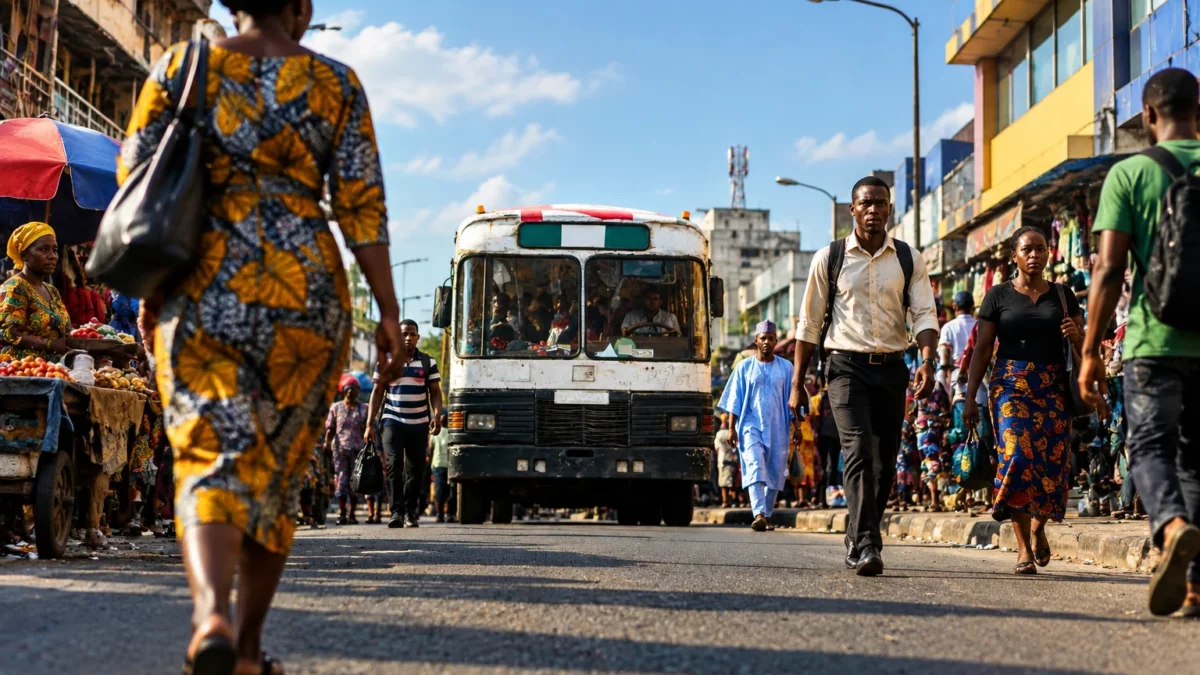
Global religious projections point to a demographic shift in which Nigeria and other sub-Saharan African countries will carry greater weight. But these figures describe neither a general conversion nor a uniform trend across the continent: they primarily reflect the growth of young populations and differences in fertility rates.
Demographic trajectories, not a fixed ranking
Published in November 2026, the Pew Research Center’s new study projects changes in the main religions between 2020 and 2070. Its central scenario estimates that the global Muslim population will rise from 2.02 billion in 2020 to more than 3.6 billion in 2070. The Christian population is also projected to grow, approaching 3 billion. According to this projection, Islam could overtake Christianity in number of followers around 2035. These are conditional estimates, not certainties.
The change in perspective matters. The text provided combines recent global figures with a national ranking for 2050, but the figures cited for countries are not all confirmed by the new study. The ranking is based on older projections or data whose period and methodology are not specified. These figures should therefore not be repeated as if they formed a coherent series.
Comparisons between countries also require a distinction between total population and the number of Muslims. A country may have more followers because its population is growing, without the share of its population that is Muslim increasing by the same proportion. These demographic projections measure neither religious practice nor the political influence of religious institutions.
African momentum, from Lagos to the Horn of Africa
Nigeria is the most prominent African case in the new projections. Africa’s most populous country has large Muslim and Christian communities, distributed unevenly across its regions. Pew estimates that by 2070 it could have the world’s third-largest Muslim population. This development is part of broader population growth and does not mean that Nigerians will convert en masse.
Nigeria is a member of ECOWAS, the regional organisation that brings together several West African countries. Its demographic weight therefore also affects regional debates on public services, education, employment and mobility. The effects will not be the same in major cities, the rural north and the economic centres of the south. National trends should not obscure this diversity.
Pew’s projections also indicate that Ethiopia is expected to join the countries with the largest Muslim populations during the period studied. This development is part of the rapid growth of the population of the Horn of Africa. Ethiopia remains a religiously diverse country, also home to large Christian communities. An increase in the number of Muslims therefore does not, on its own, sum up the country’s social changes.
Across the continent, sub-Saharan Africa is expected to account for a growing share of the world’s Muslim population. This is not a homogeneous region: trajectories differ between West Africa, the Nile Valley and the Horn. Census systems, the availability of surveys and population movements also affect the accuracy of estimates.
Fertility accounts for most of the projected increase
In its analysis, Pew attributes much of the expected growth to differences in age and fertility between religious groups. For 2020-2025, the study estimates fertility among Muslim women at an average of about 3.1 children, compared with 2.5 for Christian women and 1.6 for women in all other groups combined. These global averages conceal wide differences between countries and do not predict the behaviour of every family.
Conversions, changes in affiliation and migration are also included in the model, but are expected to weigh less than births in overall growth. In Africa, the practical question is therefore less one of a uniform religious shift than of whether states can meet the needs of young populations: schools, healthcare, vocational training and jobs.
The consequences will be unevenly distributed. Major cities will have to accommodate new residents and develop their infrastructure. In rural areas, access to education and health services may improve more slowly. Public officials will also have to work with diverse religious institutions, without confusing demographic weight with political allegiance.
What the figures cannot tell us
A projection spanning several decades depends on assumptions about fertility, mortality, migration and changes in affiliation. A change in these factors can alter the result. The figures are therefore neither a guaranteed future count nor an indicator of tensions between communities. Presenting them as a competition between religions would obscure their demographic nature.
The latest available estimates nevertheless give an indication of the starting point. In 2020, Pew put the number of Muslims in Nigeria at 120 million. Globally, the organisation estimated the Muslim population at 2.02 billion, compared with 2.27 billion Christians. Subsequent projections extend observed trends, but they do not replace future censuses and surveys.
For the African countries concerned, the challenge is to prepare public services suited to their demographics while taking local realities into account. For regional institutions and the African Union, the growing demographic weight of countries such as Nigeria reinforces their importance in discussions on education, development and international representation. The next national data will make it possible to check whether current assumptions hold.