Algeria
 Egypt
 Libya
 Morocco
 Sudan
 Tunisia
 Benin
 Burkina Faso
 Cabo Verde
 Côte d'Ivoire
 Ghana
 Guinea
 Guinea-Bissau
 Liberia
 Mali
 Mauritania
 Niger
 Nigeria
 Senegal
 Sierra Leone
 The Gambia
 Togo
 Cameroon
 Central African Republic
 Chad
 Equatorial Guinea
 Gabon
 Republic of the Congo
 São Tomé and Príncipe
 Burundi
 Comoros
 Djibouti
 Eritrea
 Ethiopia
 Kenya
 Madagascar
 Malawi
 Mauritius
 Mozambique
 Rwanda
 Seychelles
 Somalia
 South Sudan
 Tanzania
 Uganda
 Angola
 Botswana
 Eswatini
 Lesotho
 Namibia
 South Africa
 Zambia
 Zimbabwe
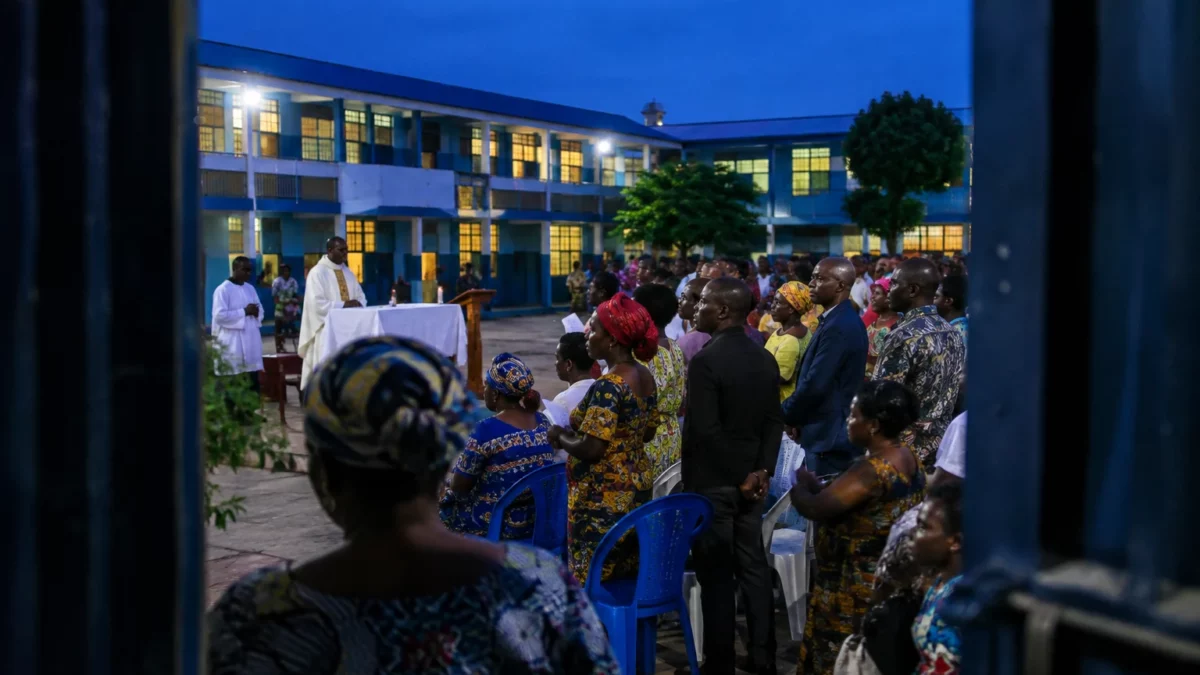
In Kinshasa, a religious celebration planned well in advance changed venue at the last minute. The episode goes beyond the organisation of a Mass: it raises questions about the rules governing public gatherings and the relationship between the authorities and a Church with an influential role in Congolese life.
A celebration moved after a late decision
On Sunday 22 November 2026, Cardinal Fridolin Ambongo was due to preside over the Diocesan Youth Day at Tata Raphaël Stadium in the capital of the Democratic Republic of the Congo. The gathering had been announced at the beginning of the month and was to coincide with the Catholic solemnity of Christ the King. The Congolese Press Agency had reported that it was scheduled to take place at the stadium, while local media had also announced the event. The ACP announcement of the Diocesan Youth Day and local publications confirm that the event was planned. Coverage of preparations for the event in Kinshasa also bears this out.
According to the Archdiocese of Kinshasa, a member of the government announced the ban on Saturday 21 November, after 10pm. The Church says it received neither official notification nor written reasons. Several Congolese media outlets have reported this account, but the authorities had not issued a statement detailing their decision at the time of the available reports. The Church’s account should therefore be distinguished from an official explanation, which remains absent. UNE.cd’s report carries the reaction of the National Episcopal Conference of Congo.
On the morning of the celebration, worshippers were unable to enter the stadium, where a large police presence had been deployed, according to several local media outlets. The archdiocese then moved the Mass to the Saint-Raphaël grounds, at a Catholic school. The change of venue allowed the gathering to go ahead, but altered the arrangements for young people who had come from parishes across Kinshasa. The cross-checked reports do not establish an independently verified count of those who were unable to attend or those who were present. 7sur7.cd’s report on the move to Saint-Raphaël confirms the change of venue.
Religious freedom and security justification
The Congolese Constitution guarantees freedom of thought, conscience and religion. Article 22 also protects the collective manifestation of religion, while allowing for restrictions linked in particular to the law, public order and the rights of others. This provision alone is not enough to determine whether the ban was lawful: that would depend on the reasons given and the procedures followed. The absence of written notification and a public explanation leaves these matters unanswered. Article 22 of the DRC Constitution sets out the rights concerned and their limits.
The archdiocese described the decision as a “provocation” and called on worshippers to remain calm. For his part, a minister quoted in initial reports cited the cardinal’s security. This justification was not elaborated in an accessible official statement. As things stand, it is therefore not possible to determine whether the authorities feared a specific risk, were responding to a constraint related to the stadium, or had another objective. The police presence describes the measures observed; on its own, it does not prove the nature of the threat cited.
The distinction between a security instruction and a disproportionate restriction is crucial. A religious gathering in a stadium requires safety measures, but a decision announced only hours before the event makes organisation more difficult and deprives participants of clear information. For young people and families, the change also meant having to reach another venue, sometimes at short notice. For the Church, the question is whether it can hold an activity that was announced and prepared. For the authorities, it is their responsibility to protect people without arbitrarily restricting a guaranteed right.
An episode amid strained relations
The episode comes amid a climate in which Cardinal Ambongo’s remarks on governance and the national situation regularly prompt political reactions. In 2024, his comments on the crisis in the east of the country and defections to the M23 sparked a dispute with the government. This history helps explain the sensitivity of the incident, but does not establish that criticism by the prelate caused the ban on 22 November 2026. A look back at tensions between the Church and the authorities in 2024 documents this precedent.
In the Democratic Republic of the Congo, the Catholic Church is involved in social and political life beyond liturgical celebrations. It runs educational and social networks, and its leaders sometimes take positions on elections, governance or conflicts. This role gives a local dispute wider significance: the way the authorities handle a highly visible religious event may be read as a signal about the space afforded to independent institutional voices. But without further evidence, it would be premature to see it as a general policy against Catholic gatherings.
The DRC belongs to the Southern African Development Community (SADC) and the East African Community (EAC), two distinct regional bodies. The Kinshasa case is not directly part of a procedure involving either organisation. It nevertheless resonates in a continental context in which the protection of civil liberties and the management of gatherings regularly test national institutions. The immediate issue is now clarification of the reasons for the ban: without a formal explanation, moving the Mass prevented its cancellation but did not resolve questions about the decision.