Algeria
 Egypt
 Libya
 Morocco
 Sudan
 Tunisia
 Benin
 Burkina Faso
 Cabo Verde
 Côte d'Ivoire
 Ghana
 Guinea
 Guinea-Bissau
 Liberia
 Mali
 Mauritania
 Niger
 Nigeria
 Senegal
 Sierra Leone
 The Gambia
 Togo
 Cameroon
 Central African Republic
 Chad
 DR Congo
 Equatorial Guinea
 Gabon
 Republic of the Congo
 São Tomé and Príncipe
 Burundi
 Comoros
 Djibouti
 Eritrea
 Ethiopia
 Kenya
 Madagascar
 Malawi
 Mauritius
 Mozambique
 Rwanda
 Seychelles
 Somalia
 South Sudan
 Tanzania
 Uganda
 Angola
 Botswana
 Eswatini
 Lesotho
 Namibia
 South Africa
 Zambia
 Zimbabwe
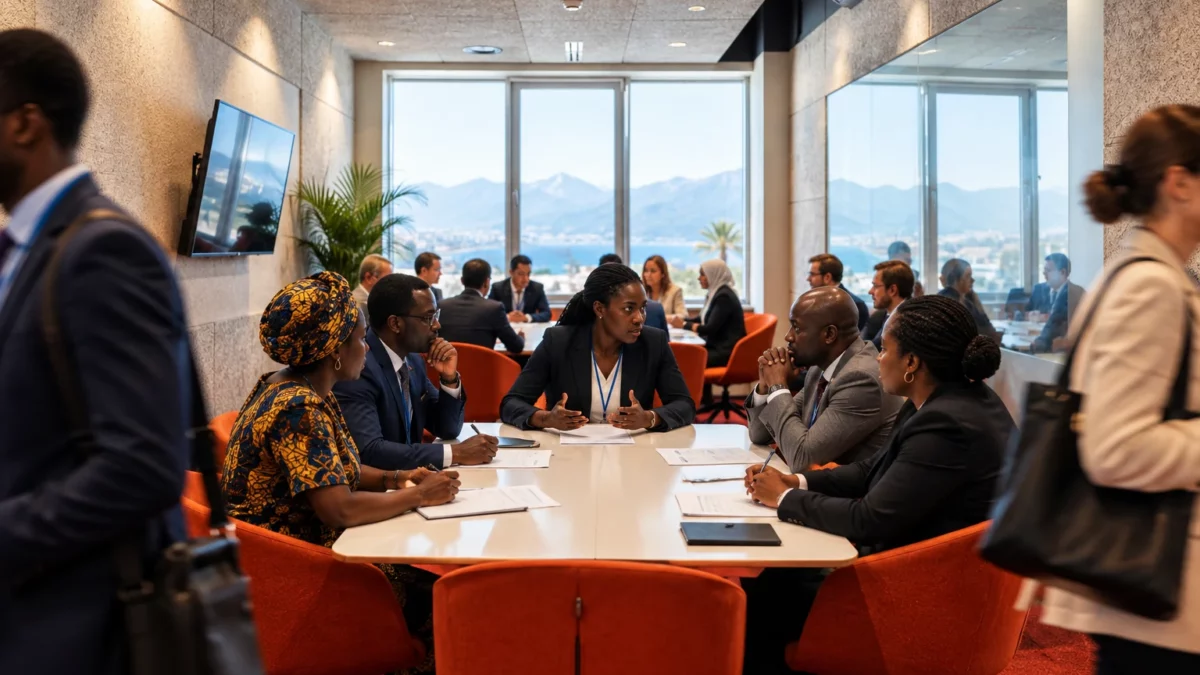
For African countries, the climate debate is not just about the promises made. It is also about the terms on which money can be accessed: grants or loans, quick or lengthy procedures, verifiable amounts or targets that are difficult to measure. In Antalya, these issues have brought the responsibility of developed countries and the burden of debt back to the fore.
In Antalya, a text still under negotiation
COP31, held in Antalya, Türkiye, was due to end on Friday 20 November 2026. But discussions were still continuing on Saturday 21 November, with no final agreement at that point. Draft decisions discussed during the conference should therefore not be presented as commitments that have been definitively adopted.
The African Group of Negotiators on Climate Change (AGN), which represents the positions of the continent’s countries in UN negotiations, defended the retention of the obligations set out in the Paris Agreement. On 19 November, its chair, Nana Dr Antwi-Boasiako Amoah, described any attempt to renegotiate the agreement, including its financial provisions, as a “red line”. The African Group of Negotiators’ statement confirms that finance and adaptation were among its priorities in Antalya.
Adopted in 2015, the Paris Agreement organises international climate action and recognises that countries have different capacities and responsibilities. Article 9 provides for developed countries to provide resources to developing countries to reduce their emissions and adapt to the effects of climate change. For African negotiators, preserving this distinction prevents an expansion of contributors from being used to dilute the commitments of traditional donors.
A target without a clear benchmark amount
The sticking point concerns adaptation finance in particular: sea walls, early warning systems, water management and infrastructure able to withstand extreme heat and flooding. An initial draft decision referred to at least $120 billion a year by 2035, in connection with the goal of tripling funding. A revised version removed this explicit amount, while retaining the principle of tripling and deferring the question of benchmarks to further work.
This change matters. Without a public baseline, countries will find it harder to determine which amount should be tripled, compare pledges with disbursements and assess progress. The COP31 presidency’s draft decision provides for work on benchmark options and a roadmap for adaptation finance. While negotiations remain open, however, these provisions could still change.
This follows on from the Glasgow Climate Pact, adopted in 2021, which called on developed countries to double their adaptation finance by 2025 compared with 2019 levels. The debate in Antalya shows that disagreements are not only about the ambition expressed. They also concern how amounts are defined, their timelines and how delivery can be verified.
Grants and loans: a tangible difference for budgets
The AGN wants grants and highly concessional loans — offered on particularly favourable terms — to play a larger role. The reasoning is practical: many adaptation measures protect people and places but do not generate direct revenue. A sea wall or an early warning system can prevent losses without generating the income needed to repay a commercial loan.
OECD figures offer an indication of the form of public climate finance, but not of the situation in Africa alone. In 2024, loans accounted for 67% of this finance provided by developed countries, or $68.5 billion, across all developing countries. Grants accounted for 29%, or $29.7 billion. These figures, published in the OECD report on climate finance, shed light on the composition of flows, but cannot on their own show how much each African country receives or the terms of each loan.
Access rules for grants pose another challenge. In Antalya, Amoah cited the case of the Global Environment Facility, where a country would, according to the example he gave, have to mobilise seven dollars of its own resources to obtain one dollar in grant funding. This ratio is not presented here as a universal rule applying to every funding arrangement: it illustrates negotiators’ concerns about co-financing requirements. For a state with limited budgetary room, raising this contribution can delay or prevent a project.
African contributions and the next stage of discussions
African governments also argue that they mobilise domestic resources when international support makes projects possible. Amoah cited four projects recently approved by the Green Climate Fund: around $300 million in grants were said to have been associated with $4.2 billion mobilised by the countries concerned. These figures, cited by the AGN chair, illustrate his argument about the leverage effect of funding. They are not, on their own, enough to establish a general trend across the continent.
The issue goes beyond the relationship between donors and governments. National budgets must balance infrastructure, public services and adaptation. Major cities need to protect networks, housing and transport from climate risks. In rural areas, agricultural resilience and access to water have a direct bearing on incomes and food security. Additional borrowing can reduce spending capacity, while accessible finance can help prevent future costs.
The next institutional step is also regional. The draft discussed in Antalya provides for a roadmap on adaptation and resilience finance, from Antalya to Addis Ababa, to inform work at COP32, scheduled for 2027 in the Ethiopian capital. African negotiators will therefore seek to turn the principles they have advocated into measurable criteria: what financial benchmark, what share of grants, what access rules and what monitoring of disbursements. It is on these points, more than on the wording of a target alone, that the agreement’s significance will be judged.