Algeria
 Egypt
 Libya
 Morocco
 Sudan
 Tunisia
 Benin
 Burkina Faso
 Cabo Verde
 Côte d'Ivoire
 Ghana
 Guinea
 Guinea-Bissau
 Liberia
 Mali
 Mauritania
 Niger
 Nigeria
 Sierra Leone
 The Gambia
 Togo
 Cameroon
 Central African Republic
 Chad
 DR Congo
 Equatorial Guinea
 Gabon
 Republic of the Congo
 São Tomé and Príncipe
 Burundi
 Comoros
 Djibouti
 Eritrea
 Ethiopia
 Kenya
 Madagascar
 Malawi
 Mauritius
 Mozambique
 Rwanda
 Seychelles
 Somalia
 South Sudan
 Tanzania
 Uganda
 Angola
 Botswana
 Eswatini
 Lesotho
 Namibia
 South Africa
 Zambia
 Zimbabwe
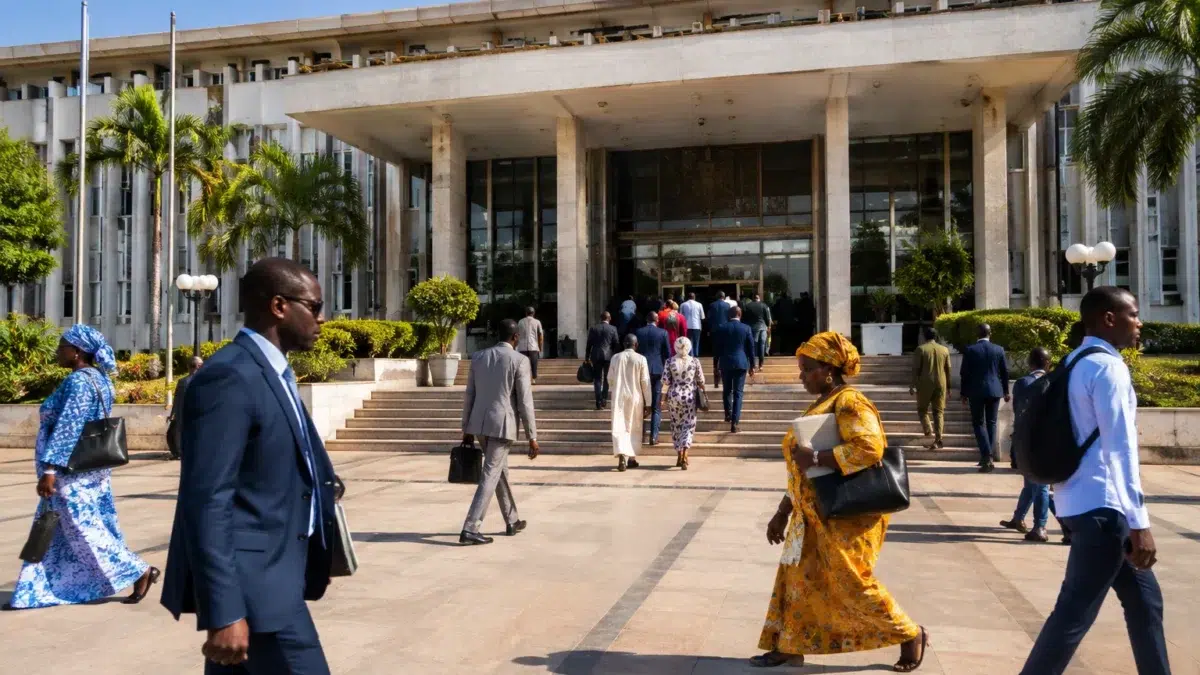
In Dakar, a rift already visible in state institutions is now taking official form within the movement that brought Bassirou Diomaye Faye to power. Pastef’s decision comes as political disagreements spill over into a budget showdown, with direct consequences for the running of the state.
A political split becomes official
On Tuesday 17 November, the National Council of Pastef-Les Patriotes announced that Bassirou Diomaye Faye and 31 other people had lost their party membership. In its statement, the party cited Article 6 of its statutes. Several Senegalese and regional media outlets reported the decision and the number of people affected.
The party presents the loss of membership as a consequence of its statutes. The measure does not end Bassirou Diomaye Faye’s presidential term. It does, however, confirm the rift between the head of state and Ousmane Sonko, Pastef’s leader and a central figure in the parliamentary majority. For several months, the two men have been pursuing distinct political paths.
Their alliance had been decisive in the 2024 presidential election. Barred from standing, Ousmane Sonko backed Bassirou Diomaye Faye’s candidacy; he was elected in the first round. Their separation subsequently deepened over political control of the movement and the conduct of public policy. In July 2026, the president launched his own party, the Patriotes républicains, marking a new stage in this realignment.
The budget at the heart of the showdown
The split comes amid a tense institutional standoff. Since the end of October, the National Assembly has repeatedly rejected the draft supplementary finance bill for 2026, which adjusts the budget during the year. The parliamentary majority, dominated by Pastef, is challenging the government’s spending choices and forecasts in particular.
On 19 November, Bassirou Diomaye Faye decided to bring the bill into force by decree after parliament rejected it, according to media reports. This outcome intensifies the conflict between the executive and the Assembly. The disagreement is therefore not only about party membership: it also concerns how spending priorities are set and how public finance constraints are addressed.
The economic context is limiting the authorities’ room for manoeuvre. The government is seeking to restore the credibility of the public accounts and is continuing discussions with the International Monetary Fund on a multi-year programme. But fiscal adjustment involves concrete trade-offs: investment, public services and household support are not affected in the same way. Parliamentary debates thus give political expression to choices that weigh on regions as well as Dakar.
A parliamentary majority faces a president without his party
Pastef’s decision creates an unusual situation: the president of the Republic no longer belongs to the movement that holds a strong majority in the National Assembly. This does not deprive the head of state of his constitutional office or powers. It does, however, complicate coordination between the presidency, the government and MPs.
For Pastef, the challenge is to preserve the cohesion of its organisation and maintain its authority over its elected representatives. For Bassirou Diomaye Faye, it is a matter of consolidating an independent political base and governing without the organisational support of the majority party. Public officials and MPs will therefore have to navigate loyalties that no longer necessarily align.
The impact will be measured in particular during consideration of the 2027 budget and in votes to come. An Assembly that rejects executive bills can slow government action. Conversely, repeated use of procedures to overcome a parliamentary deadlock risks deepening distrust between institutions. Citizens, meanwhile, have a stake in the continuity of public spending and officials’ ability to fund promised services.
A test for institutions and ECOWAS
The crisis is unfolding in a country often presented as an important contributor to political stability in West Africa. Senegal is a member of ECOWAS, the Economic Community of West African States, which brings countries in the region together around cooperation and integration. The current dispute is primarily a domestic political matter, but its outcome will be watched across a region where institutional tensions and transfers of power are major concerns.
The recent history of the two leaders’ relationship shows how quickly it has changed: allies during the election, they subsequently clashed over the direction of the political project and the management of the executive. The expulsion formalised on 17 November resolves none of these disagreements. Instead, it establishes a new framework, with two political camps now separated.
The next steps will be decisive: implementing the supplementary budget, debates on the 2027 budget and the institutions’ ability to maintain regular dialogue. Beyond the fate of Pastef and the president’s new party, the question is whether the rules of democratic competition will remain stable when the president and the parliamentary majority no longer belong to the same camp.