Algeria
 Egypt
 Libya
 Morocco
 Sudan
 Tunisia
 Benin
 Burkina Faso
 Cabo Verde
 Côte d'Ivoire
 Ghana
 Guinea
 Guinea-Bissau
 Liberia
 Mali
 Mauritania
 Niger
 Nigeria
 Senegal
 Sierra Leone
 The Gambia
 Togo
 Cameroon
 Central African Republic
 Chad
 Equatorial Guinea
 Gabon
 Republic of the Congo
 São Tomé and Príncipe
 Burundi
 Comoros
 Djibouti
 Eritrea
 Ethiopia
 Kenya
 Madagascar
 Malawi
 Mauritius
 Mozambique
 Rwanda
 Seychelles
 Somalia
 South Sudan
 Tanzania
 Uganda
 Angola
 Botswana
 Eswatini
 Lesotho
 Namibia
 South Africa
 Zambia
 Zimbabwe
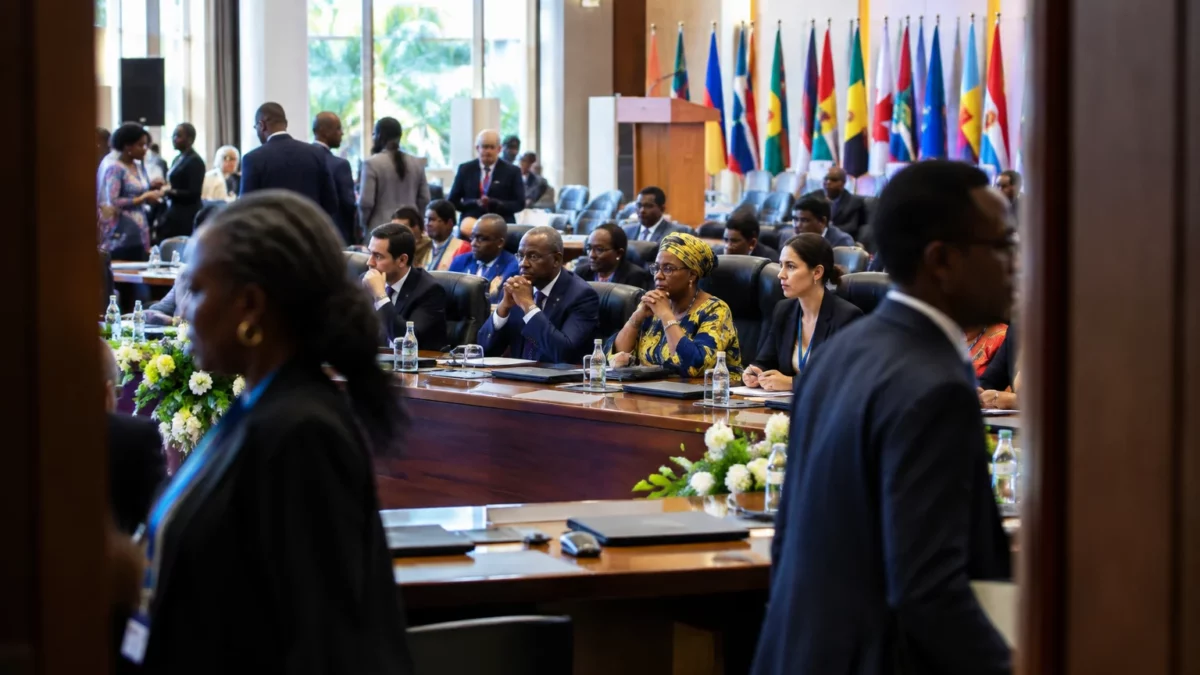
In Phnom Penh, the Francophonie summit was due to choose the person who would lead the International Organisation of La Francophonie (OIF) for the coming years. It ended with a different decision: to postpone the choice and keep Louise Mushikiwabo in office for the time being. For Kigali, this compromise avoids an immediate defeat but opens a new phase of tensions with Paris and Kinshasa.
A compromise to avoid a break
On 15 and 16 November 2026, OIF heads of state and government met in Phnom Penh, Cambodia. The organisation brings together countries and governments that share the French language. Its summit is its highest political body. The appointment of the secretary-general was expected to be among its major decisions.
The outgoing secretary-general, Rwanda’s Louise Mushikiwabo, wanted a third term. The Democratic Republic of the Congo (DRC) opposed her reappointment. Kinshasa had also threatened to leave the organisation if she were re-elected, according to several accounts of the summit.
With no agreement, members postponed the election for a year. Mushikiwabo will remain in office during this period, which is intended to allow a new appointment to be prepared and the applicable rules to be reviewed. The OIF describes the summit as its highest body; the postponement therefore highlights the limits of consensus when rivalries between states enter its deliberations.
The crisis concerns an important position, but also the place given to member states in an organisation where financial and diplomatic clout is unequal. France, the OIF’s largest contributor to its 2026 budget, called for a consensus solution. Kigali sees this as pressure. In an interview published after the decision, Rwanda’s foreign minister, Olivier Nduhungirehe, accused Paris of exerting influence over African delegations and denounced the idea that the OIF could operate as a “Françafrique”. These are the minister’s accusations, not an independently established fact.
Rivalry between Kigali and Kinshasa spills over into the OIF
Mushikiwabo’s candidacy is not simply a personal dispute. It is part of a deeply deteriorated relationship between Rwanda and the DRC. Kinshasa accuses Kigali of supporting M23, an armed group active in eastern Congo. Rwanda rejects these accusations. Security and diplomatic tensions between the two neighbours thus weighed on an election held thousands of kilometres from the Great Lakes region.
The DRC invoked its weight in the Francophone world and its opposition to another term. The country has a large number of French speakers and plays a major political role in the organisation. For Kinshasa, the OIF issue also concerns how its concerns about the country’s east are heard in international forums. For Kigali, withdrawing its candidate under pressure from other states would have infringed its sovereignty and its right to put forward a candidate.
The decision in Phnom Penh therefore settles neither the regional rivalry nor disagreements over the OIF’s role. It suspends them. Mushikiwabo’s temporary continuation in office allows Kigali to retain a Rwandan representative at the head of the organisation, while the delay spares Kinshasa from having to accept a third term immediately. This outcome may prevent a short-term rupture without addressing the reasons for the deadlock.
Paris challenged, but not the only factor
France encouraged a compromise, in a context where its financial contribution gives it considerable influence. Kigali disputes that it can steer members’ choice. The gap between these two interpretations lies at the heart of the post-summit debate: Paris presents its approach as an attempt to preserve the organisation’s unity; the Rwandan minister describes it as political pressure.
The dispute also recalls that Franco-Rwandan relations have gone through periods of rapprochement after many years of tensions linked in particular to the 1994 genocide against the Tutsi and France’s responsibilities. In 2021, following the Duclert commission report, France acknowledged its responsibilities in the genocide. This rapprochement does not erase diplomatic disagreements. French support for Mushikiwabo during her previous terms did not guarantee identical backing for her current candidacy.
The regional implications extend beyond relations between Paris and Kigali. Rwanda is a member of the East African Community (EAC), a regional bloc for political and economic cooperation. The DRC is also a member. Competition over the leadership of the OIF shows how tensions between two members can reverberate in continental or international institutions. It also complicates dialogue efforts in the Great Lakes region.
Challenges to French influence alone do not explain the deadlock. African delegations do not form a homogeneous bloc: they can defend different national interests and support different candidates. The central question remains whether they can assert these choices without the search for consensus turning into horse-trading among the most influential members.
A year to rebuild trust
The delay gives member states time to prepare a new appointment and discuss succession rules. It does not guarantee that an agreement will be reached. The coming months will show whether the candidates remain the same, whether compromises emerge or whether procedures are changed. The challenge will also be to preserve the OIF’s credibility among its members, as its leadership has become the visible arena for a regional disagreement.
For Rwanda, the episode confirms that diplomatic competition does not take place only in African organisations. For the DRC, it is a reminder that its place in the Francophonie can serve as political leverage, without being enough to resolve its disputes with its neighbour. As for Paris, its attempt to mediate has fuelled Kigali’s criticism of French influence. The next milestone will therefore be as much a test of procedure as a test of trust between states.
Sources for context and cross-checking: Africanews on the delay and tensions between the DRC and Rwanda ; Actualite.cd on Congolese reactions ; The EastAfrican on the regional stakes ; official overview of the OIF summit.