Algeria
 Egypt
 Libya
 Morocco
 Sudan
 Tunisia
 Benin
 Burkina Faso
 Cabo Verde
 Côte d'Ivoire
 Ghana
 Guinea
 Guinea-Bissau
 Liberia
 Mali
 Mauritania
 Niger
 Nigeria
 Sierra Leone
 The Gambia
 Togo
 Cameroon
 Central African Republic
 Chad
 DR Congo
 Equatorial Guinea
 Gabon
 Republic of the Congo
 São Tomé and Príncipe
 Burundi
 Comoros
 Djibouti
 Eritrea
 Ethiopia
 Kenya
 Madagascar
 Malawi
 Mauritius
 Mozambique
 Rwanda
 Seychelles
 Somalia
 South Sudan
 Tanzania
 Uganda
 Angola
 Botswana
 Eswatini
 Lesotho
 Namibia
 South Africa
 Zambia
 Zimbabwe
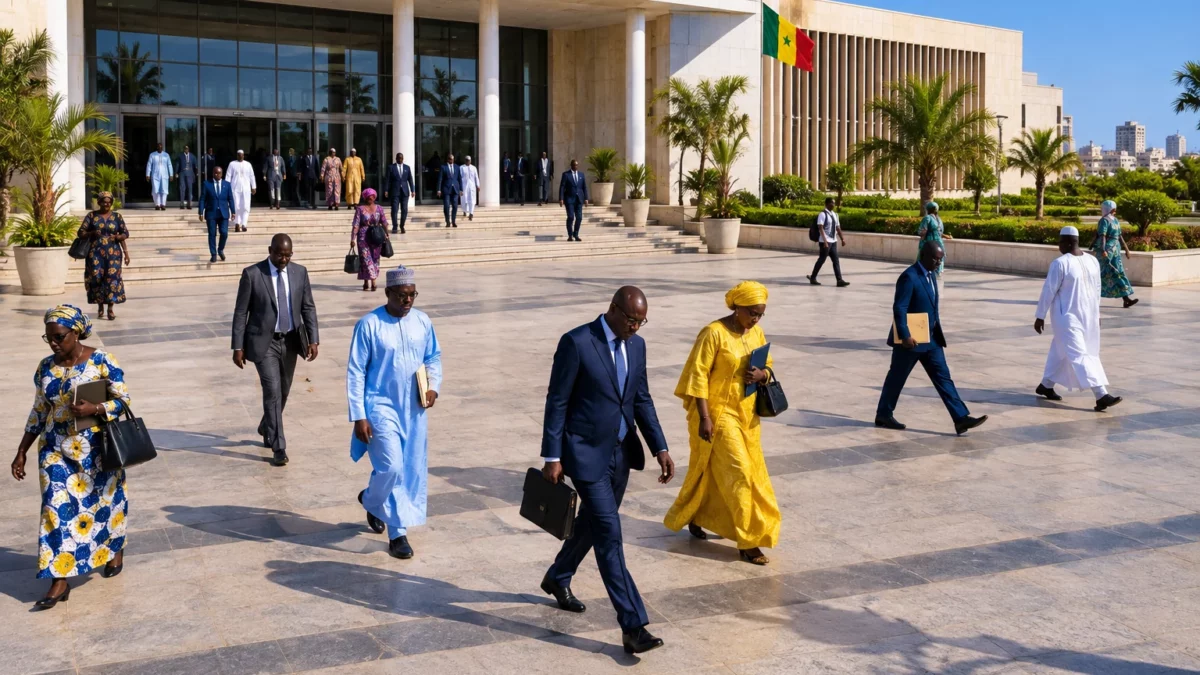
A deficit of CFAF 585.5 billion at the end of September does not, by itself, show where Senegal will finish the year. It measures the gap between revenue and spending accumulated over nine months. But the budget debate has already shifted to a more immediate question: what trajectory should be set for the final three months, after parliament rejected the supplementary budget proposed by the government?
A balance still below the initial annual target
As at 30 September 2026, general budget revenue stood at CFAF 3,785.2 billion, against expenditure of CFAF 4,370.7 billion. The difference represents a deficit of CFAF 585.5 billion, or 2.5% of nominal gross domestic product (GDP) as set out in the initial budget law. This amount is equivalent to 47% of the annual deficit originally forecast, set at CFAF 1,245.1 billion, or 5.4% of GDP, according to the quarterly report by Senegal’s ministry responsible for finance.
These figures describe the position on a particular date, not a year-end forecast. Expenditure represented 60.8% of the appropriations opened for the year, while revenue had reached 63.8% of its annual target. The pace of these two items is not, however, enough to determine the final balance: revenue and disbursements may evolve differently in the final quarter.
The report also records a shortfall of CFAF 91.7 billion against the domestic revenue target. The shortfall attributed to expected revenue from the Economic and Social Recovery Plan (PRES) amounted to CFAF 162.3 billion. This was partly offset by CFAF 70.6 billion in additional revenue from other items. These are figures from the budget administration, published in the budget execution report at the end of September.
Disagreement centres on the year-end trajectory
The government had proposed a supplementary budget law, revising the budget during the financial year. The bill raised the projected annual deficit to 7.6% of GDP, from 5.4% in the initial budget. Higher spending, particularly on energy subsidies, and revised revenue estimates were among the reasons given for the new forecast.
On 3 November, the National Assembly rejected the bill after adopting a preliminary motion. The vote was 109 in favour, 20 against and three abstentions, out of 132 votes cast, the Senegalese Press Agency (APS) reports. The parliamentary institution also confirms the bill’s rejection. The MP who introduced the preliminary motion cited concerns about the credibility of the budget forecasts. This was an argument put forward in the political debate, not an independent conclusion about the accounts. Details of the vote are reported by the APS and the National Assembly’s statement.
The rejection does not retrospectively change the deficit recorded at 30 September. It nevertheless leaves open the question of the budget framework applicable for the rest of the financial year and how the state will adjust its spending and financing. The government and MPs do not share the same reading of the forecasts: the executive justified an upward revision, while some legislators challenged the reliability of the assumptions. The disagreement therefore concerns both the transparency of the figures and spending choices.
Revenue, spending and the cost of financing
For Senegalese people, the trade-offs are not confined to a national indicator. Public revenue funds, among other things, state services and investment. Energy subsidies, meanwhile, can limit price increases for households and businesses, but they also use up budgetary resources. Decisions to cut or maintain these subsidies can therefore have different effects depending on incomes, economic activities and regions.
The constraint also applies to financing. Senegal borrows on the regional market of the West African Monetary Union (WAMU), where several states issue securities to meet their needs. On 11 September, the country raised CFAF 101.3 billion, slightly above its CFAF 100 billion target. Investors had offered CFAF 109 billion, according to the market results consulted. This operation provides a measure of Senegal’s access to regional financing at that date; it does not, on its own, meet the country’s cash requirements for the rest of the year.
The backdrop remains one of successive revisions to the public accounts and the recovery effort launched by the authorities. The challenge is to reconcile revenue mobilisation, continuity of priority spending and access to credit, without confusing a budget target with a result already achieved. September’s data provide a snapshot; the annual figure will depend on the revenue actually collected and the spending carried out by year-end.
An issue under regional scrutiny
The matter is also of interest to WAMU partners, since Senegalese sovereign bond issues take place in a market shared with other member states. Borrowing costs and conditions must therefore be considered alongside the financing needs of neighbouring countries, without assuming that their budgetary situations are identical. At the level of ECOWAS, which brings together West African countries, the Senegalese debate also highlights the importance of transparency and parliamentary oversight in the management of public finances.
The next step will be to see how Dakar sets out budget adjustments after the bill’s rejection and what assumptions will be adopted for the following financial year. For now, the 2.5% deficit remains the official figure at the end of September; 7.6% remains a projection in the rejected supplementary budget bill, not the final annual deficit.