Algeria
 Egypt
 Libya
 Morocco
 Sudan
 Tunisia
 Benin
 Burkina Faso
 Cabo Verde
 Côte d'Ivoire
 Ghana
 Guinea
 Guinea-Bissau
 Liberia
 Mali
 Mauritania
 Niger
 Nigeria
 Senegal
 Sierra Leone
 The Gambia
 Togo
 Cameroon
 Central African Republic
 Chad
 DR Congo
 Equatorial Guinea
 Gabon
 Republic of the Congo
 São Tomé and Príncipe
 Burundi
 Comoros
 Djibouti
 Eritrea
 Ethiopia
 Kenya
 Madagascar
 Malawi
 Mauritius
 Mozambique
 Rwanda
 Seychelles
 Somalia
 South Sudan
 Tanzania
 Uganda
 Angola
 Botswana
 Eswatini
 Lesotho
 Namibia
 South Africa
 Zambia
 Zimbabwe
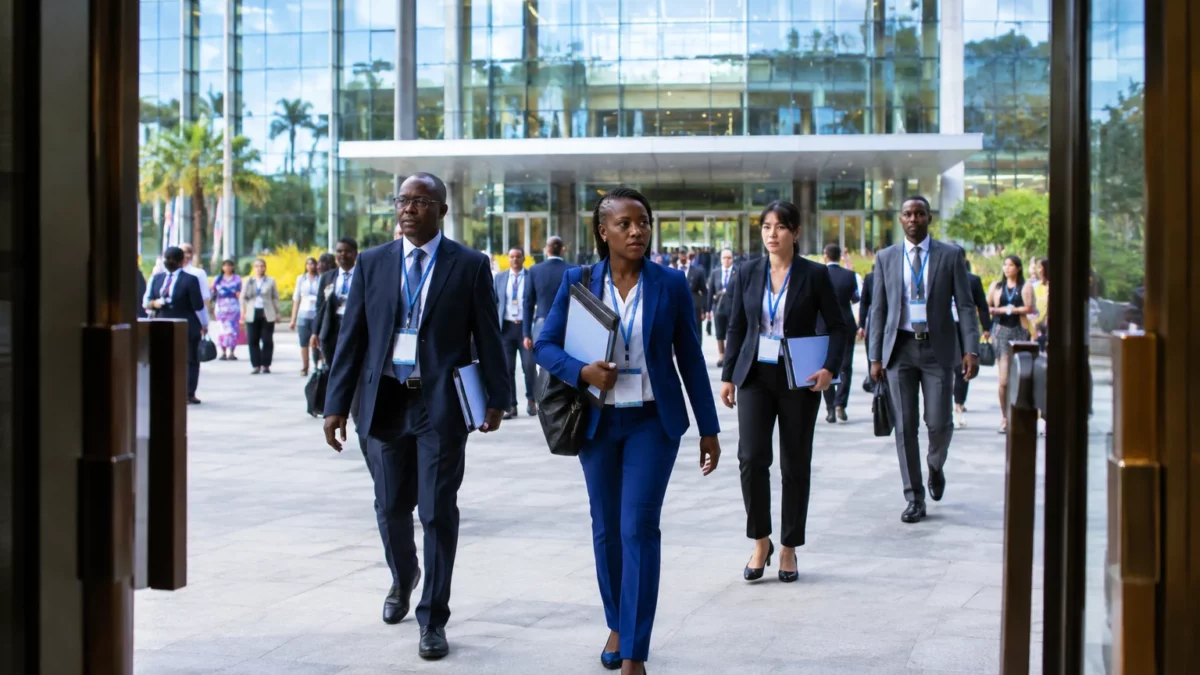
In Phnom Penh, the Francophone summit did more than celebrate a language. It exposed a question of power: who sets the priorities of an organisation whose members are largely in Africa, and how can dialogue be maintained when its states disagree?
The answer lies in debates on peace, governance and the institution’s leadership. It also lies in a concrete choice: to make the Francophonie a space for cooperation between diverse societies, rather than simply a diplomatic network associated with French.
A political, cultural and economic organisation
The International Organisation of La Francophonie (OIF) brings together states and governments linked by the use or teaching of French, or by a desire to cooperate. It is therefore not limited to promoting a language. Its missions also cover education, cultural diversity, economic cooperation, democracy and crisis prevention.
Its summit brings together heads of state and government periodically to set broad shared priorities. The network comprises 90 states and governments, divided into full members, associate members and observers. These statuses do not all carry the same weight in decision-making.
For African countries, the stakes go beyond diplomacy. French coexists with national languages and other international languages, in circumstances that vary widely between countries. Access to school, training, digital content and job opportunities also depends on national policies and available resources. The OIF can support programmes, but it does not replace states in their education choices.
The Phnom Penh summit, in Cambodia, was held on 15 and 16 November 2026. Its official theme, “Reinvesting in peace for shared prosperity and lasting stability”, linked security with development and social cohesion. The Cambodian capital hosted the gathering for the first time.
The OIF’s leadership at the heart of disagreements
The succession of Secretary-General Louise Mushikiwabo dominated the negotiations. The Rwandan leader was seeking a third term. The Democratic Republic of the Congo (DRC), whose capital is Kinshasa, opposed this and had put forward Juliana Amato Lumumba as a candidate.
Before the summit, the Congolese presidency had said that Kinshasa was prepared to withdraw the candidacy to help secure a compromise, subject to reciprocity. This official position sheds light on the negotiations, but is not, in itself, an independent account of their outcome.
At the close, the Associated Press reported that members had agreed to extend Mushikiwabo’s term by one year before choosing new leadership. The decision therefore postpones the resolution of the disagreement rather than removing it. The compromise may provisionally preserve the organisation’s unity, but leaves the question of succession open.
The dispute is set against a backdrop of acute tensions between Kigali and Kinshasa. The DRC, the United States and United Nations experts accuse Rwanda of supporting the M23, an armed group active in eastern Congo. The Rwandan government rejects the accusations. The dispute over the OIF’s leadership cannot, in itself, settle these allegations; it does, however, show how regional crises can weigh on multilateral institutions.
A diplomatic compromise, concrete expectations
For leaders, the OIF presidency offers the ability to influence the agenda, statements and cooperation networks. For the public, the organisation’s value depends more on tangible effects: access to training, youth mobility, support for the media, university cooperation and economic opportunities.
These benefits are neither automatic nor evenly distributed. Capital cities generally have more direct access to meetings and institutions. Young people, businesses, universities and associations outside political centres need programmes that are genuinely accessible, funding and continuity. This is the level at which summit announcements can be assessed.
The declaration adopted in Phnom Penh highlights crisis prevention, mediation, peace education and stronger dialogue with regional organisations. It also addresses information integrity, press freedom and the risks associated with artificial intelligence. These commitments set out a programme; their impact will depend on the resources mobilised and their implementation in the countries concerned.
The summit also highlighted an institutional reality: African states do not form a single bloc. The DRC backed a candidate and its interpretation of the crisis in the country’s east; Rwanda supported keeping its leader at the head of the organisation; other governments sought a negotiated way forward. Interests, alliances and priorities vary from one country to another.
Regional and continental implications to watch
Tensions between Kinshasa and Kigali extend beyond the OIF. They concern relations in the Great Lakes region and mediation efforts pursued in various African and international forums. The summit can provide a place for dialogue, but it does not replace regional mechanisms or negotiations directly related to the conflict.
The OIF’s cohesion is also being tested by the withdrawal of Mali, Niger and Burkina Faso, announced in 2025 after their suspension following coups. These departures are a reminder that Francophone cooperation depends on trust between governments, not just a shared language. They also raise the question of how the organisation deals with political crises and transitions of power.
Finally, a summit in Southeast Asia is a reminder that the Francophonie is synonymous neither with France nor with the African continent. But the weight of African countries, their populations and their political debates makes their representation decisive for the institution’s credibility. What follows will be measured against two tests: members’ ability to resolve the succession without a lasting rift, and the translation of the Phnom Penh commitments into sustained cooperation.