
 Algeria
 Libya
 Morocco
 Sudan
 Tunisia
 Benin
 Burkina Faso
 Cabo Verde
 Côte d'Ivoire
 Ghana
 Guinea
 Guinea-Bissau
 Liberia
 Mali
 Mauritania
 Niger
 Nigeria
 Senegal
 Sierra Leone
 The Gambia
 Togo
 Cameroon
 Central African Republic
 Chad
 DR Congo
 Equatorial Guinea
 Gabon
 Republic of the Congo
 São Tomé and Príncipe
 Burundi
 Comoros
 Djibouti
 Eritrea
 Ethiopia
 Kenya
 Madagascar
 Malawi
 Mauritius
 Mozambique
 Rwanda
 Seychelles
 Somalia
 South Sudan
 Tanzania
 Uganda
 Angola
 Botswana
 Eswatini
 Lesotho
 Namibia
 South Africa
 Zambia
 Zimbabwe
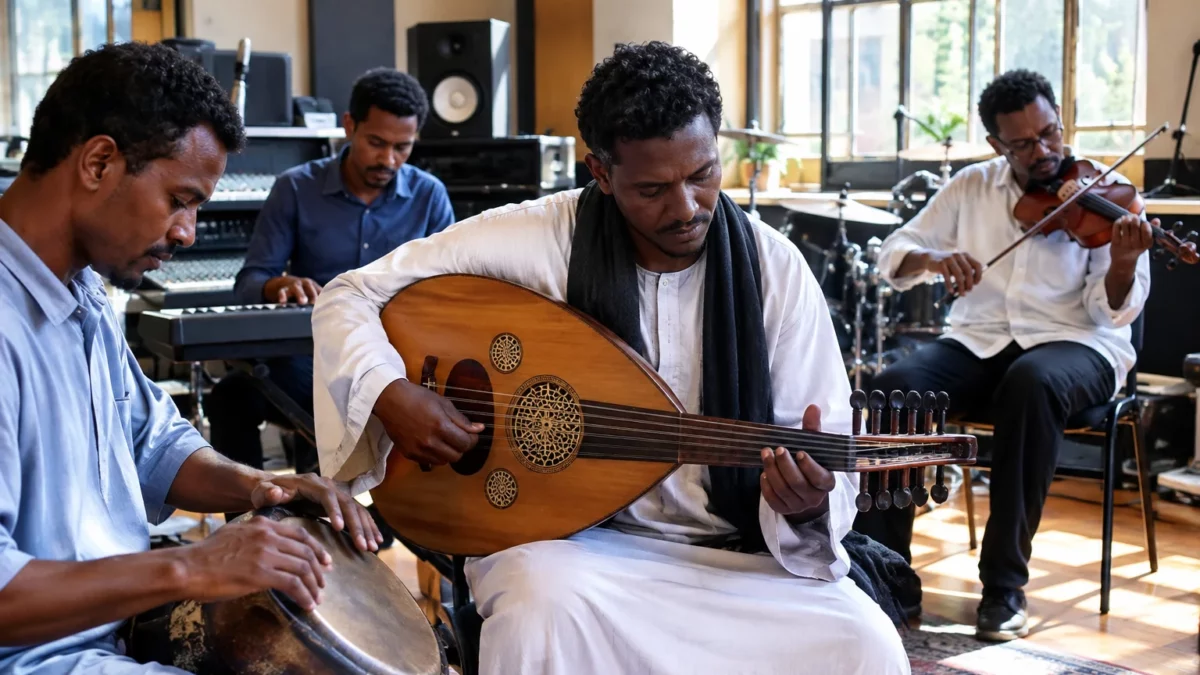
Thousands of kilometres from Khartoum, a Cairo studio is bringing Aswat al-Madina’s voices together again. For the Sudanese group, making music again after its members were dispersed is about more than returning to work: it is also a way to keep alive a connection with a city and a pro-democracy movement transformed by war.
A music scene born at a moment of rupture
Aswat al-Madina means “the voices of the city”. The collective formed in Khartoum around music that blends Sudanese traditions, jazz, reggae and contemporary rhythms. Its songs addressed corruption, social inequality and life under authoritarian rule. The group was part of an independent scene seeking new sounds and new spaces for expression.
This approach reached a wider audience during the popular mobilisation of December 2018. The protests called for an end to the regime of Omar al-Bashir, who had been in power since 1989. The group’s songs circulated on phones, in cars and near protest gatherings. They accompanied a mobilisation led by Sudanese women and men of different generations, far beyond musical circles.
Co-founder Mohamed al-Mustafa describes this music as a form of commitment. “We consider our music and the songs we perform to be a revolution in themselves,” he said. He describes lyrics that gave young people a voice and named realities that other artists were reluctant to address.
War scatters the group
On 15 April 2023, fighting broke out between the Sudanese Armed Forces and the Rapid Support Forces, a paramilitary force. The conflict began as the two sides shared power after the fall of al-Bashir; the 2021 coup then halted the civilian transition. Rivalries over the integration of the armed forces contributed to the confrontation.
Two days before the fighting began, Aswat al-Madina’s members were still preparing the set list for a concert. The war then scattered the group. Some musicians made their way to Egypt, while others settled elsewhere in Africa or in the United Arab Emirates. Regular rehearsals gave way to exchanges about visas, travel and relatives left behind in Sudan.
Resuming studio work in Cairo is giving the collective a tangible form again, without erasing the distance between its members. They have to compose together again after years in exile and following separate paths. They are also considering concerts and an international tour. The group wants to keep singing about homeland and family, themes that take on particular meaning when a return remains uncertain.
It is not only artists who have been displaced. Egypt is one of the neighbouring countries where millions of people from Sudan have sought refuge since the war began. For the musicians, Cairo offers opportunities to rehearse and meet, but exile also means rebuilding professional networks and adapting to residency constraints. An investigation published by Sudanese media outlet Al-Ahdath looks more broadly at musical initiatives by young Sudanese people in Egypt, from concerts and teaching to collaborations.
Creating despite exile
The place of Roba Beshir, the group’s keyboardist and its only woman, is a reminder that the obstacles do not stem from war alone. She explains that joining an ensemble made up of men meant overcoming her family’s reservations and social norms. Her experience highlights the barriers women musicians can face, even in an artistic milieu that sees itself as independent.
War undermines the material conditions needed for creative work: instruments, rehearsal spaces, income and travel are all difficult to secure. For artists who have been dispersed, sustaining a shared activity also depends on borders and administrative procedures. Music cannot replace security or institutions that have been destroyed or weakened. But it can preserve ties between group members and with an audience that grew up with their songs.
A 2026 BBC News Africa programme about the group confirms that its musicians are continuing their work and thinking about its future from exile. This continuity does not mean that Sudan’s music scene has regained its pre-war conditions. Rather, it shows that some creative work moves with the artists, while other initiatives are taking shape within the diaspora.
A Sudanese voice beyond borders
Aswat al-Madina’s journey links three moments in Sudan’s recent history: opposition to al-Bashir’s regime, hope for a civilian transition and open war between two armed forces. The group had accompanied a movement against authoritarianism. It must now create as the army and the Rapid Support Forces vie for power and territory.
At regional level, Egypt is hosting a significant share of those who have fled the conflict, while the Intergovernmental Authority on Development (IGAD), a cooperative organisation in the Horn of Africa, and the African Union are among the actors involved in mediation efforts. These initiatives have not produced a lasting ceasefire. Cross-border movements and the dispersal of Sudanese communities also give culture a role in exchanges between Sudan and its neighbours.
For the group, the next step is to turn its reunion into new songs and concerts. Their reach will depend on travel conditions, the ability to work together and how the war develops. Aswat al-Madina cannot speak for all Sudanese people. But its songs carry a distinct memory: that of young people demanding change, and artists now seeking to continue their work far from Khartoum.



