Algeria
 Egypt
 Libya
 Morocco
 Sudan
 Tunisia
 Benin
 Burkina Faso
 Cabo Verde
 Côte d'Ivoire
 Ghana
 Guinea
 Guinea-Bissau
 Liberia
 Mali
 Mauritania
 Niger
 Nigeria
 Sierra Leone
 The Gambia
 Togo
 Cameroon
 Central African Republic
 Chad
 DR Congo
 Equatorial Guinea
 Gabon
 Republic of the Congo
 São Tomé and Príncipe
 Burundi
 Comoros
 Djibouti
 Eritrea
 Ethiopia
 Kenya
 Madagascar
 Malawi
 Mauritius
 Mozambique
 Rwanda
 Seychelles
 Somalia
 South Sudan
 Tanzania
 Uganda
 Angola
 Botswana
 Eswatini
 Lesotho
 Namibia
 South Africa
 Zambia
 Zimbabwe
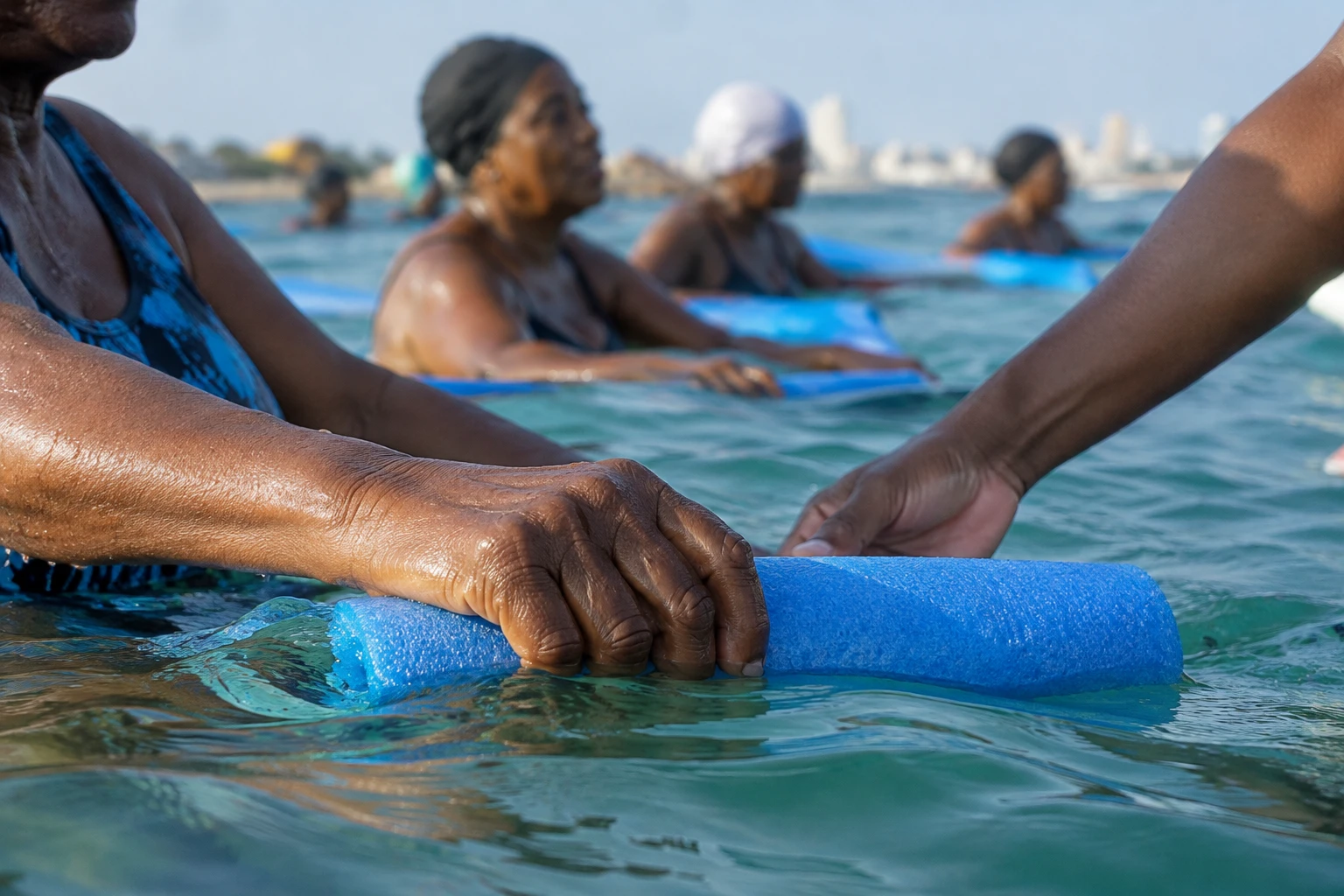
In Ngor, the session begins before Dakar is fully awake. In the water, participants of all ages repeat movements at their own pace. Some come to keep fit. Others are seeking to regain ease of movement after an illness or loss of mobility. Here, physical activity is combined with the everyday support of a group.
A local practice beyond the excitement of the Games
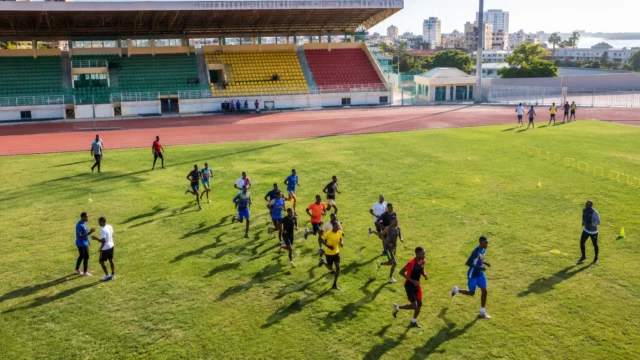
In November 2026, Senegal will host the Youth Olympic Games (YOG), taking place from 31 October to 13 November. This first Olympic event on the continent is drawing attention to Dakar and its sports venues. But in Ngor, the Dolphins’ activities follow a different timetable: morning sessions and the needs of local residents. The International Olympic Committee sets out the dates and context for the Dakar YOG.
Ngor is in the Dakar region, on the Cape Verde peninsula. The Dolphins club offers aquagym in the sea. Its founder, Ndiamé Sambe, a former firefighter specialising in underwater operations, started in 2012 with around ten people. He says the club now welcomes at least 200 participants a day, and sometimes as many as 300. These figures, like the accounts gathered on site, are reported by organisers and participants; they are not an independent count.
The initiative is part of a context in which access to rehabilitation and adapted transport can remain difficult. An Associated Press report on the club describes the obstacles faced by people with reduced mobility in Senegal. It cites, in particular, a lack of accessibility in some places and difficulties accessing specialist care. This account does not describe every situation, but it sheds light on the constraints that travelling to Ngor can involve.
In the water, everyone progresses at their own pace
Exercises sometimes begin on the sand before continuing in the water. Groups are organised according to participants’ mobility and needs. The water’s buoyancy supports part of the body’s weight, while its resistance works the muscles. Movements are adapted to each person’s abilities. Aquagym can support physical activity or rehabilitation, but it does not replace a diagnosis or medical follow-up.
Yayé Habibata, who says she had a stroke about three years ago, explains that she initially underwent eight months of physiotherapy. She has attended the sessions for more than two years, four times a week, travelling from Keur Massar. “In the water, I can do some movements that are more difficult for me on land,” she says. At first, her husband accompanied her. She now makes the journey alone, according to her account.
Ibrahima, 55, also links the sessions to progress in his daily life. He says he lost some mobility after developing muscle weakness and electric-shock sensations on his right side, at the end of 2024. He attributes his difficulties to cervical osteoarthritis. After starting the exercises in a wheelchair, he says he has regained “80%” of his independence. He says he can walk, write and drive again. This percentage reflects his personal assessment, not a published clinical measurement.
Other participants come because of joint pain or to maintain physical activity alongside their medical care. Khady Sow says she joined the group after being diagnosed with osteoarthritis. With help from the trainers and other members, she is also learning to overcome her fear of the sea. At 81, Coura Cissé, described as the group’s oldest member, says she attends three times a week. She says she drives and does her shopping alone. These accounts illustrate individual journeys, but do not allow conclusions about an identical effect for everyone.
The group matters as much as the exercises
In Ngor, mutual support extends beyond time in the water. Khady Sow describes a group whose members know one another and sometimes accompany each other home after a session. Coura Cissé says her friends call her when she misses several appointments. For participants coming from distant neighbourhoods, these ties can also help them organise their journeys.
Travel nevertheless remains a practical obstacle. Amy accompanies both her parents from Thiaroye, in Dakar’s suburbs. Her father uses a wheelchair; her mother has knee problems. The journey and transport make it difficult for them to attend. This reality is a reminder that access to a local activity depends on more than the existence of a session: people must also be able to reach the beach, have someone to accompany them and find mobility solutions.
Cost also plays a part. Yayé Habibata says she previously paid 10,000 CFA francs per physiotherapy session, three times a week, compared with a monthly contribution of 10,000 CFA francs to the Dolphins. These amounts reflect her personal experience and do not describe all healthcare fees or associated expenses. Ndiamé Sambe says the contribution helps pay for equipment and trainers’ expenses, and that people who cannot afford to pay are welcomed.
A health and mobility issue across the region
The club replaces neither health services nor public accessibility policies. Its experience nevertheless shows how a neighbourhood initiative can combine physical activity, informal support and social ties. In Dakar, distances between the outskirts and the coast affect people differently, depending on their resources, independence and means of transport.
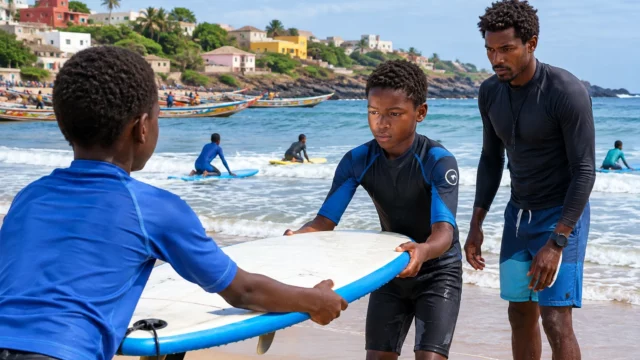
The practice also echoes other sporting initiatives along Dakar’s coastline, in a city where the sea is a place of work, leisure and physical activity. An Associated Press report on Ngor’s surfers illustrates, in a different context, the role of water sports in local life.
The YOG’s visibility may highlight facilities and elite sport. The Dolphins’ sessions point to another challenge: enabling more people to be physically active, including when age, illness or reduced mobility change what they are able to do. For this initiative, the questions to watch are practical: continuity of coaching, access to sessions and ways to make the journey easier for participants coming from the outskirts of Dakar.