
 Algeria
 Egypt
 Libya
 Morocco
 Sudan
 Tunisia
 Benin
 Burkina Faso
 Cabo Verde
 Côte d'Ivoire
 Ghana
 Guinea
 Guinea-Bissau
 Liberia
 Mali
 Mauritania
 Niger
 Nigeria
 Senegal
 Sierra Leone
 The Gambia
 Togo
 Cameroon
 Central African Republic
 Chad
 Equatorial Guinea
 Gabon
 Republic of the Congo
 São Tomé and Príncipe
 Burundi
 Comoros
 Djibouti
 Eritrea
 Ethiopia
 Kenya
 Madagascar
 Malawi
 Mauritius
 Mozambique
 Rwanda
 Seychelles
 Somalia
 South Sudan
 Tanzania
 Uganda
 Angola
 Botswana
 Eswatini
 Lesotho
 Namibia
 South Africa
 Zambia
 Zimbabwe
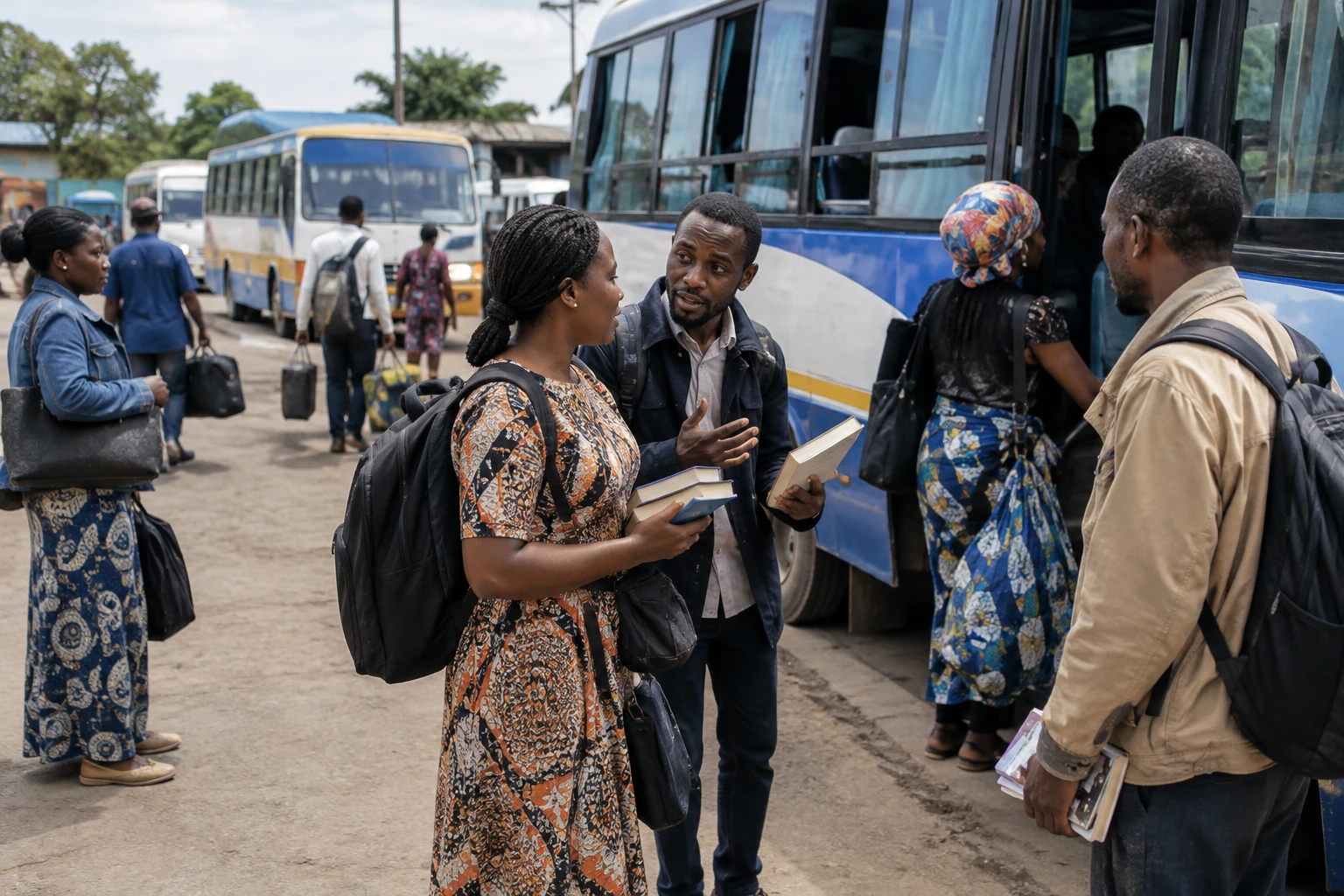
A book festival is not enough to sustain an industry. But it can bring together those who write, publish, translate, sell and share works. In the Democratic Republic of the Congo (DRC), the Book Festival returns in November with this ambition, while taking its events beyond Kinshasa.
A national festival beyond the capital
The 12th edition is scheduled to run from 10 to 28 November 2026. It will cover seven cities and localities: Kinshasa, Matadi, Muanda, Kolwezi, Kisangani, Kwilu-Ngongo and Lubumbashi. The programme opens in Matadi on 10 November. In Kinshasa, the main events are planned for 14 to 21 November, before the tour continues in several cities.
This timeline clears up an important confusion: the November 2025 edition was the 11th, held from 8 to 15 November. The November 2026 schedule is indeed for the 12th edition, according to the festival’s official website and Congolese media. This distinction matters when placing announcements and events in context, without attributing one year’s programme to another.
The 2026 programme lists 52 events and 23 guests, including discussions, readings, workshops, performances, screenings and concerts. Events are advertised as free, although some workshops have limited capacity. The festival is organised by the Institut français in the DRC with the EUNIC cluster, a cooperation network of European cultural institutes.
Books, from creation to meeting the public
Beyond meetings with authors, the festival will hold a professional programme in Kinshasa from 17 to 19 November. Industry figures from the capital and the provinces are expected to exchange views on their practices and possible collaborations. Publishing, translation, bookselling and literary events are distinct but interdependent professions: a text must be prepared, produced, transported and made accessible before it can reach its readers.
The programme also includes workshops in writing, playwriting and illustration, as well as a focus on comic books. These formats bring people closer to the different stages of creation. They allow young participants, in particular, to experiment with writing and images, rather than seeing a book as a finished object that appears fully formed in a bookshop.
The circulation of works remains a practical challenge in a country with vast distances. An event in Kinshasa does not automatically reach readers in Matadi, Kisangani or Lubumbashi. The tour broadens access to discussions and workshops, but it cannot by itself resolve questions around regular distribution, the availability of books or the continuity of cultural initiatives in the provinces.
Building bridges between disciplines
The programme is not limited to printed books. Theatre, poetry, music, comic books and public readings give texts other spaces in which to circulate. In Kinshasa, an evening on 19 November is set to celebrate Congolese poetry, with works inspired by the writing of Sony Labou Tansi and Valentin-Yves Mudimbe. The tribute to Sony Labou Tansi also recalls the diversity of Congolese literary heritage: born in what is now the DRC, the writer later lived and worked in the Republic of the Congo, where he died in 1995.
French novelist Marie NDiaye, winner of the 2009 Prix Goncourt, is the patron of this edition. Her participation is part of a programme bringing together artists and professionals from several countries. For these exchanges to provide lasting support to the Congolese sector, local authors, publishers and booksellers will also need a visible place, and collaborations must continue beyond the festival dates.
A cultural event, not yet a consolidated industry
The festival can help connect industry figures and introduce audiences to new works. However, it is not, on its own, a measure of the economic health of the book sector in the DRC. The available announcements provide no consolidated data on sales, print runs, the number of bookshops or the share of Congolese publishers in the programme. It would therefore be premature to conclude that the sector has already become professionalised.
The effects are not the same for everyone. Invited artists gain a platform and opportunities to meet audiences. Publishers and booksellers can make contacts, while readers in the cities on the tour can attend events without travelling to Kinshasa. But the reach of these opportunities will depend on the availability and price of books, points of sale and the ability to maintain professional ties after the event.
This edition also resonates across Central Africa, where the movement of works and professionals crosses national borders. The official programme mentions, in particular, exchanges with the Bilili BD Festival in Brazzaville. This relationship between the two banks of the Congo River points to the potential for regional cooperation in comic books and creative work, without conflating the DRC, whose capital is Kinshasa, with the Republic of the Congo, whose capital is Brazzaville.
In the coming days, the key points to follow are the professional programme in Kinshasa, the effective participation of provincial cities and the tour’s next stop in Lubumbashi, scheduled from 23 to 28 November. The most useful assessment will not be just the number of events held. It will also show whether the meetings led to collaborations, better circulation of books and new opportunities for Congolese professionals.
See the official programme for the 2026 DR Congo Book Festival and the Kinshasa schedule published by Actualite.cd.



