Algeria
 Egypt
 Morocco
 Sudan
 Tunisia
 Benin
 Burkina Faso
 Cabo Verde
 Côte d'Ivoire
 Ghana
 Guinea
 Guinea-Bissau
 Liberia
 Mali
 Mauritania
 Niger
 Nigeria
 Senegal
 Sierra Leone
 The Gambia
 Togo
 Cameroon
 Central African Republic
 Chad
 DR Congo
 Equatorial Guinea
 Gabon
 Republic of the Congo
 São Tomé and Príncipe
 Burundi
 Comoros
 Djibouti
 Eritrea
 Ethiopia
 Kenya
 Madagascar
 Malawi
 Mauritius
 Mozambique
 Rwanda
 Seychelles
 Somalia
 South Sudan
 Tanzania
 Uganda
 Angola
 Botswana
 Eswatini
 Lesotho
 Namibia
 South Africa
 Zambia
 Zimbabwe
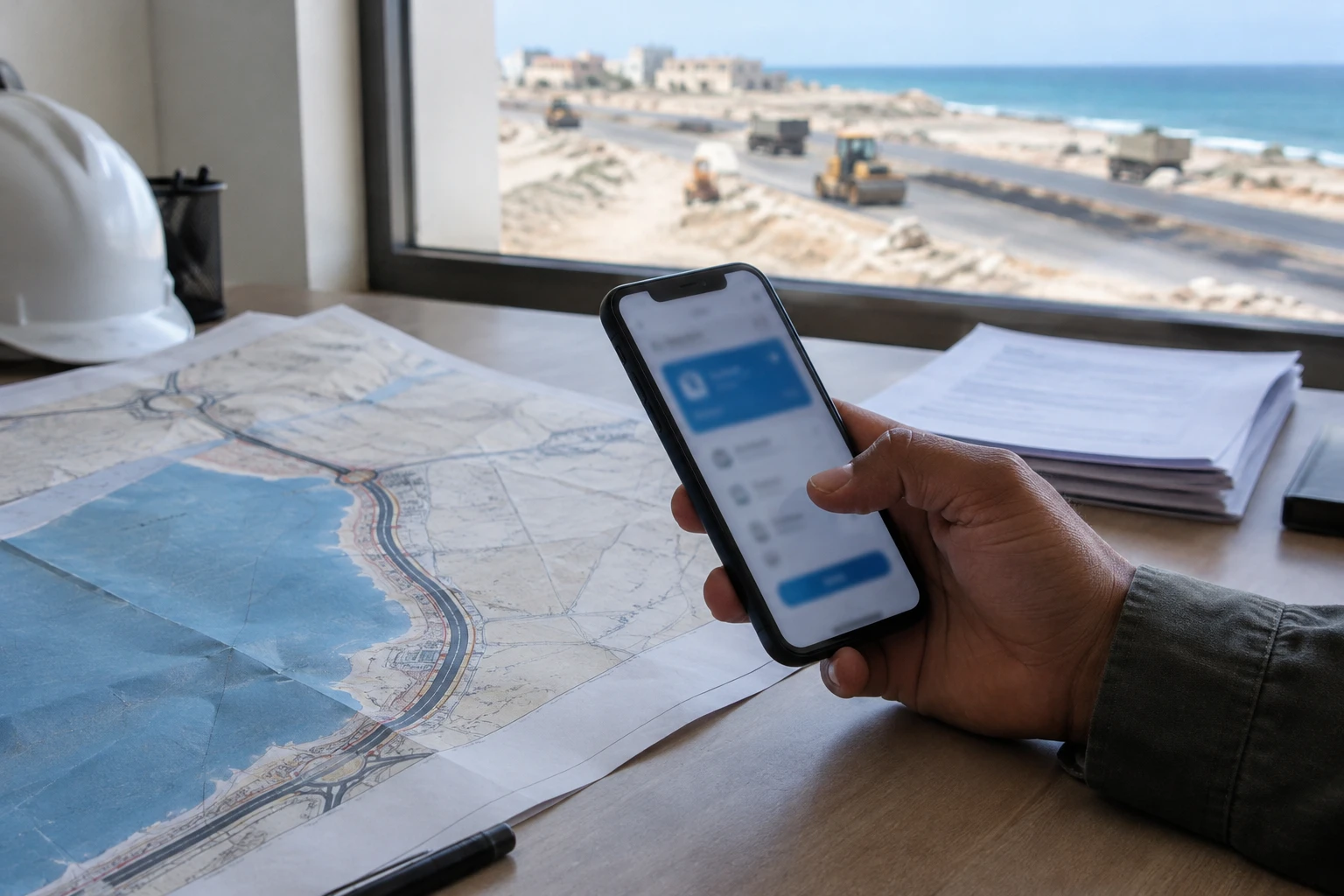
A highway can bring cities closer without, on its own, resolving a country’s political and financial divisions. In Libya, restarting the coastal project now depends as much on funding and public procurement as on the new route being considered in the east.
A national project caught in a fragmented landscape
The Emsaad-Ras Jedir road is intended to run along the Libyan coast, from the Egyptian border in the east to the Tunisian border in the west. The Authority responsible for its construction and management describes the project as a route of about 1,750 kilometres, designed to connect the main coastal cities and facilitate the transport of goods.
The project is set against a national backdrop of divided institutions and authorities since 2011. This fragmentation complicates the continuity of public decisions, the coordination of projects and the oversight of contracts spanning several years. In Tripoli, the seat of the government recognised by some international actors, decisions on infrastructure on this scale also affect territories administered by other centres of power.
The regional dimension is tangible: Ras Jedir is a major crossing between Libya and Tunisia, while the eastern end opens towards Egypt. The road could also connect to trans-Saharan corridors. However, this prospect does not mean the route is already part of an operational continental network. The Arab Maghreb Union, which includes Libya, Tunisia and Algeria, among others, remains largely inactive as a framework for regional integration.
Eastern contract starts from scratch
On 5 November 2026, the Libyan authority responsible for the project confirmed the termination of its contract with Webuild, signed in 2013 for an eastern section of about 400 kilometres. According to the Libyan news agency LANA, the authority cites the company’s failure to meet its contractual obligations and says the decision comes after four years of negotiations. A new tender process has been announced.
The dispute also concerns the financial balance of the contract. Reports published about the case cite an initial price of close to €940 million and a request for a substantially higher revision, attributed to Webuild, amid changing costs. As the parties have not made the full records of their exchanges public in the material reviewed, these amounts should be regarded as reported figures, not as definitively established contractual sums.
The announced redesign would alter the route in the east. The Emsaad-Tobruk segment would be dropped because another expressway between the two cities is under construction. In its place, an Al Marj-Suluq link would be added. The proposed route would pass through Al Qaara and Al Kharruba before joining the coastal road at Suluq, towards Benghazi. The authority says studies for the Al Kharruba-Suluq section still need to be completed.
This change is therefore more than a new tender. It means clarifying interfaces with existing or planned roads, updating studies and defining the guarantees that will apply to future contracts. These steps will affect both the timetable and the final cost.
Italian funding remains a decisive question
The project is based on the Treaty of Friendship, Partnership and Cooperation concluded between Italy and Libya on 30 August 2008. Rome undertook to allocate $5 billion over 20 years to Libyan projects, including the highway. LANA had previously described a €3.6 billion allocation for the coastal route. The two amounts are in different currencies: they should not be conflated or presented as two separate commitments.
The difficulty is also evident in the west. For the Ras Jedir-Al Aziziyah section, the contractor Todini is waiting for an advance payment. According to information published on 5 November, the request has been sent to the Italian side; the Libyan authority is considering splitting the payment to allow work to start on a sub-section. This solution could unlock part of the project, but it guarantees neither full funding nor a stable timetable.
The previous contract highlights what is at stake for companies, whether foreign or Libyan. A restart could open up contracts for domestic construction and public works companies. But payment delays, price revisions and uncertainty over guarantees could also limit their ability to mobilise staff, equipment and subcontractors. For residents and transport operators, the benefits will depend above all on sections actually entering service: more reliable access to cities, smoother journeys and continuity of trade.
What to watch
The next step is the publication of the terms of the new tender and the final route. The payment of the advance expected by Todini will also need to be monitored, as will decisions on the other sections of the route. Without available funding and clarified contractual rules, the road risks remaining a succession of announced contracts rather than becoming a continuous corridor.
At regional level, the project matters for trade between Libya, Tunisia and Egypt, and could strengthen connections to the south. But it will have an impact beyond Libyan territory only if connecting infrastructure, border posts and arrangements for cross-border movement keep pace. For now, the new tender announcement marks a reorganisation of the project; it does not mean work has resumed on the eastern section.
For cross-checking the details, see Madar’s report on the new route and tender, the Libyan agency LANA’s details on the treaty and highway funding and Agenzia Nova’s information on the negotiations and contract.