
 Algeria
 Egypt
 Libya
 Morocco
 Sudan
 Tunisia
 Benin
 Burkina Faso
 Cabo Verde
 Côte d'Ivoire
 Ghana
 Guinea
 Guinea-Bissau
 Liberia
 Mali
 Mauritania
 Niger
 Nigeria
 Senegal
 Sierra Leone
 The Gambia
 Togo
 Cameroon
 Central African Republic
 Chad
 Equatorial Guinea
 Gabon
 Republic of the Congo
 São Tomé and Príncipe
 Burundi
 Comoros
 Djibouti
 Eritrea
 Ethiopia
 Kenya
 Madagascar
 Malawi
 Mauritius
 Mozambique
 Rwanda
 Seychelles
 Somalia
 South Sudan
 Tanzania
 Uganda
 Angola
 Botswana
 Eswatini
 Lesotho
 Namibia
 South Africa
 Zambia
 Zimbabwe
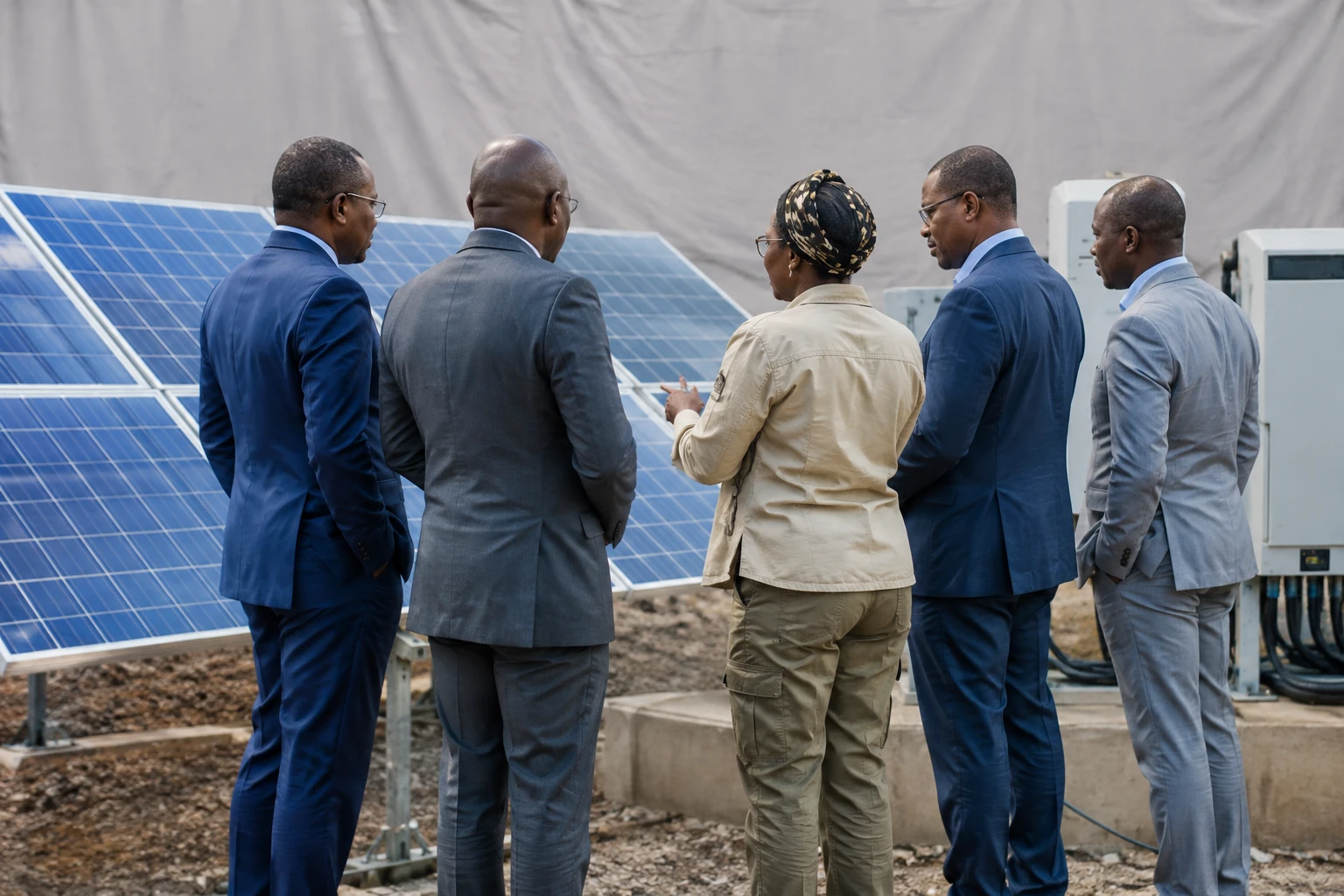
In Kindu, reliable electricity can change how a school, a health centre or a workshop operates. In Maniema, the laying of the foundation stone for a solar power plant at Mikelenge highlights a broader issue: generating more power is not enough if networks and equipment cannot sustainably supply residents.
A province where installed capacity remains limited
In 2024, Maniema had 18.7 megawatts of installed electrical capacity, according to the annual report of the Electricity Sector Regulatory Authority (ARE). This total comprises 17 megawatts of hydroelectric capacity and 1.7 megawatts of thermal capacity. It describes the theoretical power of the recorded installations, not necessarily the electricity available at any given time: some power plants across the country are shut down or operate below their capacity.
This point is essential. An installed plant guarantees neither regular production nor a connection for households. The condition of equipment, the transmission of electricity and local distribution also matter. In a sprawling province, remote villages far from the main centres can remain off-grid, even when an installation exists nearby.
Maniema is not an isolated case. In the Democratic Republic of the Congo, production infrastructure is unevenly distributed across provinces. The ARE’s 2024 report records 3,646.5 megawatts installed nationally, a significant share of which is concentrated in Kongo Central and Lualaba. These figures give a measure of the recorded fleet, but on their own they do not show how many people actually benefit from a reliable service.
Mikelenge: a solar plant and a network still to be built
On 26 October 2026, Prime Minister Judith Suminwa laid the foundation stone for a 3-megawatt-peak photovoltaic plant at Mikelenge, near Kindu. According to the Congolese Press Agency, the project includes battery storage of 2.5 megawatt-hours and two backup generators of 630 kilovolt-amperes each. The works are being carried out by the National Agency for Electrification and Energy Services in Rural and Peri-urban Areas, with support from the Industry Promotion Fund.
The authorities announced the connection of 2,700 households, as well as schools, health facilities and productive activities. The installation must also be accompanied by a distribution network. This last link will turn production capacity into a concrete service: without lines, connections and maintenance, the energy produced does not necessarily reach the intended users.
The project is part of an electrification plan for Maniema covering 2026 to 2036. The stated objectives envisage raising the province’s installed capacity to 25 megawatts by 2030, and then to 65 megawatts by 2036. The programme notably provides for hybrid solar mini-grids in the territorial capitals, as well as the rehabilitation and extension of existing hydroelectric plants. These are projections, and their realisation will depend on financing, network construction and the availability of equipment.
The national challenge: linking capacity to needs
Across the country, the gap between energy potential and actual access remains considerable. The ARE estimates national installed capacity at around 4,133 megawatts in 2025. Yet data from the World Bank’s Tracking SDG 7 platform indicate an electricity access rate of 11.3% in 2024. The two indicators do not measure the same thing: the first counts the power of installations, the second the share of the population with access to the service.
The divide is also territorial. Urban centres and major economic hubs concentrate more infrastructure, while many rural communities remain difficult to connect through long and costly lines. For households, access can determine lighting and the storage of medicines. For small businesses and producers, irregular supply complicates local processing and may require more expensive backup solutions.
Yet the DRC has substantial resources. The Ministry of Water Resources and Electricity records about 94 gigawatts of hydroelectric potential, as well as solar sites. However, turning this potential into usable electricity requires investment in power plants, transmission networks and distribution systems. The challenge is therefore as much one of infrastructure and its maintenance as of natural resources.
A provincial, national and regional issue
Maniema is part of the Democratic Republic of the Congo, a Central African country that also participates in the Southern African Development Community (SADC), a regional economic cooperation organisation. Electricity interconnections and cross-border trade can contribute to regional energy security. However, they do not replace the local networks needed to serve secondary towns and rural areas in the Congo.
The Mikelenge plant will therefore serve as a test of a concrete ambition: combining solar production, storage, thermal backup and distribution in a province where recorded capacity remains modest. Monitoring will focus on the actual commissioning, the number of connections genuinely supplied and the continuity of service. These results will show whether the announced provincial targets can bring electricity closer to residents and support local economic activity.



