Algeria
 Egypt
 Libya
 Morocco
 Sudan
 Benin
 Burkina Faso
 Cabo Verde
 Côte d'Ivoire
 Ghana
 Guinea
 Guinea-Bissau
 Liberia
 Mali
 Mauritania
 Niger
 Nigeria
 Senegal
 Sierra Leone
 The Gambia
 Togo
 Cameroon
 Central African Republic
 Chad
 DR Congo
 Equatorial Guinea
 Gabon
 Republic of the Congo
 São Tomé and Príncipe
 Burundi
 Comoros
 Djibouti
 Eritrea
 Ethiopia
 Kenya
 Madagascar
 Malawi
 Mauritius
 Mozambique
 Rwanda
 Seychelles
 Somalia
 South Sudan
 Tanzania
 Uganda
 Angola
 Botswana
 Eswatini
 Lesotho
 Namibia
 South Africa
 Zambia
 Zimbabwe
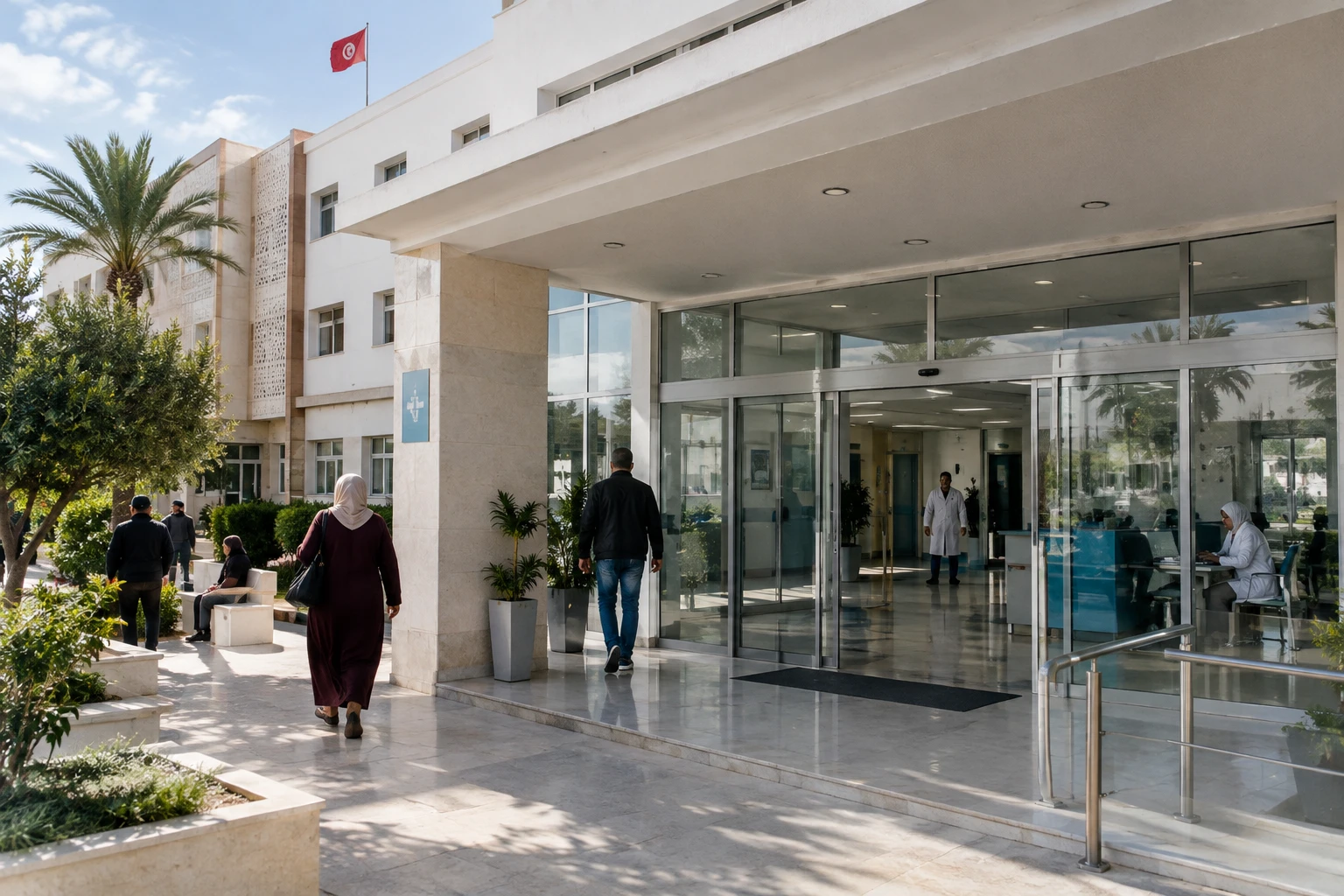
A medical record accessible across several departments can prevent repeat tests and help a doctor follow a patient over time. In Tunisia, delivering on this promise depends less on announcing a partnership than on hospitals’ ability to run tools that are compatible, secure and genuinely available.
A Tunisian project already under way
Digital health is not a new project for Tunis. In 2012, Tunisia launched a pilot scheme in six public hospitals with the support of Spanish experts. It aimed to bring a patient’s medical information together in a single record, rather than keeping it separate across departments.
A second phase, carried out from 2015 to 2017 with €1 million in European funding, was intended to extend the system to ten more facilities. The International and Ibero-American Foundation for Administration and Public Policies (FIIAPP), together with Spanish health services, said 16 hospitals had integrated the system by the end of the programme. The outcome of the Tunisian-Spanish hospital programme also covered medico-economic management, meaning the linking of care data with costs.
Since then, Tunisia’s health ministry has continued with several digital projects. A programme backed by the French Development Agency (AFD), launched in 2019 with a €27.3 million loan, includes plans for electronic medical records, digital archives and telemedicine tools in public hospitals. Its stated aim is also to reduce disparities in access to care between regions. The AFD’s presentation of its e-health programme sets out its components.
Madrid, a possible partner, not a model to copy
On Monday, 2 November 2026, Health Minister Mustapha Ferjani met Spain’s ambassador, Isidro Antonio González Afonso, in Tunis. The Tunisian news agency TAP reports that discussions focused on developing digital hospitals and electronic medical records. They also covered medicines, organ transplantation and other areas of health co-operation. The Tunisian news agency TAP’s report confirms the date and participants.
The meeting opens a possible avenue for co-operation, but does not in itself constitute a funding agreement or a timetable for implementation. The authorities have highlighted the need for an action plan to turn priorities into concrete projects. The next steps will therefore have to specify who will oversee implementation, which facilities will be involved and how existing systems will be connected.
Spain’s experience could provide expertise in interoperability: the ability of different software and facilities to exchange medical information in a way that is understandable and secure. But Tunisia’s challenge is not to replicate a foreign system exactly. It is to build tools suited to the organisation of Tunisian hospitals, the resources available and national data-protection rules.
Technology alone will not bring care closer
For patients, a shared record can help ensure continuity of care as they move from one department to another. It can also reduce repeat tests, provided the information is up to date and accessible to authorised professionals. For hospital teams, the change requires new equipment, training and time to adapt practices.
The benefits will not be distributed automatically. A well-connected hospital in a large city may adopt these tools more quickly than a remote facility facing network or staffing difficulties. Telemedicine can bring some specialists closer to inland and rural regions, but it cannot replace infrastructure or in-person consultations when they are needed.
Data security is another decisive issue. A digital record centralises sensitive information: access rights, responsibilities in the event of an incident and the terms for sharing data must be clearly defined. The IT Centre of the Health Ministry already lists training and support for public institutions among its responsibilities. The IT Centre of the Health Ministry develops and deploys hospital information systems.
A regional issue of health sovereignty
In September and October 2026, Tunisia put digital transformation at the heart of a national health charter and international exchanges on digital health. TAP reports that the authorities highlighted equitable access, data protection and the development of national skills. This approach gives the talks with Spain a broader framework: foreign partnerships should support lasting Tunisian capabilities. The commitments in the National Health Charter place digital technology within the goal of universal health coverage.
Across North Africa, these choices may interest neighbouring countries also grappling with patient mobility, the uneven distribution of specialists and the modernisation of hospitals. The Arab Maghreb Union (AMU), a regional body that includes Tunisia, could provide a forum for dialogue, although the 2 November meeting remains bilateral and is not part of a joint Maghreb programme.
The next concrete measure will therefore not be another partnership announcement, but the adoption of a plan specifying responsibilities, confidentiality safeguards and the facilities involved. That is the stage at which the announced co-operation can be judged by its effects: more continuous care for patients, without widening the gap between hospitals in Tunis and those in the regions.