Algeria
 Egypt
 Libya
 Morocco
 Sudan
 Tunisia
 Benin
 Burkina Faso
 Cabo Verde
 Côte d'Ivoire
 Ghana
 Guinea
 Guinea-Bissau
 Liberia
 Mali
 Mauritania
 Niger
 Nigeria
 Senegal
 Sierra Leone
 The Gambia
 Togo
 Cameroon
 Central African Republic
 Chad
 Equatorial Guinea
 Gabon
 Republic of the Congo
 São Tomé and Príncipe
 Burundi
 Comoros
 Djibouti
 Eritrea
 Ethiopia
 Kenya
 Madagascar
 Malawi
 Mauritius
 Mozambique
 Rwanda
 Seychelles
 Somalia
 South Sudan
 Tanzania
 Uganda
 Angola
 Botswana
 Eswatini
 Lesotho
 Namibia
 South Africa
 Zambia
 Zimbabwe
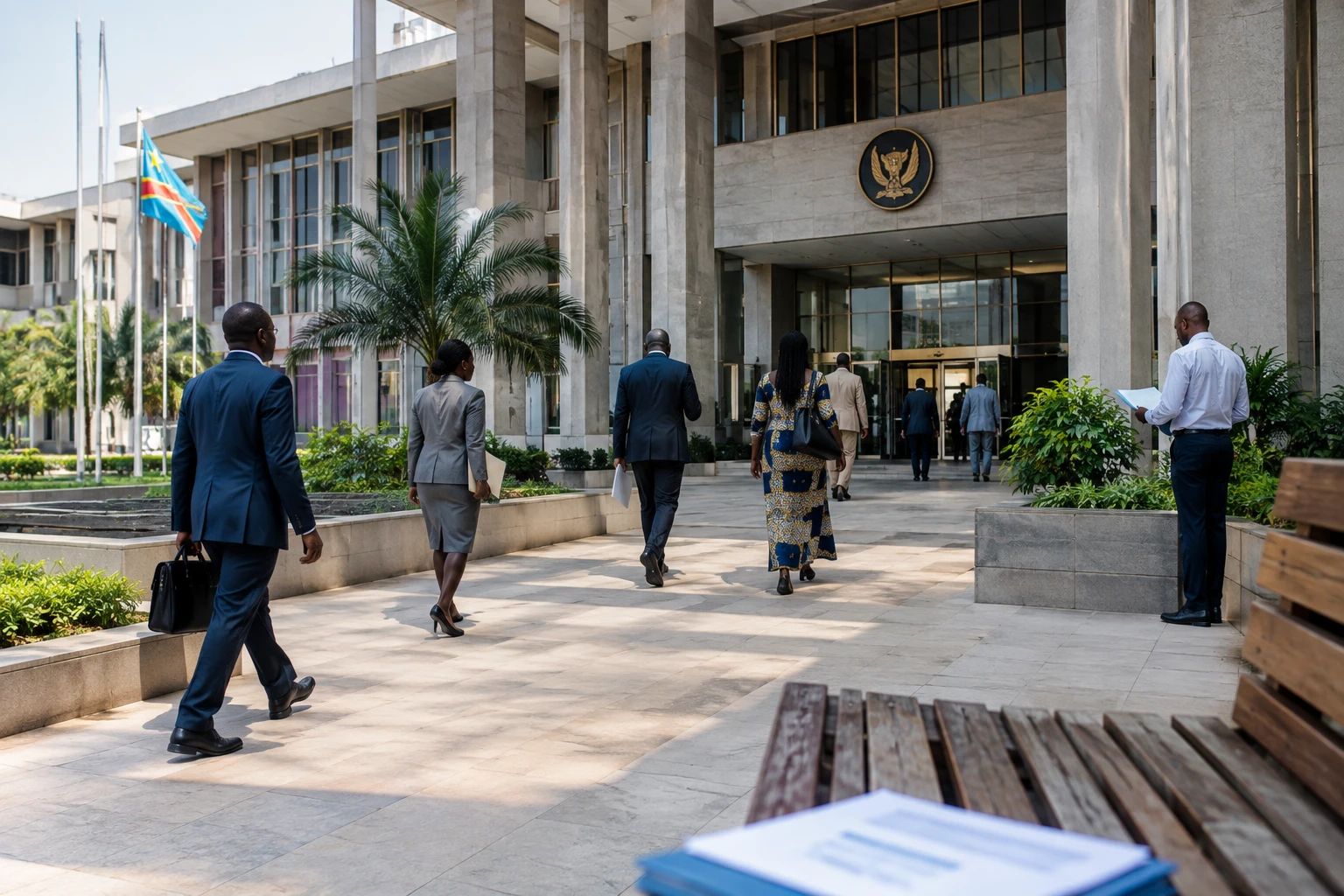
In the Democratic Republic of the Congo, the security effort announced for 2027 is not limited to buying military equipment. It also covers internal security, justice, diplomacy and community stabilisation. The challenge will be to turn the planned allocations into tangible results, as the draft budget has not yet completed its parliamentary examination.
A draft still before parliament
On 29 October 2026, Prime Minister Judith Suminwa presented a 56,930 billion Congolese franc finance bill, equivalent to about $24.8 billion, to the National Assembly. The overall allocation is up nearly 12% on the 2026 revised budget, according to the Congolese Press Agency and the Prime Minister’s Office.
The following day, MPs declared the text admissible. This opens detailed examination by committee; it does not mean the budget has been definitively adopted. Allocations and priorities may still change before the next stages of the parliamentary process. The Ministry of the Budget has published the finance bill documents on its official portal.
Under the draft, 14,091 billion Congolese francs, or about $6.1 billion, is allocated to the government pillar devoted to protecting the territory and the security of people and their property. This is 18.4% more than the 11,896 billion allocated in the 2026 budget. However, this is not an allocation reserved exclusively for the armed forces: the government also includes internal security, community stabilisation, justice and diplomacy.
In the east, security remains a regional issue
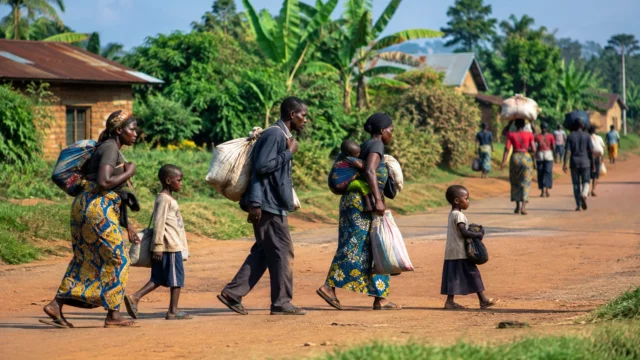
This budget priority comes amid a security situation that remains tense in the east of the country. Violence and clashes involving armed groups continue to affect the areas concerned. Kinshasa accuses Rwanda of supporting the AFC/M23; Kigali disputes the accusation. In this sensitive context, claims about responsibility and military developments should be reported with attribution, rather than presented as established facts without independent verification.
The crisis extends beyond the DRC’s borders. The DRC is a member of the Southern African Development Community (SADC), a regional organisation in southern Africa, and the East African Community (EAC), which brings together several countries in the Great Lakes region and East Africa. Diplomatic initiatives, including the Washington and Doha processes, are also seeking to advance discussions. Their effectiveness will depend, among other things, on the implementation of commitments and the ability to verify any de-escalation.
The prime minister said funding for this pillar would support the training, equipment and logistics of the forces, as well as the welfare of military personnel and police officers. The Prime Minister’s Office also reported to MPs a plan to recruit 20,000 military personnel and 18,000 police officers in 2027. These announcements indicate the stated objectives; they guarantee neither that recruitment will take place nor that security will improve.
Announced funding must deliver results on the ground
For the authorities, strengthening the forces’ capabilities is a response to security pressures. But the effectiveness of a budget increase cannot be measured solely by the amount approved. It also depends on spending execution, the availability of equipment, training, logistics and oversight of how funds are used. Tangible results for people in the east will ultimately depend on the protection of civilians and the lasting return of public services to affected areas.
The effects will not be the same everywhere. In Kinshasa, debates focus on national trade-offs and the state’s ability to fund its priorities. In the eastern provinces, the concerns are more immediate: everyday security, access to services and continuity of economic activity. For employees in the formal economy as well as small traders and informal workers, lasting improvement requires security that allows people to travel, work and trade without interruption.
The government is also planning 14,151 billion francs for basic social services, including education, healthcare, water and electricity. Public investment is expected to reach 13,722 billion, up 30% year on year. These figures, too, are projections in the draft. Whether they are achieved will determine if the announced effort balances security imperatives with social needs and infrastructure.
Financing is another challenge. The government is relying on broadening the tax base, fighting fraud and modernising financial administrations. It forecasts real growth of 5.8% in 2027, compared with 5.6% in 2026, and average inflation of 6.4%, after 3.5% the previous year. These are budget assumptions, not outcomes already secured; how they evolve will affect available revenue and purchasing power.
The next test: budget scrutiny and execution
At the regional level, then, the issue goes beyond military reinforcement. Stability in the east of the DRC affects relations between neighbouring countries, regional mechanisms and diplomatic efforts to reduce clashes. A larger budget can support state capacity, but it cannot replace a political solution or verification of commitments made by the parties concerned.
The next step is parliamentary: after being declared admissible by the National Assembly, the text must undergo more in-depth examination before proceeding further through the legislative process. Changes to allocations will need to be tracked, then the funds ultimately approved compared with actual spending. For Congolese people, the decisive measure will not simply be the size of the allocation, but what it actually enables the country to change, both in conflict zones and in essential public services.