Algeria
 Egypt
 Libya
 Morocco
 Sudan
 Tunisia
 Benin
 Burkina Faso
 Cabo Verde
 Côte d'Ivoire
 Ghana
 Guinea
 Guinea-Bissau
 Liberia
 Mali
 Mauritania
 Niger
 Nigeria
 Sierra Leone
 The Gambia
 Togo
 Cameroon
 Central African Republic
 Chad
 DR Congo
 Equatorial Guinea
 Gabon
 Republic of the Congo
 São Tomé and Príncipe
 Burundi
 Comoros
 Djibouti
 Eritrea
 Ethiopia
 Kenya
 Madagascar
 Malawi
 Mauritius
 Mozambique
 Rwanda
 Seychelles
 Somalia
 South Sudan
 Tanzania
 Uganda
 Angola
 Botswana
 Eswatini
 Lesotho
 Namibia
 South Africa
 Zambia
 Zimbabwe
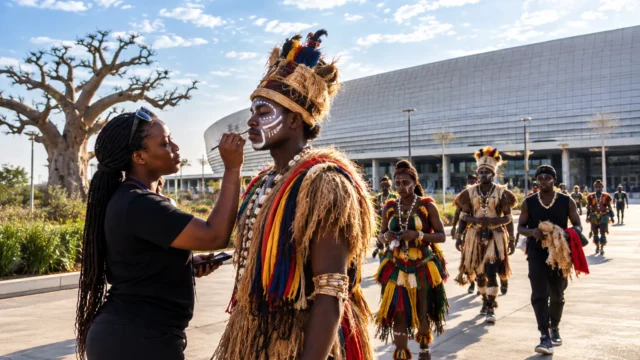
At the Abdoulaye-Wade Stadium, Africa did not merely host a competition. Senegal chose to tell its story through dancers, musicians, figures from its history and scenes from everyday life. This artistic direction, led by ceremony director Khady Niang, placed Senegalese creators at the heart of the narrative.
A ceremony built around bodies and stories
On 31 October 2026, the opening ceremony of the Youth Olympic Games (YOG) took place in Diamniadio, near Dakar. The Games, which run until 13 November, are the first Olympic sporting event to be hosted on African soil. The ceremony brought together more than 1,100 participants, according to the International Olympic Committee (IOC). The Senegalese Press Agency (APS) reports that 628 dancers took part in the show and that nearly 1,500 costumes were made in Senegal. The IOC’s review of the opening and the APS account of the show’s tableaux confirm the scale of the production.
Khady Niang championed a particular approach: relying less on technological effects and more on the presence of artists and the power of images. Queen Mother Alkebulan, wrestlers, dancers forming a map of Africa and a city inspired by everyday life shaped the performance. The show brought historical references into conversation with popular and contemporary forms.
The narrative unfolded in three stages — yesterday, today and tomorrow — and centred on a child named Sitoë. Within this thread, the passing of knowledge between generations connected family memory to the future symbolised by the Olympic flame. The APS also noted references to Aline Sitoé Diatta, Lat Dior and filmmaker Djibril Diop Mambéty. These allusions are not merely decorative: they invite audiences to recognise stories and works that are often little seen on international stages.
Who tells Africa’s story, and from what perspective?
The choice of references raises a broader question: who has control over the cultural narrative? For this ceremony, the artistic direction, staging and several creative roles were entrusted to Senegalese professionals. The APS identifies Khady Niang, artistic director Xalil Cissé and stage director Adama Diop among those responsible for the show. This local presence gives concrete weight to the ambition of telling the country’s story through its own points of reference.
Images of street vendors and ordinary streets also challenged a portrayal that can reduce African cities to business districts and skyscrapers. Showing Dakar in all its diversity neither denies its difficulties nor turns it into a uniform backdrop. Rather, it is a reminder that a city is made up of different places, professions and rhythms, and that modernity is not measured solely by the height of its buildings.
This approach comes in a context in which the YOG extend beyond sport. Activities are taking place in Dakar, Diamniadio and Saly, while public authorities present the event as an opportunity to develop skills and creative industries. Before the Games, the Senegalese Copyright and Neighbouring Rights Society and the organising committee formalised their collaboration on rights relating to YOG activities. The stakes are therefore economic too: artists’ pay, protection of works and the ability to sustain opportunities after the ceremonies have ended.
A regional showcase, but also a test of legacy
The event’s reach extends beyond Senegal’s borders. The Economic Community of West African States (ECOWAS), the regional organisation bringing together West African countries, presented Dakar 2026 as an event engaging the region’s young people. The IOC says some 2,650 young athletes from 204 national committees are taking part in the Games, alongside a Refugee Olympic Team. The competition thus provides a shared stage for delegations from across the continent and the world.
But the success of one evening is not enough to guarantee a lasting legacy. The dancers, technicians, costume-makers and craftspeople involved must be able to access further contracts, training and production resources. Copyright, pay and the continuity of cultural infrastructure will matter as much as the images broadcast internationally. For audiences in Dakar and in other regions, the question is whether this visibility will translate into opportunities to participate and work beyond the capital and the duration of the Games.
The ceremony brought Senegalese artists and references into view at a global Olympic event. Its next test lies beyond the stadium: whether institutions and cultural players can turn that visibility into a lasting place for local creativity, in Senegal and in West African exchanges.