Algeria
 Libya
 Morocco
 Sudan
 Tunisia
 Benin
 Burkina Faso
 Cabo Verde
 Côte d'Ivoire
 Ghana
 Guinea
 Guinea-Bissau
 Liberia
 Mali
 Mauritania
 Niger
 Nigeria
 Senegal
 Sierra Leone
 The Gambia
 Togo
 Cameroon
 Central African Republic
 Chad
 DR Congo
 Equatorial Guinea
 Gabon
 Republic of the Congo
 São Tomé and Príncipe
 Burundi
 Comoros
 Djibouti
 Eritrea
 Ethiopia
 Kenya
 Madagascar
 Malawi
 Mauritius
 Mozambique
 Rwanda
 Seychelles
 Somalia
 South Sudan
 Tanzania
 Uganda
 Angola
 Botswana
 Eswatini
 Lesotho
 Namibia
 South Africa
 Zambia
 Zimbabwe
On 4 November 2026, it will be 104 years since the discovery of Tutankhamun’s tomb. In Cairo, the date also marks a new chapter for Egypt: thousands of objects belonging to the young pharaoh have been brought together in a museum designed to tell his story on a grand scale.
A treasure trove assembled near the pyramids
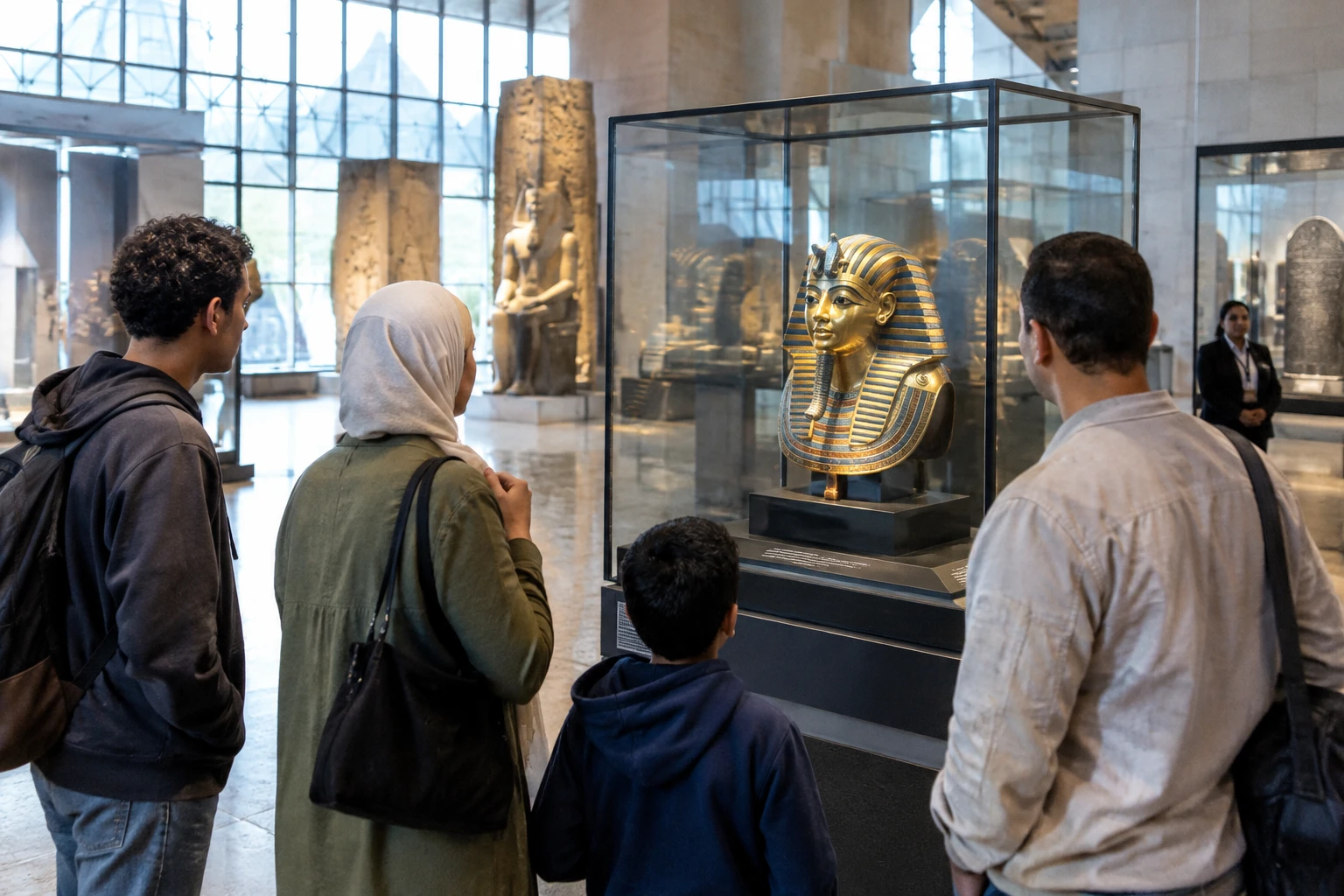
The Grand Egyptian Museum, near the pyramids of Giza, opened fully to the public on 4 November 2025. Tutankhamun’s collection is now displayed in its entirety there for the first time since its discovery, according to the Egyptian authorities and UNESCO. The galleries devoted to the pharaoh bring together more than 5,000 objects.
The timing echoes that of the discovery. On 4 November 1922, British Egyptologist Howard Carter and his team uncovered the entrance to the tomb in the Valley of the Kings, near Luxor. The excavation revealed an exceptionally rich burial containing thousands of objects. The site was not entirely intact, however: it had been entered in ancient times before the tomb was sealed again.
The funerary mask draws the eye, but it does not sum up the treasure. Furniture, jewellery, chariots and ritual objects shed light on funerary practices and royal power in ancient Egypt. Standing 54 centimetres tall, the mask is made of several materials, including gold. Published estimates of its weight vary, so it is best not to present a precise figure as indisputable.
Bringing these objects together in a single visitor route changes how they are understood. Visitors can see them as part of a whole rather than encountering them separately. The museum, which also houses collections spanning several periods of Egyptian history, gives new prominence to the work of the country’s curators, restorers and researchers.
A discovery that shaped Egyptology
Tutankhamun’s fame owes less to the length of his reign than to the condition of his tomb and the significance of the 1922 discovery. Crowned as a child, he ruled at the end of the 18th dynasty, in the 14th century BCE. He died very young, probably aged 18 or 19. The precise dates of his reign and the circumstances of his death remain disputed.
His fame grew through excavations, exhibitions and research. It also reflects the uneven history of archaeology: foreign teams long occupied a central place in accounts of discoveries, while the work of Egyptian labourers and specialists received less attention. Today, Egyptian institutions and professionals also have responsibility for conserving and presenting the country’s heritage.
The transfer of the objects to the new museum is part of this shift, but raises practical questions: how can fragile objects be preserved, access to them organised and their appeal made to benefit the country? The project brings together heritage, research, public access and tourism. The authorities hope the museum will attract visitors and support economic activity. This aim alone does not guarantee that the benefits will be shared fairly among workers, local businesses and different regions.
What science can — and cannot — establish
The young king’s death has inspired popular stories and medical theories. Radiological and genetic examinations published by researchers identified several possible health problems, as well as traces consistent with a malaria infection. One study also described a leg injury. These findings inform possible scenarios, but do not allow a single cause of death to be stated with certainty.
The idea of a “curse” linked to the tomb belongs to legend. It spread in the press after the discovery, but is not a scientific explanation. Distinguishing established facts from sensational stories helps preserve the site’s historical significance without turning the pharaoh’s death into a spectacle.
The same principle applies to descriptions of his physical condition. Analyses have suggested bone abnormalities and a possible difficulty walking. But retrospective diagnoses remain difficult: ancient remains do not always provide a complete picture of a person’s health, and interpretations can change as research methods evolve.
An Egyptian undertaking with regional reach
For Egypt, the Grand Egyptian Museum is both a cultural institution and a project to raise the country’s profile. Cairo remains the country’s political and institutional centre, while the museum is in the Giza region, near the pyramids. This proximity could strengthen the tourism offer, but it also concentrates visitor flows around a handful of sites. The challenge will be to connect this showcase with jobs, expertise and cultural activity beyond this hub.
At regional level, Egypt is a member of the Common Market for Eastern and Southern Africa (COMESA), an organisation that aims to facilitate trade among its member states. Heritage is not a trade policy, but it contributes to the movement of visitors, expertise and cultural co-operation. The role given to Egyptian teams in research and conservation also matters to how the continent presents and studies its history.
The symbolic 104-year milestone does not bring Tutankhamun’s story to a close. Instead, it opens a new period of public access to his collection. The quality of its conservation, the role of Egyptian researchers in future work and the museum’s local benefits remain to be seen. The mask still fascinates; its context continues to unfold.
Official presentation of the Grand Egyptian Museum · UNESCO feature on the museum · Mask entry in the University of Oxford archives · Published genetic and medical study of Tutankhamun · Review of palaeopathological evidence and the curse legend · Report on the museum’s opening to the public