Algeria
 Egypt
 Libya
 Morocco
 Sudan
 Tunisia
 Benin
 Burkina Faso
 Cabo Verde
 Côte d'Ivoire
 Ghana
 Guinea-Bissau
 Liberia
 Mali
 Mauritania
 Niger
 Nigeria
 Senegal
 Sierra Leone
 The Gambia
 Togo
 Cameroon
 Central African Republic
 Chad
 DR Congo
 Equatorial Guinea
 Gabon
 Republic of the Congo
 São Tomé and Príncipe
 Burundi
 Comoros
 Djibouti
 Eritrea
 Ethiopia
 Kenya
 Madagascar
 Malawi
 Mauritius
 Mozambique
 Rwanda
 Seychelles
 Somalia
 South Sudan
 Tanzania
 Uganda
 Angola
 Botswana
 Eswatini
 Lesotho
 Namibia
 South Africa
 Zambia
 Zimbabwe
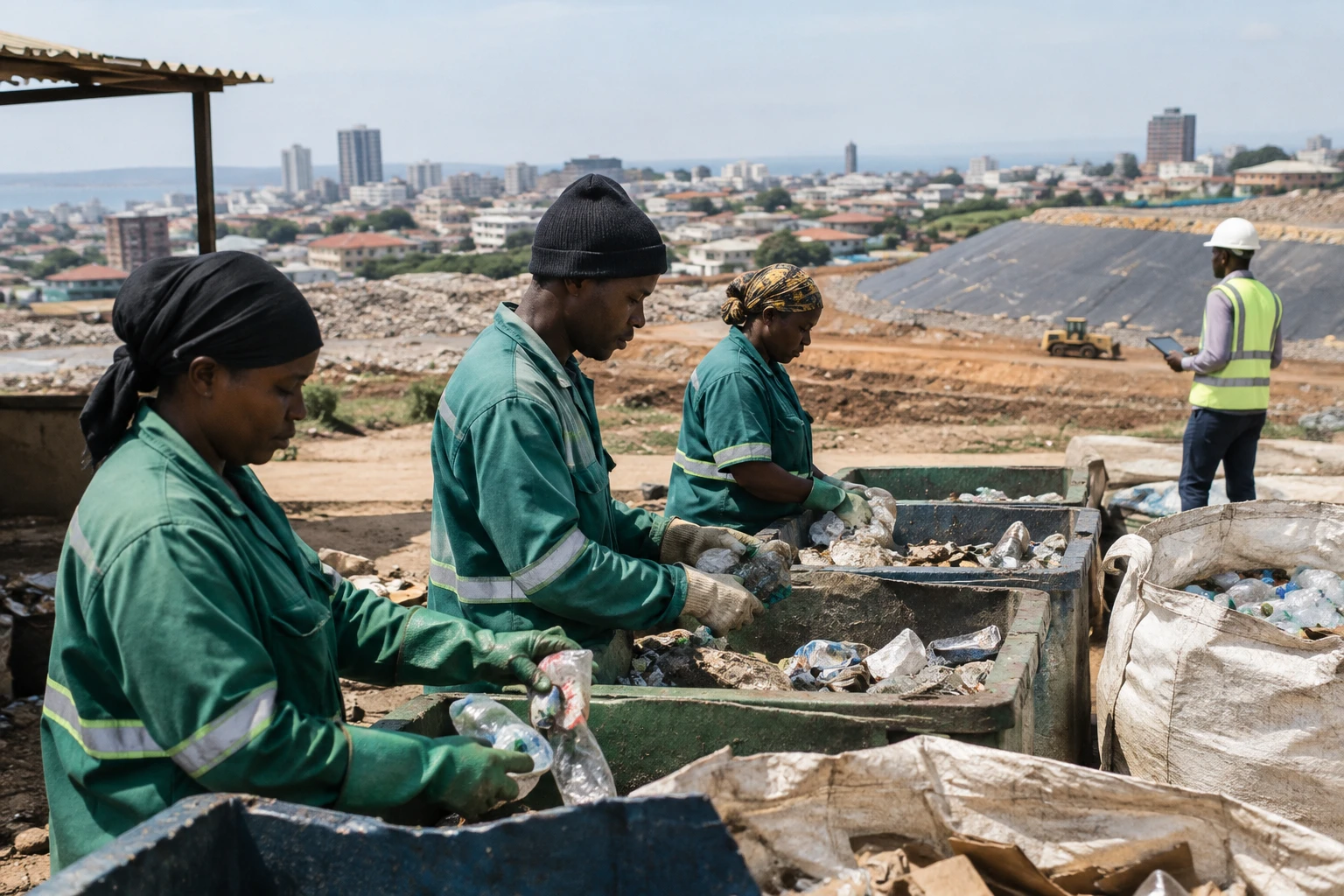
At Dar-es-Salam, the project is about more than making a mountain of rubbish disappear. It must also prevent a closed site from continuing to threaten local residents and ensure that Conakry’s waste now has somewhere else to go.
A closed site, but a risk that must be addressed
On 2 November 2026, Guinean Prime Minister Amadou Oury Bah launched environmental rehabilitation work at the Dar-es-Salam landfill, in the commune of Gbessia, in Conakry. The project plans to secure and clean up the site, then develop it as a landscaped urban park. No opening date for the park has been announced.
The immediate issue is safety. During the night of 22–23 August, part of the landfill collapsed onto neighbouring homes. The official death toll, subsequently established by the Guinean authorities, stands at 36, including 17 Sierra Leonean nationals. A funeral ceremony held on 4 September confirmed the toll. Initial reports published on the day of the disaster put the number of dead at 30, with search operations still under way: the figure therefore rose over time as people died in hospital.
The disaster highlighted the danger posed by the accumulation of waste close to homes. It also affected Guinean and Sierra Leonean families, a reminder that urban risks do not stop at borders. After 36 days in emergency accommodation, the affected families left the reception centres on 29 September, according to Guinea’s Ministry of Territorial Administration.
Closure shifts the problem elsewhere
Dar-es-Salam has been declared closed. But closing a landfill is not enough to organise waste collection across a city. Waste still has to be collected in neighbourhoods, transported and treated. If these steps do not follow, illegal dumping and the associated nuisances may shift to other areas.
The Guinean government has identified Baritodé, in Coyah, as the site expected to take over waste disposal. The facility is intended to move waste treatment away from Conakry’s residential areas. Its commissioning, capacity and the practical organisation of transport remain crucial to making the transition work.
The Prime Minister himself described the reorganisation as a project involving all of Conakry: collection, transport and treatment must form a continuous chain, with facilities that protect local residents. A significant part of the project’s success depends on this. Residents need a reliable service, while collection teams, municipalities and operators must have the resources and clearly defined responsibilities.
A dissertation on waste management in Conakry highlights, in particular, the value of sorting waste at source, regular collections, recovery facilities and better coordination between public, private and community stakeholders. These proposals show that Dar-es-Salam’s rehabilitation is only one part of a broader policy. The park may improve how the site is used, but it will not replace daily collection or waste treatment.
Stabilise before transforming
The programme first aims to stabilise the mass of waste and reduce the risks of collapse, fire and pollution. The site must be decontaminated before it is redeveloped. Announcements at the launch described a project funded by Winning International Group, a Singaporean company also active in Guinea’s mining sector. The cost of the work and its full schedule were not specified in the information made public at the ceremony.
Figures given for the volume of the site vary slightly between communications: Guinea Radio and Television cites about 7.2 million tonnes of waste, while other accounts refer to seven million. These estimates give an idea of the scale of the project, but are not, by themselves, an independent assessment of pollution. To judge the outcome, it will be necessary to know what checks have been carried out on the soil and water, as well as what arrangements are planned to monitor the site after the work.
The planned transformation recalls that of the former Akouédo landfill in Abidjan, which became an urban park after its closure and rehabilitation. This Ivorian experience shows that a former dump can be put to new uses. It does not, however, guarantee that the same methods are appropriate for Dar-es-Salam: the nature of the waste, the surrounding area, the risks and residents’ needs must guide technical decisions in Guinea.
Results will be measured day to day
For local residents, the assessment will not focus solely on the appearance of the future park. It will also depend on whether smoke, odours, polluted run-off and the dangers associated with ground movement are effectively reduced. Families affected by the collapse must also be able to follow the response to the human consequences of the disaster, beyond the period of emergency accommodation.
At regional level, the issue also concerns Sierra Leone, whose nationals are among the victims, as well as relations between the two neighbouring countries. More broadly, it is a reminder that a large city cannot manage its waste sustainably by simply pushing the nuisances towards a less visible outlying area. The Guinean authorities must now demonstrate that Baritodé can take over and that collection remains organised in neighbourhoods.
The project is now moving into a practical phase, but its final timetable remains to be clarified. The steps to watch are stabilising the site, reducing pollution risks and bringing the Baritodé centre into operation. It is how these steps fit together — not merely the promise of a green space — that will show whether Dar-es-Salam marks a lasting change for Conakry.