Algeria
 Egypt
 Morocco
 Sudan
 Tunisia
 Benin
 Burkina Faso
 Cabo Verde
 Côte d'Ivoire
 Ghana
 Guinea
 Guinea-Bissau
 Liberia
 Mali
 Mauritania
 Niger
 Nigeria
 Senegal
 Sierra Leone
 The Gambia
 Togo
 Cameroon
 Central African Republic
 Chad
 DR Congo
 Equatorial Guinea
 Gabon
 Republic of the Congo
 São Tomé and Príncipe
 Burundi
 Comoros
 Djibouti
 Eritrea
 Ethiopia
 Kenya
 Madagascar
 Malawi
 Mauritius
 Mozambique
 Rwanda
 Seychelles
 Somalia
 South Sudan
 Tanzania
 Uganda
 Angola
 Botswana
 Eswatini
 Lesotho
 Namibia
 South Africa
 Zambia
 Zimbabwe
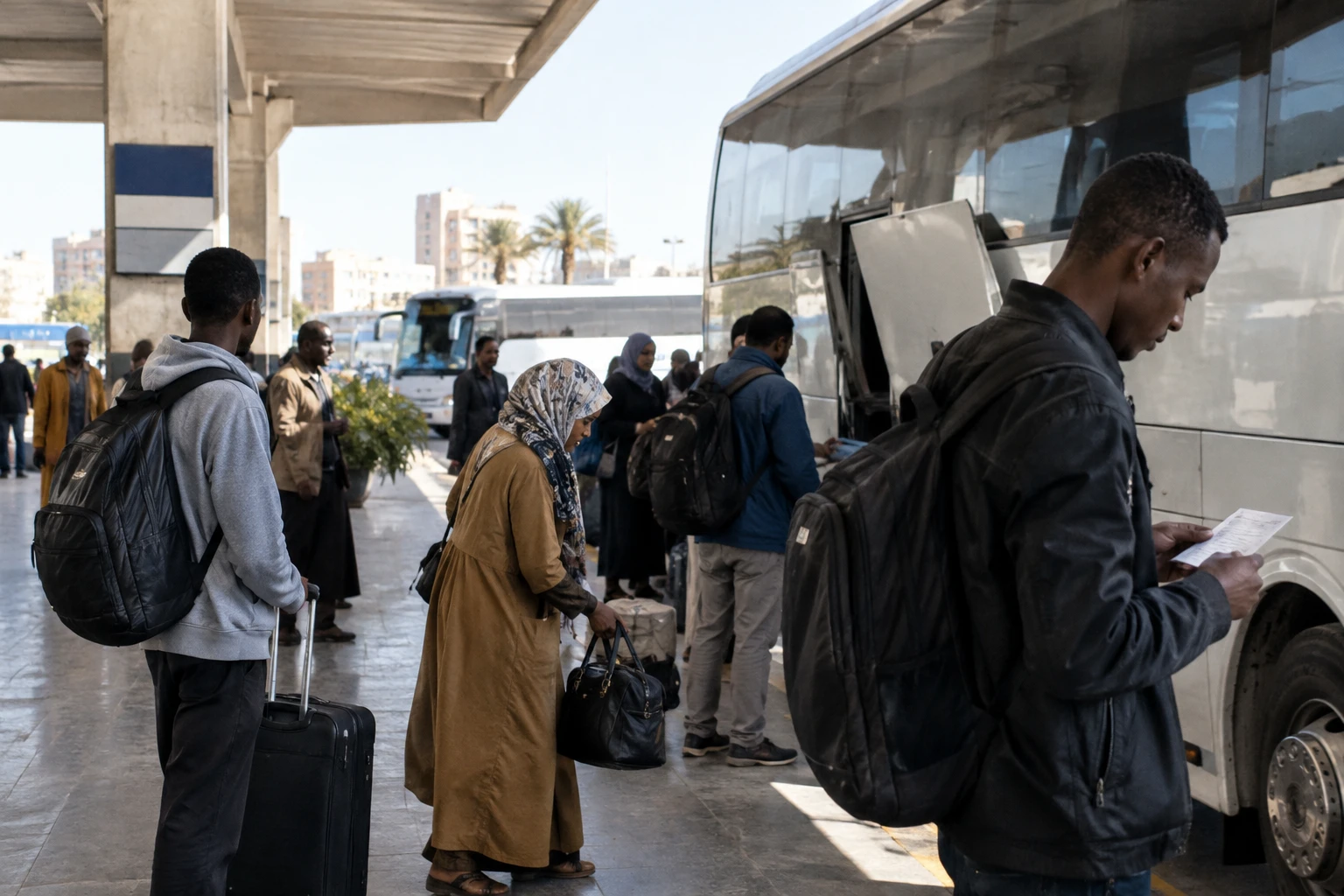
For people crossing Libya in the hope of reaching Europe, the sea is not always the first danger. Before embarking, some say they have suffered violence, arbitrary detention or forced labour. Their accounts shed light on a reality that departure and interception figures alone cannot capture.
A country of transit, but also of destination
Libya occupies a particular place in regional migration. People from neighbouring countries and other parts of the continent travel there to work, join relatives or continue north. For many, the plan changes along the way: crossing the Mediterranean is neither the sole reason for leaving nor a step accessible to everyone.
The International Organization for Migration estimated that 936,134 migrants were present in Libya in January and February 2026. This figure, from its tracking system, describes a diverse population; it does not mean that all these people are seeking to leave for Europe.
The country remains marked by political division and the presence of armed groups. In Tripoli, the capital of Libya, the recognised authorities and institutions responsible for the borders do not alone control the entire territory. In the south and east, transit routes and local power balances also shape migration journeys.
Libya belongs to the Arab Maghreb Union, a regional organisation bringing together five North African countries. Its integration is, however, very limited. Migration management therefore depends largely on bilateral agreements and cooperation with external actors, rather than on a fully operational common Maghreb framework.
Accounts gathered at sea
Aboard the Ocean Viking, the rescue ship chartered by SOS Méditerranée, people rescued at sea described to senior reporter Eliott Brachet violence they had experienced during their journeys in Libya. Their accounts refer in particular to abuse and situations amounting to exploitation. They put a human face to the risks people face even before setting out to sea.
These are individual testimonies: on their own, they cannot establish the scale of each practice or determine responsibility in a specific case. But they are part of a context documented by the United Nations. In February 2026, the United Nations Support Mission in Libya and the Office of the UN High Commissioner for Human Rights published a report covering the period from January 2024 to December 2025.
The report describes arbitrary arrests and detention, abductions, violence, forced labour and extortion targeting migrants, refugees and asylum seekers. It says state or state-linked actors are involved in some abuses, alongside traffickers, smugglers and armed groups. It also calls for an end to collective expulsions and dangerous interceptions at sea.
The distinction between trafficking and smuggling matters. Smuggling refers to arranging irregular passage for payment. Trafficking involves the exploitation of a person through coercion or other means. In journeys where people are displaced, detained or forced to pay for their release, the two phenomena can overlap.
Responsibilities that are hard to untangle
At sea, the central Mediterranean route links mainly the Libyan coast with Italy and Malta. The IOM describes it as one of the most dangerous routes. Departures, rescues and interceptions are shaped by sea conditions, smuggling networks and the decisions of coastal authorities.
Interceptions followed by returns to Libya raise a central question: what place can be considered safe for disembarking rescued people? UN agencies and rescue organisations have for years warned of the risk of detention and ill-treatment after forced returns. Protection at sea therefore does not end with rescue; it also includes the place to which survivors are taken.
This question involves several levels of responsibility. The Libyan authorities are responsible for protecting people on their territory. European states, for their part, fund or support various forms of migration cooperation with Libyan actors. The United Nations documents abuses and advocates respect for international law. These roles are not identical, but their decisions can intersect in the management of departures and returns.
The situation also affects the everyday economy. Migrants work in formal and informal sectors, but a lack of status or documents can increase their exposure to withheld wages, eviction from accommodation and arrest. People who are detained or deprived of income have fewer means to leave a dangerous area, contact relatives or access legal and humanitarian assistance.
A regional issue that goes beyond departures
Journeys to Libya link the countries of the Sahel, the Lake Chad basin, the Horn of Africa and the Maghreb. They follow family ties, employment needs and dynamics of conflict or insecurity. A response focused solely on border control risks overlooking people who live and work in the country without plans to cross the sea.
For countries of origin in Africa, forced returns and disappearances at sea complicate consular protection and family reunifications. For continental institutions, the issue tests the African Union’s commitments on the rights of migrants and refugees. It also underscores the need for cooperation between countries of origin, transit and destination, without conflating regional mobility with migration to Europe.
Monitoring the implementation of the UN report’s recommendations, changes in detention practices and disembarkation conditions after rescues will be important indicators. The testimonies gathered aboard the Ocean Viking do not replace independent investigations. They nevertheless point to a concrete issue: people’s safety is at stake throughout their journey, on land as well as at sea.