Algeria
 Egypt
 Libya
 Morocco
 Sudan
 Tunisia
 Benin
 Burkina Faso
 Cabo Verde
 Côte d'Ivoire
 Ghana
 Guinea
 Guinea-Bissau
 Liberia
 Mali
 Mauritania
 Niger
 Nigeria
 Sierra Leone
 The Gambia
 Togo
 Cameroon
 Central African Republic
 Chad
 DR Congo
 Equatorial Guinea
 Gabon
 Republic of the Congo
 São Tomé and Príncipe
 Burundi
 Comoros
 Djibouti
 Eritrea
 Ethiopia
 Kenya
 Madagascar
 Malawi
 Mauritius
 Mozambique
 Rwanda
 Seychelles
 Somalia
 South Sudan
 Tanzania
 Uganda
 Angola
 Botswana
 Eswatini
 Lesotho
 Namibia
 South Africa
 Zambia
 Zimbabwe
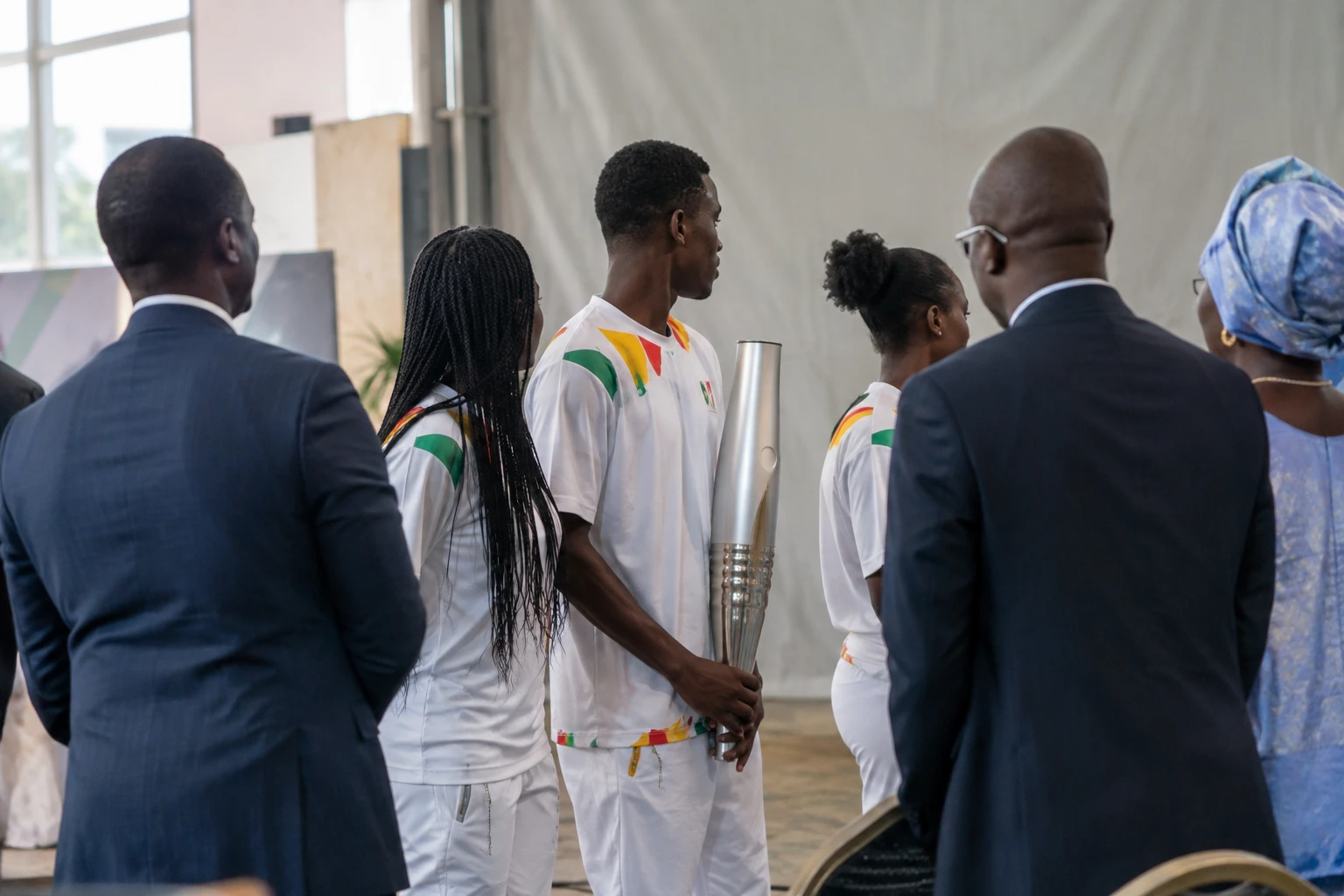
In Dakar, the final leg of a relay is measured in more than kilometres. It also reveals whom the Games want to bring together and how far their promise to young people can reach, beyond stadiums and celebrities.
A flame that passed through all 14 regions
On Friday 30 October 2026, on the eve of the opening of the Youth Olympic Games (YOG), the flame completed its national tour in the Senegalese capital. The route, announced by the relay organisers as running from 12 September to 30 October, was due to pass through all 14 regions of Senegal. It forms part of an effort to bring the Games beyond Dakar before the competitions begin.
The opening ceremony is scheduled for 31 October. The YOG will run until 13 November, with events and activities in Dakar, Diamniadio and Saly. It is the first Olympic event to be held on African soil. The stakes therefore go beyond hosting a sporting event: Senegal becomes a meeting point for athletes and delegations from many countries, while the continent takes centre stage in the Olympic calendar.
The national tour gives this ambition a territorial dimension. The flame linked regions that will not all host competition venues. The relay thus provides a way, at least symbolically, to make participation extend beyond the capital’s residents. The official route schedule lists all 14 regions and stages in several cities, from Saint-Louis to Ziguinchor.
Celebrities and less well-known torchbearers
In Dakar, 20 torchbearers took turns over the final kilometres, between Place de l’Indépendance and Place de la Nation, according to information released about this stage. They included Khaby Lame, a content creator born in Senegal, and actor Omar Sy, who is of Senegalese origin. Wrestler Modou Lô and other figures from sport and culture also took part in the relay.
The fame of the two diaspora figures drew attention, but it does not capture the full meaning of the relay. Less well-known torchbearers also took part, including Sergeant Djibril Sarr, who described the mission as an honour for himself and his country. Their presence is a reminder that the staging of the Games also relies on people involved in institutions, neighbourhoods and everyday life.
The route through the capital passed familiar landmarks for Dakar residents, including the area around the Regional Express Train station, the Grand Théâtre and Senegalese Radio and Television Broadcasting. This urban geography gives the relay a tangible presence. It does not, however, guarantee uniform engagement on its own. Residents interviewed at the scene voiced different expectations: some followed the procession, while others were mainly hoping to attend events such as athletics or boxing.
The contrast between celebrities and ordinary participants highlights another question: how can interest generated by an exceptional event be turned into lasting participation by young Senegalese? Ambassadors can help raise awareness of the Games, particularly among a connected audience. But people’s experience will also depend on access to venues, practical information and the place given to residents who do not live near the facilities.
A national event with regional stakes
For Senegal, hosting the YOG involves several levels of public action: the state, local authorities, the organising committee and the services responsible for transport, security and hospitality. Distributing venues between Dakar, Diamniadio and Saly extends the event beyond the centre of the capital. It also presents different challenges in different areas: travel and public access, the operation of economic activities, co-ordination between services and the visibility of regions far from the competition venues.
The Games are also an opportunity for international representation. Senegal can demonstrate its ability to organise a major event and welcome young people from several continents. For Senegalese people, the assessment will be more immediate: will the infrastructure remain accessible and useful after the competitions? Will local businesses and workers benefit? Will communication around the Games resonate with young people’s everyday experiences? These questions concern a legacy still to be built, not an outcome already secured.
Across West Africa, Dakar 2026 also draws attention to sporting co-operation and regional mobility. Senegal is a member of the Economic Community of West African States (ECOWAS), an organisation that brings countries in the region together around economic and political co-operation. The Games are not an ECOWAS event, but their African reach could encourage exchanges between federations, coaches and young athletes, provided the ties formed during the competition continue afterwards.
The celebrations open the chapter on results
The torch relay offered a high-profile moment, led by popular figures and participants from different backgrounds. It also concluded a tour intended to involve the regions in preparations for the Games. But the excitement of a ceremony is not enough to measure the impact of a sporting event. Attendance at competitions, young athletes’ experiences, local benefits and the future use of facilities will provide more reliable measures.
From 31 October, competition will take over from symbolism. For Senegal, the challenge will be to make this first Olympic event in Africa more than a showcase for a few days. For the continent’s young people, the question will be whether this visibility leads to more opportunities to take part in sport, improve and meet one another. The lasting impact of the flame’s journey, which ended in Dakar, will be judged over time.
The schedule and scope announced for the Games can be found on the International Olympic Committee’s official Dakar 2026 website and on the national torch relay page.