Algeria
 Egypt
 Libya
 Morocco
 Sudan
 Tunisia
 Benin
 Burkina Faso
 Cabo Verde
 Côte d'Ivoire
 Ghana
 Guinea
 Guinea-Bissau
 Liberia
 Mali
 Mauritania
 Niger
 Nigeria
 Sierra Leone
 The Gambia
 Togo
 Cameroon
 Central African Republic
 Chad
 DR Congo
 Equatorial Guinea
 Gabon
 Republic of the Congo
 São Tomé and Príncipe
 Burundi
 Comoros
 Djibouti
 Eritrea
 Ethiopia
 Kenya
 Madagascar
 Malawi
 Mauritius
 Mozambique
 Rwanda
 Seychelles
 Somalia
 South Sudan
 Tanzania
 Uganda
 Angola
 Botswana
 Eswatini
 Lesotho
 Namibia
 South Africa
 Zambia
 Zimbabwe
In Dakar, wrestling is often passed down in arenas, and sports stories tend to focus on men. Yet young Senegalese women are also training on the sand, with ambitions of their own. For them, the Youth Olympic Games (YOG) are both a competition and an opportunity to make their place more visible.
A widening sporting stage
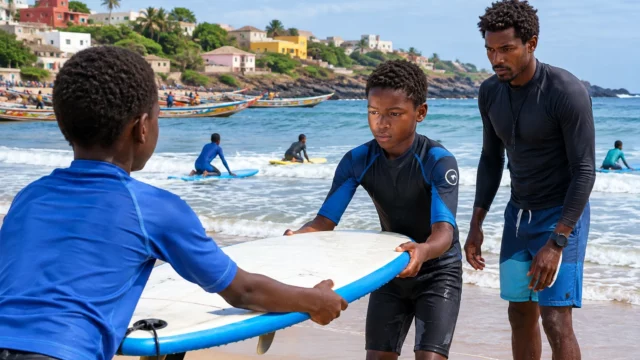
In the beach wrestling sessions described in Dakar, girls and boys train side by side. The rules are simple: take down an opponent or push them out of the combat area. The discipline is on the YOG programme, which includes women’s and men’s events in each of the sports concerned.
The International Olympic Committee expects around 2,700 athletes and 25 competition sports at Dakar 2026. The Games take place from 31 October to 13 November 2026. They are the first Olympic sporting event to be held on the African continent. The official Dakar 2026 press kit also presents gender balance as a principle of the programme.
This parity gives young sportswomen a visible place, but it is not enough to ensure that everyone has the same training, travel or support arrangements. These realities also play out far from major competitions, in clubs, families and federations.
Wrestling, between heritage and personal choice
Wrestling has an important place in Senegalese sporting life. It draws diverse audiences and is rooted in traditional practices, while evolving towards codified formats for international competitions. Beach wrestling retains physical contact and the connection with the sand, but follows defined sporting rules.
Elisabeth Ebedo Diatta, 17 at the time of the profile of her journey, says she wants to win a medal for Senegal. She also explains that training helps her relieve stress. Her testimony is a reminder that a combat sport can be a space for discipline, confidence and camaraderie for a teenage girl, as well as preparation for competition.
She describes the comments directed at girls who take up wrestling, with some criticising them for choosing an activity considered masculine. This prejudice is not confined to the arenas. It reflects broader expectations about which sports are considered suitable for young women and how they should occupy public space.
The athletes’ response is not expressed in words alone. It is built through regular training, quality coaching and the opportunity to continue their education while developing in sport. This balance is particularly important for minors, whose sporting journeys must remain compatible with education and the protection of their health.
Role models and local support
Isabelle Sambou, a leading figure in Senegalese wrestling, supports young athletes. Her career gives a face to a discipline in which women have had to make a place for themselves. Having a champion alongside the junior athletes matters: it makes a sporting career that has so far been under-represented seem attainable, and she passes on technical guidance as well as experience at the highest level.
The profile locates part of women’s wrestling in Casamance, where the sport is also present in local traditions. This does not mean that women wrestle nowhere else in Senegal: the information available here does not establish such exclusivity. Rather, this regional origin is a reminder that sporting practices are rooted in diverse histories and communities, not in a single national model.
For young athletes from regions far from Dakar, access to training and competitions may depend on transport, the cost of equipment, coaching and family support. The Games concentrate attention in the capital and at the competition venues. Their legacy will also be measured by the continuity of clubs and sporting pathways in the regions.
A national event with regional reach
Dakar 2026 is a Senegalese event, but its significance extends beyond the country’s borders. It puts West Africa at the centre of an Olympic sporting event and gives African federations a platform for their young talent. ECOWAS, the West African regional cooperation organisation, provides a space in which these sporting exchanges and youth mobility can take on a regional dimension.
For Senegal, the stakes therefore go beyond medals. The YOG could draw attention to infrastructure, coach training and the place given to girls in clubs. But a brief spell of international visibility alone cannot guarantee lasting change. It will be important to see whether training and talent-identification programmes continue after the competition.
Women’s wrestling brings these questions together in a discipline deeply rooted in the country’s sporting imagination. A young wrestler stepping onto the sand does not represent all Senegalese women, or every practice in Casamance. But she carries a clear ambition: to compete, improve and be recognised for her work. As the events approach, success will be measured as much by the results as by the ability to sustain these journeys beyond the Games.