Algeria
 Egypt
 Libya
 Morocco
 Sudan
 Benin
 Burkina Faso
 Cabo Verde
 Côte d'Ivoire
 Ghana
 Guinea
 Guinea-Bissau
 Liberia
 Mali
 Mauritania
 Niger
 Nigeria
 Senegal
 Sierra Leone
 The Gambia
 Togo
 Cameroon
 Central African Republic
 Chad
 DR Congo
 Equatorial Guinea
 Gabon
 Republic of the Congo
 São Tomé and Príncipe
 Burundi
 Comoros
 Djibouti
 Eritrea
 Ethiopia
 Kenya
 Madagascar
 Malawi
 Mauritius
 Mozambique
 Rwanda
 Seychelles
 Somalia
 South Sudan
 Tanzania
 Uganda
 Angola
 Botswana
 Eswatini
 Lesotho
 Namibia
 South Africa
 Zambia
 Zimbabwe
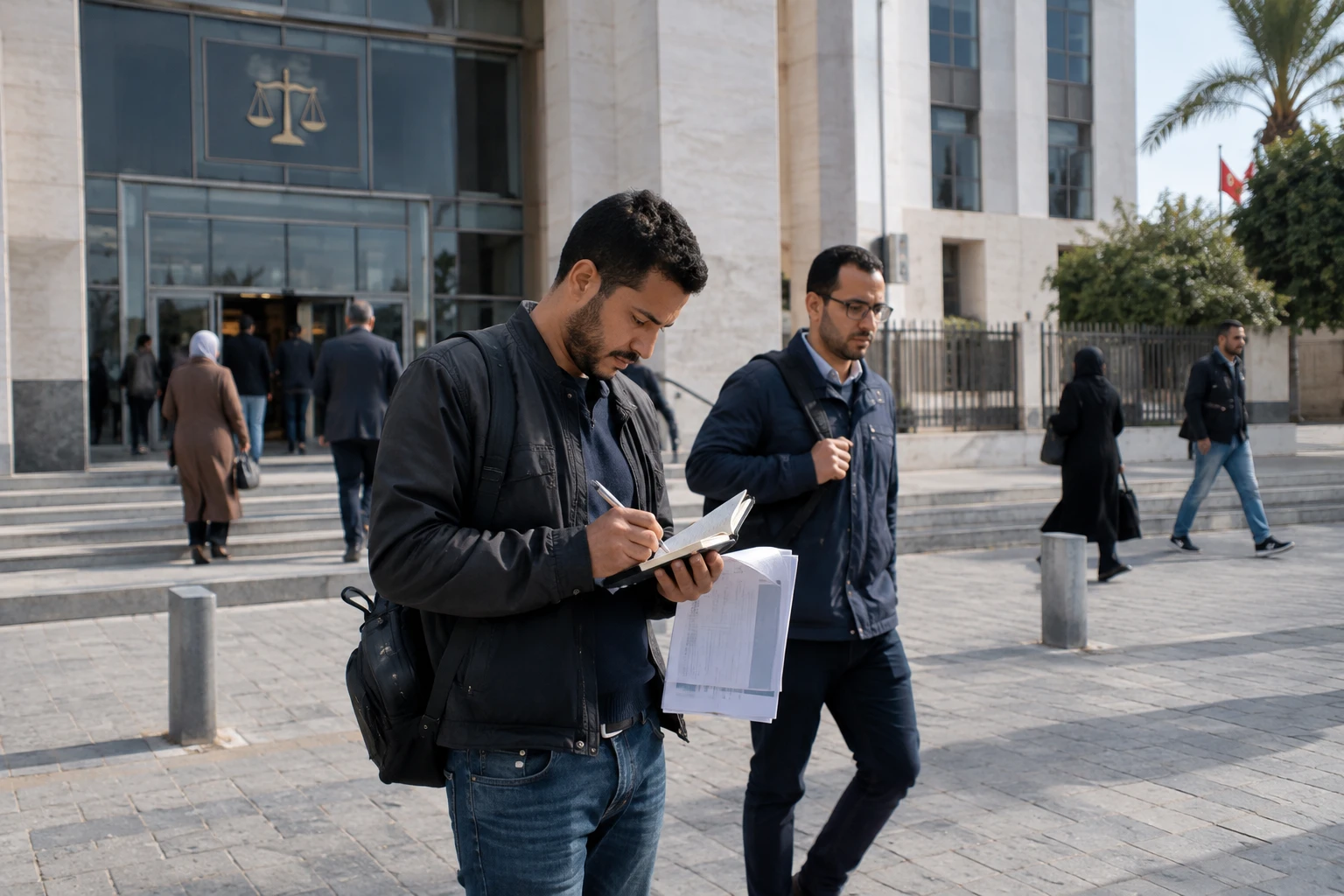
In Tunisia, a journalist’s work can now find itself at the centre of an anti-terrorism proceeding. On 27 October 2026, Zied El-Heni was sentenced to four years in prison in a case linked to leaked recordings. The decision raises a central question: what safeguards protect journalists when they investigate politically sensitive matters?
A case stemming from leaked recordings
The criminal chamber specialising in terrorism cases at the Tunis Court of First Instance handed down the sentence, with immediate effect, according to Tunis Afrique Presse (TAP), as cited by La Presse de Tunisie. Zied El-Heni, an independent journalist and founding member of the National Union of Tunisian Journalists (SNJT), appeared by videoconference from Mornaguia prison. The International Federation of Journalists (IFJ) reports that he was unable to attend his lawyers’ closing arguments.
The proceedings concern audio recordings attributed to Mondher Ounissi, a former acting leader of the Ennahdha movement. The journalist had produced a report about them. Accounts in Tunisian media indicate that the charges include failing to report information relating to a possible terrorist act and having contacts with agents of a foreign state. These are the charges brought by the justice system; they should not be conflated with independent proof of guilt.
In the same case, Mondher Ounissi was sentenced to nine years in prison. Other defendants, several of whom were tried in absentia, received sentences of 25 years, according to TAP reports carried by La Presse de Tunisie and Webdo. The IFJ says the defence contests the conditions under which the trial took place. These details describe the reported rulings without prejudging the outcome of any potential appeals.
The case follows another conviction against El-Heni. On 7 May 2026, a Tunis court sentenced him to one year in prison for comments published on public communication networks, according to TAP, as cited by La Presse de Tunisie. The Committee to Protect Journalists (CPJ) also reported the sentence. The two cases are separate proceedings: the four-year sentence is therefore not simply a legal extension of the May conviction.
Tunisia’s political and judicial context
Since 25 July 2021, when President Kaïs Saïed suspended parliament and set in motion a concentration of executive power, relations between institutions and bodies of scrutiny have been at the centre of Tunisian political debate. The president presents his decisions as a response to deadlock and corruption. Rights and journalists’ organisations, meanwhile, warn of a decline in democratic safeguards and the use of criminal proceedings against critical voices. These opposing interpretations do not remove the need to examine the evidence and procedural safeguards in each case closely.
The issue is particularly sensitive when anti-terrorism law intersects with the work of gathering information. A journalist may receive documents, verify recordings or protect a source’s identity. The IFJ reports that, in El-Heni’s case, the accusations concern, among other things, a request to verify information and his refusal to hand over his phone to the authorities without a warrant, citing source confidentiality. This is the professional organisation’s account; the judicial authorities, for their part, have found that terrorism-related offences were committed.
This distinction matters to journalists and the public alike. If the law punishes established acts, it must also preserve the ability to investigate without automatically treating contact with a source as participation in that source’s activities. The protection of source confidentiality is not a personal privilege: it enables the media to verify information that powerful actors might sometimes prefer to keep confidential. Conversely, criminal allegations must be examined on the basis of the facts and through fair proceedings.
The May conviction also shows that the risks are not confined to anti-terrorism investigations. The CPJ says the first sentence was linked to an article of the Telecommunications Code and comments concerning proceedings against a fellow journalist. For newsrooms, a proliferation of separate proceedings can make it harder to cover the justice system and encourage self-censorship, even without a formal ban on publication. For readers, the issue is access to information that is diverse and verifiable.
A regional impact to watch
Tunisia is a member of the Arab Maghreb Union (AMU), a regional organisation in North Africa. Its political system and media environment are also part of a neighbourhood where national trajectories differ sharply. It would therefore be misleading to speak of a single North African experience. But Tunisian debates about judicial independence, security and freedom of expression resonate beyond the country’s borders, particularly among journalists and professional organisations in the region.
What happens next will depend on avenues of appeal and future court decisions. Observers will also monitor El-Heni’s conditions of detention, the defence’s access to proceedings and the treatment of source confidentiality. In Tunis and elsewhere in the country, the case’s real-world significance will also be measured by the media’s ability to continue investigating sensitive matters without public debate being reduced to fear of prosecution.
The procedural details reported here have been cross-checked against Tunisian media, including La Presse de Tunisie and Webdo, and professional or press freedom organisations, including the IFJ and CPJ. The SNJT, the national journalists’ organisation, is also associated with the statements reported by the IFJ. Criminal allegations are presented as such, rather than as facts judicially established beyond the announced conviction.