Algeria
 Egypt
 Libya
 Morocco
 Sudan
 Tunisia
 Benin
 Burkina Faso
 Cabo Verde
 Côte d'Ivoire
 Ghana
 Guinea
 Guinea-Bissau
 Liberia
 Mali
 Mauritania
 Niger
 Nigeria
 Sierra Leone
 The Gambia
 Togo
 Cameroon
 Central African Republic
 Chad
 DR Congo
 Equatorial Guinea
 Gabon
 Republic of the Congo
 São Tomé and Príncipe
 Burundi
 Comoros
 Djibouti
 Eritrea
 Ethiopia
 Kenya
 Madagascar
 Malawi
 Mauritius
 Mozambique
 Rwanda
 Seychelles
 Somalia
 South Sudan
 Tanzania
 Uganda
 Angola
 Botswana
 Eswatini
 Lesotho
 Namibia
 South Africa
 Zambia
 Zimbabwe
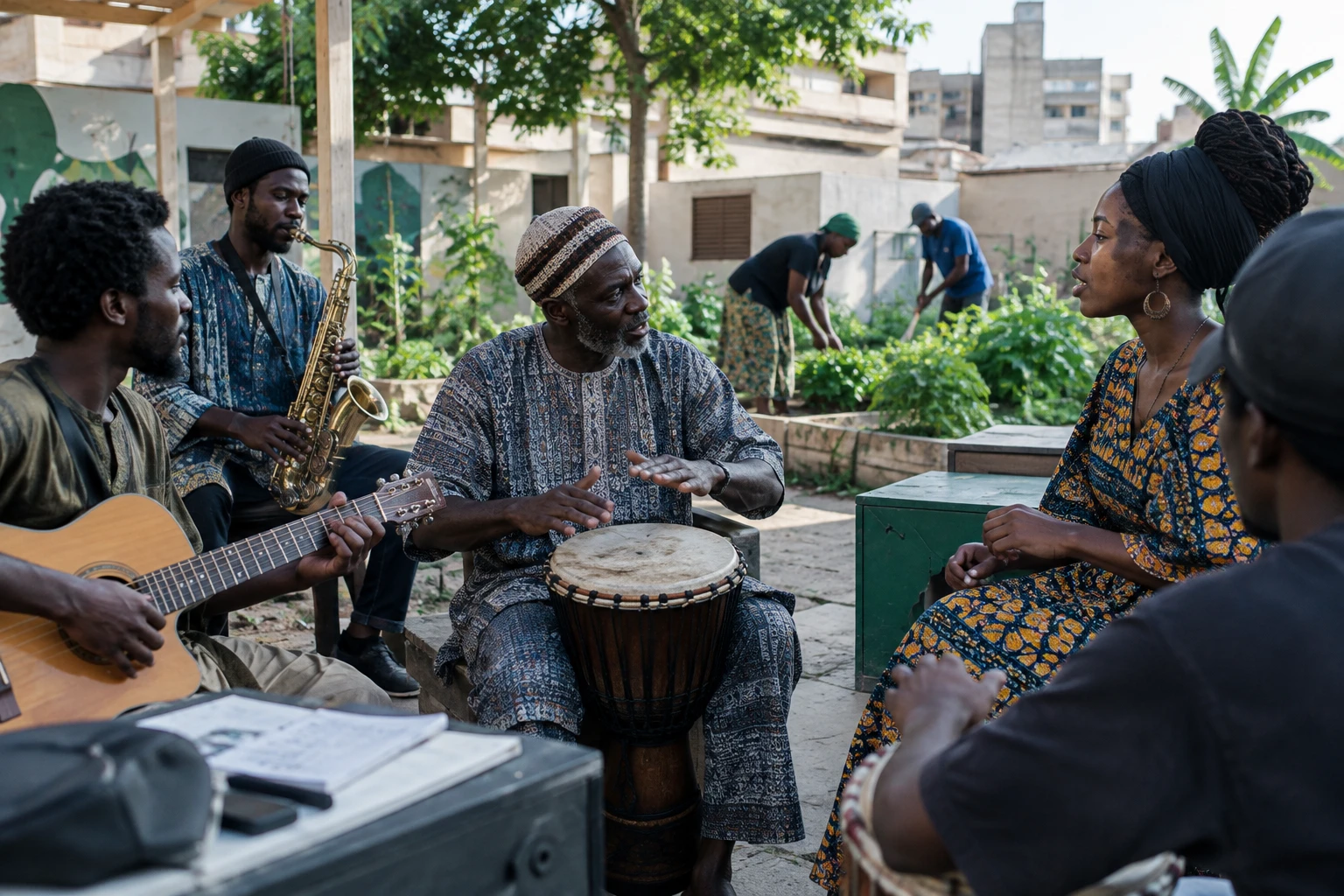
In Dakar, an orchestra can remain a family affair without shutting itself off from the past. For more than fifty years, Orchestra Baobab has carried rhythms across generations and borders. Its new album, due out on 23 October 2026, poses a simple question: how can a musical identity be passed on without being frozen in time?
A Dakar sound shaped by many influences
Orchestra Baobab was formed in 1970 in Dakar’s clubs. From the outset, the group brought together different languages and musical influences. Senegalese and Mandé traditions engaged with jazz, Afro-Cuban rhythms and sounds from other musical scenes. This mixture is not an afterthought added for effect: it is the orchestra’s signature.
This story belongs to a period when Senegalese musicians were creating modern forms from local repertoires and international exchanges. In Senegal, music has accompanied social change, circulating through clubs, radio stations, ceremonies and concert stages. Orchestra Baobab made this movement into a recognisable language without reducing it to a single tradition.
The group went through a lengthy hiatus before finding an international audience again in the early 2000s. Its album Made in Dakar, released in 2007, followed by Tribute to Ndiouga Dieng in 2017, mark milestones in that journey. Several historic members have died, including singers Balla Sidibé and Rudy Gomis, as well as saxophonist Issa Cissokho. Mountaga “Taga” Koité remains the group’s only active founding member.
Twelve tracks make room for new talent
The new album has twelve tracks, including six original compositions. Recorded in Dakar, it is due out on 23 October 2026, almost ten years after the previous album. These details have been confirmed by the Senegalese Press Agency and information published by the group and its label.
The line-up brings veterans together with new members, including singer Korka Dieng. She joined the orchestra in 2023 and is its first woman. Her presence marks a change in the group’s make-up while forming part of a process of passing on its legacy, rather than a declared break with the past. She has also noted that young listeners are discovering the orchestra today as something other than an “old-school” band.
Among the new songs is “Gorgoulou”, written by Wilfried Zinsou. The Wolof word refers to someone who works hard to provide for themselves. “Wida”, composed by guitarist Bolero Lagratte, refers to Ouidah in Benin, a city whose history is linked to the transatlantic slave trade. These choices bring social realities and memories beyond the group’s own story into the album.
The record also makes room for the older repertoire. It revisits songs associated with the orchestra’s history and reworks well-known tracks with new voices and arrangements. This back-and-forth between new compositions and heritage gives the next generation room to assert its own character. It also allows audiences to recognise a familiar sound without expecting an identical reproduction.
Passing on the legacy beyond the stage
For the musicians, the challenge is not simply to preserve a musical formula. The orchestra carries an image of Senegal abroad, but that image is shaped in Dakar, in contact with the country’s artists and audiences. When it performs on international stages, its history also recalls that African music is not isolated: it has developed through exchanges, travel and reinterpretation.
This matters in a region where artists move between countries and repertoires cross borders without necessarily following those of states. The West African, Afro-Cuban and Congolese influences running through Baobab’s sound tell a story of connections. They also show that a Senegalese work can be deeply rooted in its territory and still resonate elsewhere.
Passing on the legacy also depends on the practical conditions of musical life. Older members bring their experience of the repertoire and the stage. Younger ones add other sensibilities and may attract an audience unfamiliar with the historic albums. This dynamic alone cannot guarantee the group’s continuity: that also depends on time for rehearsals, touring and the ability to sustain music in Senegal, not only abroad.
A new chapter, not a final word
With Made in Senegal, Orchestra Baobab is doing more than celebrating its longevity. With half the tracks new, the record puts as much emphasis on current creativity as on memory. Its title asserts a national grounding, while its musical language recalls the exchanges that have shaped the orchestra since its beginnings.
The release on 23 October 2026 will be a new meeting point for Senegalese listeners and the diaspora. What follows will depend on the group’s ability to bring these compositions to the stage and pass its repertoire on to other musicians. For Orchestra Baobab, longevity does not mean standing still: it means letting new voices join a story that began in Dakar.