Algeria
 Egypt
 Libya
 Morocco
 Sudan
 Tunisia
 Benin
 Burkina Faso
 Cabo Verde
 Côte d'Ivoire
 Guinea
 Guinea-Bissau
 Liberia
 Mali
 Mauritania
 Niger
 Nigeria
 Senegal
 Sierra Leone
 The Gambia
 Togo
 Cameroon
 Central African Republic
 Chad
 DR Congo
 Equatorial Guinea
 Gabon
 Republic of the Congo
 São Tomé and Príncipe
 Burundi
 Comoros
 Djibouti
 Eritrea
 Ethiopia
 Kenya
 Madagascar
 Malawi
 Mauritius
 Mozambique
 Rwanda
 Seychelles
 Somalia
 South Sudan
 Tanzania
 Uganda
 Angola
 Botswana
 Eswatini
 Lesotho
 Namibia
 South Africa
 Zambia
 Zimbabwe
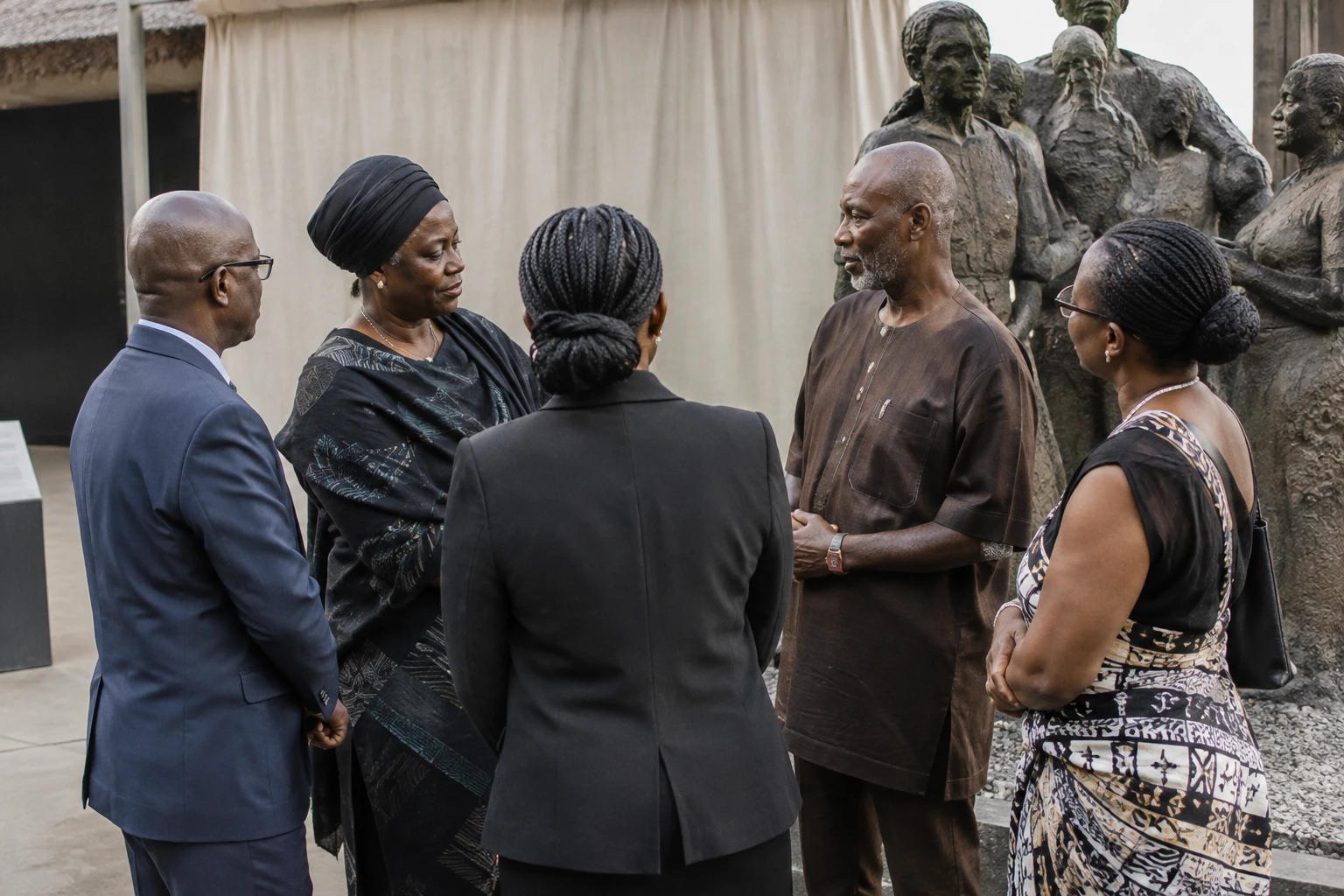
In Nuhalenya, in the Greater Accra Region, songs and libations give public form to a history that is often fragmented. For three days, members of the African diaspora gathered at Nkyinkyim Museum to honour their ancestors and reconnect with memories disrupted by the transatlantic slave trade.
The gathering goes beyond a ceremony. It poses a practical question: how can stories interrupted by slavery, forced displacement and the erasure of names be passed on? In Ghana, artists, institutions and diaspora communities are seeking answers through places of remembrance, research and cultural exchange.
A living place of memory in the Volta estuary
The museum is in Nuhalenya-Ada, near Ada, east of Accra. It is dedicated to African memory and heritage. Its central installation brings together figurative sculptures linked to the history of the continent and of Africans who were enslaved. The museum describes its work as visual archiving, complemented by oral transmission and educational activities. The Nkyinkyim Museum’s account of its work and memorial project places this approach within work begun in the 2000s by Ghanaian artist Kwame Akoto-Bamfo.
The ceremony brought together African Americans and people from other diaspora communities. According to the organisers, participants paid tribute to their ancestors through libations, offerings, songs, percussion and dancing. These gestures make room for cultural practices in a historical account that is not limited to written archives.
For some visitors, travelling to Ghana is also a personal quest: to find a connection with the continent, explore their origins and rebuild a sense of belonging. But such a journey cannot, on its own, restore identities or establish precise family ties, often made difficult to trace by the ruptures imposed on enslaved families.
Memory beyond monuments
Kwame Akoto-Bamfo champions a locally led initiative. “This initiative comes from us and is led by us,” the museum’s founder said, according to remarks reported during the gathering. The emphasis points to a central issue: African communities and their descendants want to contribute directly to how their history is told, preserved and passed on.
The museum is not merely an exhibition space. It brings together sculpture, oral storytelling and cultural interpretation. According to its institutional account, trained guides, known as griots, explain the symbols and stories connected with the works. This approach puts transmission and interpretation at the heart of the experience, rather than presenting the sculptures as mere objects to be viewed.
Subrina Starke, co-founder of Diasporan WelHouse, said her organisation wants to deepen research into the history of the Surinamese people and other diaspora communities. This perspective is a reminder that ties between Ghana and the descendants of deported Africans are not limited to the United States. They also encompass the Caribbean, Latin America and other regions shaped by forced migration.
Personal testimonies shared during the ceremony link memory with reparation. Efua Irene Agyeman Hin, also a co-founder of Diasporan WelHouse, believes reparations are needed to address the trauma and suffering inflicted on African peoples. This demand is part of a political and legal debate; the ceremony gives it a human and cultural grounding, without replacing decisions by states or discussions about possible forms of reparation.
From Ghana to Africa’s reparations agenda
The initiative is part of a broader national trajectory. Accra has hosted meetings on reparative justice for several years — that is, measures intended to acknowledge and address the lasting consequences of historical crimes. In November 2023, a conference organised in Ghana with the African Union adopted the Accra Proclamation. Among other things, it recommends cooperation between Africa, the Caribbean and the diaspora, as well as mechanisms for expertise and dialogue. The African Union’s Accra Proclamation also highlights the potential role of civil society and the cultural industries.
In February 2025, Ghanaian President John Dramani Mahama called for stronger legal and institutional mechanisms related to the cause, at the launch of the African Union’s annual theme on reparations. Ghana’s presidency said these efforts require cooperation between states, regional organisations and the diaspora. The Ghanaian presidency’s statement calling for collective action thus places memory within a continental diplomatic agenda.
Political progress, however, does not guarantee that demands will lead to concrete measures. The discussions involve complex questions: who can be held responsible, what forms of reparation would be appropriate, and how should those concerned be involved in designing them? Historical research, official recognition, the return of objects and responses to contemporary inequalities may all form part of the debate, but none constitutes a single solution.
A regional reach, with next steps to be developed
Ghana is a member of the Economic Community of West African States (ECOWAS), which brings neighbouring countries together around regional cooperation. The issue nevertheless extends beyond this framework: descendants of deported people live in many countries, and the African Union has explicitly called for stronger links with the Caribbean and African communities settled elsewhere. Memory thus becomes a space for dialogue between societies divided by history but facing shared questions of transmission and recognition.
For visitors, reconnecting with songs, gestures and stories can contribute to rebuilding a sense of identity. For Ghanaian residents and cultural practitioners, these gatherings also bring visibility to local work in creativity, education and preservation. These benefits are not the same for everyone: an individual visitor’s experience, the work of local communities and government commitments operate at different levels.
The ceremony in Nuhalenya is a reminder, finally, that memory is not shaped only at summits or in official declarations. It is also built in cultural spaces, through research conducted with communities and exchanges between generations. The next challenge will be to connect these grassroots initiatives with the commitments announced by Ghana and the African Union, while ensuring that descendants and local voices remain involved in decisions.